

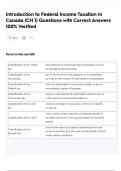
Introduction to Federal Income Taxation In
Canada (CH 1) Questions with Correct Answers
100% Verified
Save
Terms in this set (50)
Classification of tax: Head tax existence of a particular type of taxpayer such as
tax tax $X paid by all individuals
Classification of tax: tax on the income of the taxpayer, as is exemplified
Income tax by a tax on the income of individuals or corporations
Classification of tax: a tax on capital gains or succession duties, or tax on
Wealth tax accumulated capital of taxpayer
Classification of tax: a tax on consumption of commodity subject to tax, as
Commodity tax is the case of provincial retail sales tax
Classification of tax: User a toll for a bridge or road, a tax on the use of facility
tax or service
a tax or duty usually imposed on imported goods to
Classification of tax: Tariff increase the price of such goods relative to domestic
goods
a tax on the value of property transferred from one
Classification of tax:
owner to another, as is the case on the transfer of land
transfer tax
under certain conditions
, a value added tax, or a multistage sales tax, such as
goods and services tax or harmonized sales tax on
Classification of tax:
the increase in value of commodity created by
Business transfer tax
taxpayer in moving it from one stage of production or
distribution to another
a method of classification which determines the
taxpayer who ultimately bears the tax
Incidence of direct tax is likely to be on the initial
Incidence of tax: payer of the tax
Incidence of indirect tax is usually not on initial payer
of tax, but on someone else. A sales tax imposed at
the manufacturer's level is an example of such an
indirect tax
taxes can be classified by the proportion of the tax
levy.
Proportional or flat tax is levied at constant
percentage of the income of the payer of the tax.
Under certain conditions, the corporate income tax
can be considered as such a tax
Classification of tax: Progressive tax is levied at an increasing percentage
nature of the tax of income of the payer, as is the case of the personal
income tax
Regressive tax is levied at decreasing percentage of
the income of the payer. A sales tax is considered to
be regressive tax to the extent that those with higher
income may spend lower proportion of income on
item subject to sales tax
, 1. Horizontal equity
2. Vertical equity
3. Neutrality
Desirable Characteristics
4. Flexibility
of tax
5. Certainty
6. Simplicity and Compliance
7. Feasibility
tax system needs to be fair. It should be equitable
horizontally so that persons at the same economic
Horizontal Equity level are affected by the tax to the same degree in
terms of the amount of tax, irrespective of the form of
income generated
income tax should be equitable vertically so that
persons at higher economic level pay greater share of
Vertical equity
tax based on their greater ability to pay than those at
a lower economic level.
Income tax should be neutral so that the tax does not
affect economic decisions. For tax system to be
considered neutral, decision based on after tax results
Neutrality
of an economic opportunity should not be any
different than it would have been in absence of
taxation
income tax system should be sufficiently flexible to
Flexibility permit its use as an instrument of economic policy to
achieve economic objectives.
taxpayers know in advance the tax consequences of
any transaction that they may plan affairs accordingly.
taxpayer must be in a position to understand and
Certainty
determine with some certainty the payer of tax, base
of tax, the amount of tax, deadline for payment of tax,
and method of payment
Canada (CH 1) Questions with Correct Answers
100% Verified
Save
Terms in this set (50)
Classification of tax: Head tax existence of a particular type of taxpayer such as
tax tax $X paid by all individuals
Classification of tax: tax on the income of the taxpayer, as is exemplified
Income tax by a tax on the income of individuals or corporations
Classification of tax: a tax on capital gains or succession duties, or tax on
Wealth tax accumulated capital of taxpayer
Classification of tax: a tax on consumption of commodity subject to tax, as
Commodity tax is the case of provincial retail sales tax
Classification of tax: User a toll for a bridge or road, a tax on the use of facility
tax or service
a tax or duty usually imposed on imported goods to
Classification of tax: Tariff increase the price of such goods relative to domestic
goods
a tax on the value of property transferred from one
Classification of tax:
owner to another, as is the case on the transfer of land
transfer tax
under certain conditions
, a value added tax, or a multistage sales tax, such as
goods and services tax or harmonized sales tax on
Classification of tax:
the increase in value of commodity created by
Business transfer tax
taxpayer in moving it from one stage of production or
distribution to another
a method of classification which determines the
taxpayer who ultimately bears the tax
Incidence of direct tax is likely to be on the initial
Incidence of tax: payer of the tax
Incidence of indirect tax is usually not on initial payer
of tax, but on someone else. A sales tax imposed at
the manufacturer's level is an example of such an
indirect tax
taxes can be classified by the proportion of the tax
levy.
Proportional or flat tax is levied at constant
percentage of the income of the payer of the tax.
Under certain conditions, the corporate income tax
can be considered as such a tax
Classification of tax: Progressive tax is levied at an increasing percentage
nature of the tax of income of the payer, as is the case of the personal
income tax
Regressive tax is levied at decreasing percentage of
the income of the payer. A sales tax is considered to
be regressive tax to the extent that those with higher
income may spend lower proportion of income on
item subject to sales tax
, 1. Horizontal equity
2. Vertical equity
3. Neutrality
Desirable Characteristics
4. Flexibility
of tax
5. Certainty
6. Simplicity and Compliance
7. Feasibility
tax system needs to be fair. It should be equitable
horizontally so that persons at the same economic
Horizontal Equity level are affected by the tax to the same degree in
terms of the amount of tax, irrespective of the form of
income generated
income tax should be equitable vertically so that
persons at higher economic level pay greater share of
Vertical equity
tax based on their greater ability to pay than those at
a lower economic level.
Income tax should be neutral so that the tax does not
affect economic decisions. For tax system to be
considered neutral, decision based on after tax results
Neutrality
of an economic opportunity should not be any
different than it would have been in absence of
taxation
income tax system should be sufficiently flexible to
Flexibility permit its use as an instrument of economic policy to
achieve economic objectives.
taxpayers know in advance the tax consequences of
any transaction that they may plan affairs accordingly.
taxpayer must be in a position to understand and
Certainty
determine with some certainty the payer of tax, base
of tax, the amount of tax, deadline for payment of tax,
and method of payment


