

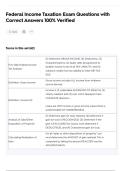
Federal Income Taxation Exam Questions with
Correct Answers 100% Verified
Save
Terms in this set (62)
(1) Determine GROSS INCOME; (2) Deductions; (3)
Characterizations; (4) Apply rates (progressive) to
Five Step Federal Income
taxable income to arrive at TAX LIABILITY; and (5)
Tax Analysis*
Subtract credits from tax liability to meet NET TAX
DUE.
Gross income includes ALL income from whatever
Definition: Gross Income
source derived.
Income is (1) undeniable ACESSIONS TO WEALTH; (2)
clearly realized; and (3) over which taxpayers have
COMPLETE dominion.
Definition: Income (3)
Loans are NOT income or gross income unless there is
a DISCHARGE OF INDEBTEDNESS.
(1) Determine gain (or loss) realized; (2) Determine if
Analysis of Sale/Other gain (or loss) is RECOGNIZED; (3) Determine if the
Disposition of Property* gain is EXCLUDED (for losses, must determine if
DEDUCTIBLE); and (4) Characterize gain (or loss).
For all "sales or other dispositions of property," you
Calculating Realization of must determine the AMOUNT of gain realized. This is
Gain computed by taking the amount REALIZED less the
ADJUSTED BASIS.
, The amount of gain realized is the sum of MONEY and
Amount of Gain Realized the FMV of property OTHER than money received -
includes any liabilities relieved.
The adjusted basis is the basis under the applicable
section (based on HOW the property was acquired),
adjusted for capital expenditures or depreciation.
Adjusted Basis
Conceptually, adjusted basis is the amount of capital
(money) that a taxpayer has in any given piece of
property.
Cost basis is the amount of money used to purchase
Cost Basis the property. This INCLUDES any liabilities incurred in
purchasing the property.
Recourse Loan: The lender has a recourse against the
borrower's OTHER assets, not just the property
purchased with the loan.
Definitions:
Non-Recourse Loan: The lender's ONLY recourse is
Recourse Loan
AGAINST THE SECURITY FOR THE LOAN. If the
Non-Recourse Loan
borrower defaults, the lender can only take the
security interest, not any of the borrower's other
assets.
The transferee's adjusted basis is the SAME as the
Gift Basis transferor's basis. It is said that the transferee "steps
into the shoes" of the transferor.
The basis of property acquired from a decedent is the
Basis of Property Acquired FMV at the date of the DECEDENT'S DEATH. The rule
from Decedent applies to BOTH appreciated AND depreciated
property. Generally known as the "stepped-up basis."
Property which represents the surviving spouse's one-
Basis of Property Acquired half share of community property held by the
by Surviving Spouse of decedent and the surviving spouse under the
Decedent community property laws of any State will also
receive the FMV basis.
Correct Answers 100% Verified
Save
Terms in this set (62)
(1) Determine GROSS INCOME; (2) Deductions; (3)
Characterizations; (4) Apply rates (progressive) to
Five Step Federal Income
taxable income to arrive at TAX LIABILITY; and (5)
Tax Analysis*
Subtract credits from tax liability to meet NET TAX
DUE.
Gross income includes ALL income from whatever
Definition: Gross Income
source derived.
Income is (1) undeniable ACESSIONS TO WEALTH; (2)
clearly realized; and (3) over which taxpayers have
COMPLETE dominion.
Definition: Income (3)
Loans are NOT income or gross income unless there is
a DISCHARGE OF INDEBTEDNESS.
(1) Determine gain (or loss) realized; (2) Determine if
Analysis of Sale/Other gain (or loss) is RECOGNIZED; (3) Determine if the
Disposition of Property* gain is EXCLUDED (for losses, must determine if
DEDUCTIBLE); and (4) Characterize gain (or loss).
For all "sales or other dispositions of property," you
Calculating Realization of must determine the AMOUNT of gain realized. This is
Gain computed by taking the amount REALIZED less the
ADJUSTED BASIS.
, The amount of gain realized is the sum of MONEY and
Amount of Gain Realized the FMV of property OTHER than money received -
includes any liabilities relieved.
The adjusted basis is the basis under the applicable
section (based on HOW the property was acquired),
adjusted for capital expenditures or depreciation.
Adjusted Basis
Conceptually, adjusted basis is the amount of capital
(money) that a taxpayer has in any given piece of
property.
Cost basis is the amount of money used to purchase
Cost Basis the property. This INCLUDES any liabilities incurred in
purchasing the property.
Recourse Loan: The lender has a recourse against the
borrower's OTHER assets, not just the property
purchased with the loan.
Definitions:
Non-Recourse Loan: The lender's ONLY recourse is
Recourse Loan
AGAINST THE SECURITY FOR THE LOAN. If the
Non-Recourse Loan
borrower defaults, the lender can only take the
security interest, not any of the borrower's other
assets.
The transferee's adjusted basis is the SAME as the
Gift Basis transferor's basis. It is said that the transferee "steps
into the shoes" of the transferor.
The basis of property acquired from a decedent is the
Basis of Property Acquired FMV at the date of the DECEDENT'S DEATH. The rule
from Decedent applies to BOTH appreciated AND depreciated
property. Generally known as the "stepped-up basis."
Property which represents the surviving spouse's one-
Basis of Property Acquired half share of community property held by the
by Surviving Spouse of decedent and the surviving spouse under the
Decedent community property laws of any State will also
receive the FMV basis.


