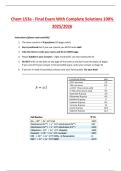
Chem 153a - Final Exam With Complete Solutions 100%
2025/2026
Instructions (please read carefully)
1. The exam consists of 8 questions (10 pages total)
2. Pen is preferred but if you use a pencil you MUST write dark
3. Take the time to write your name and ID on EVERY page
4. Please bubble in your answers – light checkmarks can’t be read by the AI
5. Do NOT write on the back of any page of the exam as we don’t scan the backs of pages.
If you cannot fit your answer in the provided space, write your answer on Page 10.
6. If you are in need of assistance, please raise your hand quietly. Do your best!
1
, First and Last Name SID-------------------------
1. Amino acids and protein structure (12 pts)
a. (2 pts) A protein uses an α-helix to associate with the cell membrane (see
diagram). Which of the following is most likely
to be part of its primary sequence?
A-L-I-F-F-N-K-E-K-D
K-I-E-F-S-L-N-A-K-F
L-I-E-K-A-V-N-S-A-L
b. Using the idealized β-sheet model provided, do the following:
i. (2 pts) Notate the N and C termini on each polypeptide above.
N C N C
N C N C
ii. (2 pts) Is the above β-sheet parallel or antiparallel?
parallel antiparallel
c. (2 pts) A solution of aspartic acid is set to a pH of 3.6. Which of the
following species predominates in solution?
d. (4 pts) The following free energy diagram is a representation of our
leading theory about how proteins fold into their native states. What does
this diagram say about the process of protein
folding? (hint: make sure to note the distinct
portions of the energy landscape)
The “waterfall” portion of the diagram shows how (initially) the protein is
subject to hydrophobic collapse, the rapid aggregation of hydrophobic amino
acid residues as driven by entropy. The protein then enters a series of molten
globule states, as characterized by the “jagged terrain” of the lower portion of
the diagram. This slower stage of folding is characterized by a number of
2
kinetic traps as the protein works out its final native structure (shown by ‘N’)
2025/2026
Instructions (please read carefully)
1. The exam consists of 8 questions (10 pages total)
2. Pen is preferred but if you use a pencil you MUST write dark
3. Take the time to write your name and ID on EVERY page
4. Please bubble in your answers – light checkmarks can’t be read by the AI
5. Do NOT write on the back of any page of the exam as we don’t scan the backs of pages.
If you cannot fit your answer in the provided space, write your answer on Page 10.
6. If you are in need of assistance, please raise your hand quietly. Do your best!
1
, First and Last Name SID-------------------------
1. Amino acids and protein structure (12 pts)
a. (2 pts) A protein uses an α-helix to associate with the cell membrane (see
diagram). Which of the following is most likely
to be part of its primary sequence?
A-L-I-F-F-N-K-E-K-D
K-I-E-F-S-L-N-A-K-F
L-I-E-K-A-V-N-S-A-L
b. Using the idealized β-sheet model provided, do the following:
i. (2 pts) Notate the N and C termini on each polypeptide above.
N C N C
N C N C
ii. (2 pts) Is the above β-sheet parallel or antiparallel?
parallel antiparallel
c. (2 pts) A solution of aspartic acid is set to a pH of 3.6. Which of the
following species predominates in solution?
d. (4 pts) The following free energy diagram is a representation of our
leading theory about how proteins fold into their native states. What does
this diagram say about the process of protein
folding? (hint: make sure to note the distinct
portions of the energy landscape)
The “waterfall” portion of the diagram shows how (initially) the protein is
subject to hydrophobic collapse, the rapid aggregation of hydrophobic amino
acid residues as driven by entropy. The protein then enters a series of molten
globule states, as characterized by the “jagged terrain” of the lower portion of
the diagram. This slower stage of folding is characterized by a number of
2
kinetic traps as the protein works out its final native structure (shown by ‘N’)