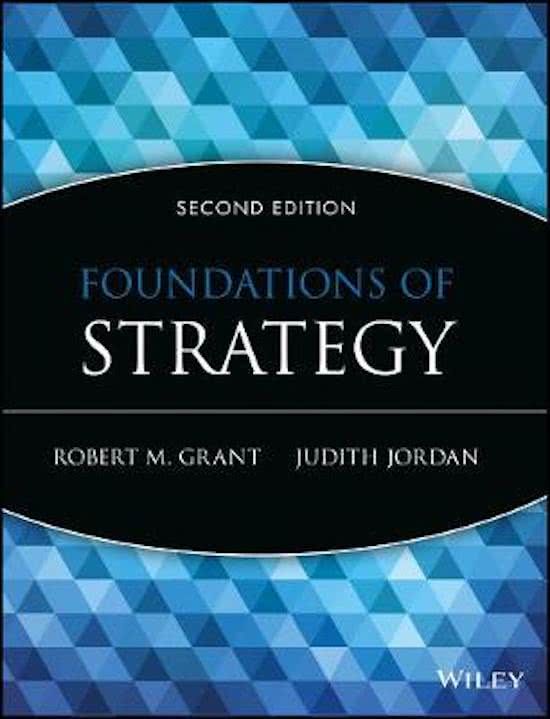
Foundations of Strategy
2nd Edition
ST
UV
SOLUTIONS
IA
MANUAL
_A
PP
Robert M. Grant
Judith J. Jordan
RO
Comprehensive Solutions Manual for Instructors
VE
and Students
D?
© Robert M. Grant & Judith J. Jordan
All rights reserved. Reproduction or distribution without permission is prohibited.
?
© DREAMSHUB
, Solutions Manual for Foundations of Strategy (2nd Edition)
Robert M. Grant & Judith J. Jordan
ISBN: 9781118914700
ST
UNIT 1: STRATEGIC FOUNDATIONS
1. The Concept of Strategy
2. Industry Analysis
3. Resources and Capabilities
UV
UNIT 2: COMPETITIVE ADVANTAGE AND STRATEGIC CHANGE
4. The Nature and Sources of Competitive Advantage
5. Industry Evolution and Strategic Change
6. Technology-Based Industries and the Management of Innovation
IA
UNIT 3: CORPORATE AND GLOBAL STRATEGY
7. Corporate Strategy
_A
8. Global Strategies and the Multinational Corporation
UNIT 4: STRATEGY IMPLEMENTATION AND FUTURE
DIRECTIONS
9. Realizing Strategy
PP
10. Current Trends in Strategic Management
RO
VE
D?
?
© DREAMSHUB
, Solutions Manual for Foundations of Strategy
2e Robert Grant Judith Jordan (All Chapters)
Chapter 1: The Concept of Strategy
Introduction
The major goal of this first class in Strategy is to convey an appreciation of what strategy
ST
is, by introducing students to a range of different perspectives and to some of the key
debates in this field of study.
The principal themes that we emphasise are:
UV
• The contribution of strategy to the success of individuals and organizations
• The origins and lineage of strategy - the ways in which ideas about ‘strategy’ have
developed over time
• Key questions and debates in strategy which include:
o What is strategy?
IA
o What role does strategy play in business organizations?
o How can we describe and identify a firm’s strategy?
o What role does strategy perform?
o Whose interests does strategy serve?
_A
• The role of strategy in not-for-profit organizations
Lecture/Instructor-led activity
There are a number of different ways of introducing strategy but the main aim is to get
students engaged and reflecting critically on the material from the start. We outline two
PP
approaches that seem to work well. Which one is adopted depends to a large extent on
the nature and size of the student group as well as the tutor’s individual preference. The
first approach is to start the session by asking students to write down what they
understand by the term ‘strategy’ i.e. how they interpret the term in everyday speech. They
are then asked to work in pairs or small groups comparing their different statements. The
RO
instructor invites selected groups to share their thoughts with the whole class and builds
up a list of key terms associated with ‘strategy’. Students tend to think define strategy in
terms of plans, routes to achieving goals, competitive tactics and so on. Distilling points of
similarity and difference between different students’ common sense understandings leads
nicely into a discussion of the history of strategy and the way different perspectives on
VE
strategy have emerged over time. It also highlights the fact that there is no universally
agreed definition of strategy and that the perspective or definition that you adopt shapes
the questions you ask and the role you think strategy plays within business organizations.
This acts as a logical bridge to the next step of the session that looks more systematically
at different definitions of strategy and the role that strategy plays within organizations.
D?
An alternative starting point which tends to work well with large groups of undergraduates
in a lecture setting is to start with images (or video clips) of successful individuals – in the
text we focus on Lady Gaga and Jeff Bezos. The instructor invites members of the
audience to identify these individuals, say something about what they do and why they
think the instructor has chosen them as examples of successful individuals. The instructor
?
then asks the audience to consider whether these individuals, despite their obvious
Downloaded by: tutorsection | Want to earn $1.236
Distribution of this document is illegal extra per year?
, differences, have anything in common. This leads to a discussion of the role that strategy
plays in success and some of the key characteristics of strategy.
Having, hopefully, captured the student’s attention, the session proceeds by posing some
fundamental questions, in particular
1. What is strategy?
2. What role does strategy play in business organizations
3. How can we describe strategy?
ST
4. How can we identify strategy?
5. Whose interests are/should be prioritised?
It is worthwhile spending a little time on questions 3 and 4 particularly if, at a later stage in
the course, students are asked to undertake assignment work that requires them to gather
UV
information of selected companies. Many students find the notion of ‘strategy’ hard to get
to grips with initially so the more concrete examples that can be given at the start, the
better. Concluding the first session by connecting ‘strategy’ to topical debate about
shareholder capitalism and corporate social responsibility alerts students to the currency
and importance of the subject matter to which they will be introduced in subsequent
sessions. It also creates the opportunity for the instructor to provide a road map for
IA
subsequent classes and to explain how themes introduced in this first session are
subsequently picked up and developed in more detail. At the end of the class the
instructor might ask students to reflect on their own goals and strategies for success,
particularly given the rather turbulent economic conditions most economies have faced in
_A
recent years.
Tutorial/Student-led activity
The mini-case that accompanies this session is ‘Tough Mudder’. It goes without saying
that it is a good idea to get students to read the mini-case in advance but the video clip
PP
that accompanies this chapter gives students a sense of the business and reinforces some
of the information contained within the case. Tough Mudder was chosen as an introductory
case because it is a business that is easily understood and likely to appeal to students.
The main aim of the case session is to get students thinking about strategy. The case
RO
allows the instructor to draw out both analytical aspects of strategy and also human and
processual ones and invites us to pose questions about the links between strategy and
success. Suggested answers to the case questions are provided in the teaching and
learning materials for this chapter.
VE
D?
?
Downloaded by: tutorsection | Want to earn $1.236
Distribution of this document is illegal extra per year?
2nd Edition
ST
UV
SOLUTIONS
IA
MANUAL
_A
PP
Robert M. Grant
Judith J. Jordan
RO
Comprehensive Solutions Manual for Instructors
VE
and Students
D?
© Robert M. Grant & Judith J. Jordan
All rights reserved. Reproduction or distribution without permission is prohibited.
?
© DREAMSHUB
, Solutions Manual for Foundations of Strategy (2nd Edition)
Robert M. Grant & Judith J. Jordan
ISBN: 9781118914700
ST
UNIT 1: STRATEGIC FOUNDATIONS
1. The Concept of Strategy
2. Industry Analysis
3. Resources and Capabilities
UV
UNIT 2: COMPETITIVE ADVANTAGE AND STRATEGIC CHANGE
4. The Nature and Sources of Competitive Advantage
5. Industry Evolution and Strategic Change
6. Technology-Based Industries and the Management of Innovation
IA
UNIT 3: CORPORATE AND GLOBAL STRATEGY
7. Corporate Strategy
_A
8. Global Strategies and the Multinational Corporation
UNIT 4: STRATEGY IMPLEMENTATION AND FUTURE
DIRECTIONS
9. Realizing Strategy
PP
10. Current Trends in Strategic Management
RO
VE
D?
?
© DREAMSHUB
, Solutions Manual for Foundations of Strategy
2e Robert Grant Judith Jordan (All Chapters)
Chapter 1: The Concept of Strategy
Introduction
The major goal of this first class in Strategy is to convey an appreciation of what strategy
ST
is, by introducing students to a range of different perspectives and to some of the key
debates in this field of study.
The principal themes that we emphasise are:
UV
• The contribution of strategy to the success of individuals and organizations
• The origins and lineage of strategy - the ways in which ideas about ‘strategy’ have
developed over time
• Key questions and debates in strategy which include:
o What is strategy?
IA
o What role does strategy play in business organizations?
o How can we describe and identify a firm’s strategy?
o What role does strategy perform?
o Whose interests does strategy serve?
_A
• The role of strategy in not-for-profit organizations
Lecture/Instructor-led activity
There are a number of different ways of introducing strategy but the main aim is to get
students engaged and reflecting critically on the material from the start. We outline two
PP
approaches that seem to work well. Which one is adopted depends to a large extent on
the nature and size of the student group as well as the tutor’s individual preference. The
first approach is to start the session by asking students to write down what they
understand by the term ‘strategy’ i.e. how they interpret the term in everyday speech. They
are then asked to work in pairs or small groups comparing their different statements. The
RO
instructor invites selected groups to share their thoughts with the whole class and builds
up a list of key terms associated with ‘strategy’. Students tend to think define strategy in
terms of plans, routes to achieving goals, competitive tactics and so on. Distilling points of
similarity and difference between different students’ common sense understandings leads
nicely into a discussion of the history of strategy and the way different perspectives on
VE
strategy have emerged over time. It also highlights the fact that there is no universally
agreed definition of strategy and that the perspective or definition that you adopt shapes
the questions you ask and the role you think strategy plays within business organizations.
This acts as a logical bridge to the next step of the session that looks more systematically
at different definitions of strategy and the role that strategy plays within organizations.
D?
An alternative starting point which tends to work well with large groups of undergraduates
in a lecture setting is to start with images (or video clips) of successful individuals – in the
text we focus on Lady Gaga and Jeff Bezos. The instructor invites members of the
audience to identify these individuals, say something about what they do and why they
think the instructor has chosen them as examples of successful individuals. The instructor
?
then asks the audience to consider whether these individuals, despite their obvious
Downloaded by: tutorsection | Want to earn $1.236
Distribution of this document is illegal extra per year?
, differences, have anything in common. This leads to a discussion of the role that strategy
plays in success and some of the key characteristics of strategy.
Having, hopefully, captured the student’s attention, the session proceeds by posing some
fundamental questions, in particular
1. What is strategy?
2. What role does strategy play in business organizations
3. How can we describe strategy?
ST
4. How can we identify strategy?
5. Whose interests are/should be prioritised?
It is worthwhile spending a little time on questions 3 and 4 particularly if, at a later stage in
the course, students are asked to undertake assignment work that requires them to gather
UV
information of selected companies. Many students find the notion of ‘strategy’ hard to get
to grips with initially so the more concrete examples that can be given at the start, the
better. Concluding the first session by connecting ‘strategy’ to topical debate about
shareholder capitalism and corporate social responsibility alerts students to the currency
and importance of the subject matter to which they will be introduced in subsequent
sessions. It also creates the opportunity for the instructor to provide a road map for
IA
subsequent classes and to explain how themes introduced in this first session are
subsequently picked up and developed in more detail. At the end of the class the
instructor might ask students to reflect on their own goals and strategies for success,
particularly given the rather turbulent economic conditions most economies have faced in
_A
recent years.
Tutorial/Student-led activity
The mini-case that accompanies this session is ‘Tough Mudder’. It goes without saying
that it is a good idea to get students to read the mini-case in advance but the video clip
PP
that accompanies this chapter gives students a sense of the business and reinforces some
of the information contained within the case. Tough Mudder was chosen as an introductory
case because it is a business that is easily understood and likely to appeal to students.
The main aim of the case session is to get students thinking about strategy. The case
RO
allows the instructor to draw out both analytical aspects of strategy and also human and
processual ones and invites us to pose questions about the links between strategy and
success. Suggested answers to the case questions are provided in the teaching and
learning materials for this chapter.
VE
D?
?
Downloaded by: tutorsection | Want to earn $1.236
Distribution of this document is illegal extra per year?