Psychology Paper 2 Exam Questions with
Answers
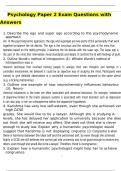
1. Describe the ego and super ego according to the psychodynamic
approach
(4): In the psychodynamic approach, the ego and superego are two parts of the personality that work
together to balance the ids desires. The ego is the conscious and the rational part of the mind that
operates based on the reality principle, it balances the ids desires with the super ego. The super ego is
the part of the mind that internalises moral standards and ideals. It controls the id with feelings of guilt.
2. Outline Wundt's method of introspection (4): Wilhelm Wundt's method of
introspection was a
research technique that involved training people to analyse their own thoughts and feelings in a
controlled environment. He believed it could be an objective way of studying the mind. Participants were
trained to give detailed observations in a controlled environment whilst exposed to the same stimuli
(e.g. a ticking metronome).
3. Outline one example of how neurochemistry influences behaviour
(3): Neuro-
chemical imbalances in the brain are often associated with abnormal behaviour. For example, imbalances
of dopamine (linked to the brains pleasure system) is associated with mood disorders such as depression.
It can also play a role ion schizophrenia within the dopamine hypothesis.
4. Karishma has very low self-esteem, even though she achieved ver
high GCSE
grades. She would like to be a lawyer. Although she is studying A-
levels, she has delayed her application to university because she does
not think she will receive any offers. She does not think she is clever
enough to study law. Explain why a humanistic psychologist would
suggest that Karishma is not displaying congruence. (2): Congruence is when
there is harmony between the ideal self and the perceived self. So even though she achieved
highly in GCSE she still believes she cannot get into university and is not good enough to receive any
otters, even though she would like to be a lawyer. Therefore, there is incongruence.
5. Explain how a humanistic psychologist might help her to achieve
congruence
1/
7
, (3): The psychologist should give her unconditional positive regard such as saying that she will get
otters from university, will dissolve her conditions of worth so that she can have a more realistic true self
6. Outline how behaviourists explain learning through the process of
operant conditioning. Compare operant conditioning with social
learning. (8): Operant conditioning can be described as the process in which behaviour is
shaped and maintained through its consequences. Operant conditioning focuses on voluntary
behaviour, meaning that an organism actively acts on its environment to receive the consequence.
Operant conditioning was famously investigated by B.F Skinner through his rat studies. He investigated
positive reinforcement (receiving a positive stimulus when a behaviour is acted) and negative reinforce-
ment (the removal of a negative stimulus when a behaviour is acted). So, whenever the rat in the box
would pull the lever, either a treat would drop, or the electric shocks that the rat was receiving would
stop. Both conditions made the
2/
7
Answers
1. Describe the ego and super ego according to the psychodynamic
approach
(4): In the psychodynamic approach, the ego and superego are two parts of the personality that work
together to balance the ids desires. The ego is the conscious and the rational part of the mind that
operates based on the reality principle, it balances the ids desires with the super ego. The super ego is
the part of the mind that internalises moral standards and ideals. It controls the id with feelings of guilt.
2. Outline Wundt's method of introspection (4): Wilhelm Wundt's method of
introspection was a
research technique that involved training people to analyse their own thoughts and feelings in a
controlled environment. He believed it could be an objective way of studying the mind. Participants were
trained to give detailed observations in a controlled environment whilst exposed to the same stimuli
(e.g. a ticking metronome).
3. Outline one example of how neurochemistry influences behaviour
(3): Neuro-
chemical imbalances in the brain are often associated with abnormal behaviour. For example, imbalances
of dopamine (linked to the brains pleasure system) is associated with mood disorders such as depression.
It can also play a role ion schizophrenia within the dopamine hypothesis.
4. Karishma has very low self-esteem, even though she achieved ver
high GCSE
grades. She would like to be a lawyer. Although she is studying A-
levels, she has delayed her application to university because she does
not think she will receive any offers. She does not think she is clever
enough to study law. Explain why a humanistic psychologist would
suggest that Karishma is not displaying congruence. (2): Congruence is when
there is harmony between the ideal self and the perceived self. So even though she achieved
highly in GCSE she still believes she cannot get into university and is not good enough to receive any
otters, even though she would like to be a lawyer. Therefore, there is incongruence.
5. Explain how a humanistic psychologist might help her to achieve
congruence
1/
7
, (3): The psychologist should give her unconditional positive regard such as saying that she will get
otters from university, will dissolve her conditions of worth so that she can have a more realistic true self
6. Outline how behaviourists explain learning through the process of
operant conditioning. Compare operant conditioning with social
learning. (8): Operant conditioning can be described as the process in which behaviour is
shaped and maintained through its consequences. Operant conditioning focuses on voluntary
behaviour, meaning that an organism actively acts on its environment to receive the consequence.
Operant conditioning was famously investigated by B.F Skinner through his rat studies. He investigated
positive reinforcement (receiving a positive stimulus when a behaviour is acted) and negative reinforce-
ment (the removal of a negative stimulus when a behaviour is acted). So, whenever the rat in the box
would pull the lever, either a treat would drop, or the electric shocks that the rat was receiving would
stop. Both conditions made the
2/
7