

MCB 100 EXAM 2 STUDY GUIDE QUESTIONS AND CORRECT
ANSWERS
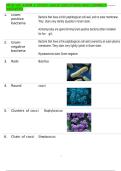
1. Gram-
Bacteria that have a thick peptidoglycan cell wall, and no outer membrane.
positive
They stain very darkly (purple) in Gram stain.
bacteria
Actinomycetes are spore-forming Gram-positive bacteria (often mistaken
for fun- gi).
2. Gram- Bacteria that have a thin peptidoglycan cell wall covered by an outer plasma
negative membrane. They stain very lightly (pink) in Gram stain.
bacteria
Myxobacteria stain Gram-negative
3. Rods Bacillus
4. Round cocci
5. Clusters of cocci Staphylococcus
6. Chain of cocci Streptococcus
1/
35
, MCB 100 EXAM 2 STUDY GUIDE QUESTIONS AND CORRECT
ANSWERS
7. Palisades Corynebacterium
8. Spiral/ Helical Spirillum
9. Curved Rod Vibrio
10. Chain of Rods Streptobacillus
11. Bacterial Cell
2/
35
, MCB 100 EXAM 2 STUDY GUIDE QUESTIONS AND CORRECT
ANSWERS
12. Biofilms They attach to a surface and to each other through a matrix comprised of
an
extracellular polysaccharide coating that holds the community together.
Formation of biofilms can be detected and measured by staining with the dye
crystal violet (binds extracellular polysaccharides - recognizes
capsules
Bacterial biofilms are particularly resistant to antibiotics and contribute to a num-
ber of medical problems.
-Dental Plaque
-Nosocomial Infections
-Legionella pneumophila (biofilm on AC units)
-Pseudomonas aeruginosa (Biofilms on mucosal surfaces Cystic
Fibrosis & Burn Wounds)
13. Planktonic Describes bacteria that are freely floating in water then bacteria form a
and dense group and become highly motile
Swarming
Bacteria attach together and clump together starting to form a body
14. Attachment
and
Aggregation
15. Fruiting body A colony/ biofilm of bacteria is formed
16. Sporulation the process of spore formation
3/
35
, MCB 100 EXAM 2 STUDY GUIDE QUESTIONS AND CORRECT
ANSWERS
17. Universal Tree
of Life
4/
35
ANSWERS
1. Gram-
Bacteria that have a thick peptidoglycan cell wall, and no outer membrane.
positive
They stain very darkly (purple) in Gram stain.
bacteria
Actinomycetes are spore-forming Gram-positive bacteria (often mistaken
for fun- gi).
2. Gram- Bacteria that have a thin peptidoglycan cell wall covered by an outer plasma
negative membrane. They stain very lightly (pink) in Gram stain.
bacteria
Myxobacteria stain Gram-negative
3. Rods Bacillus
4. Round cocci
5. Clusters of cocci Staphylococcus
6. Chain of cocci Streptococcus
1/
35
, MCB 100 EXAM 2 STUDY GUIDE QUESTIONS AND CORRECT
ANSWERS
7. Palisades Corynebacterium
8. Spiral/ Helical Spirillum
9. Curved Rod Vibrio
10. Chain of Rods Streptobacillus
11. Bacterial Cell
2/
35
, MCB 100 EXAM 2 STUDY GUIDE QUESTIONS AND CORRECT
ANSWERS
12. Biofilms They attach to a surface and to each other through a matrix comprised of
an
extracellular polysaccharide coating that holds the community together.
Formation of biofilms can be detected and measured by staining with the dye
crystal violet (binds extracellular polysaccharides - recognizes
capsules
Bacterial biofilms are particularly resistant to antibiotics and contribute to a num-
ber of medical problems.
-Dental Plaque
-Nosocomial Infections
-Legionella pneumophila (biofilm on AC units)
-Pseudomonas aeruginosa (Biofilms on mucosal surfaces Cystic
Fibrosis & Burn Wounds)
13. Planktonic Describes bacteria that are freely floating in water then bacteria form a
and dense group and become highly motile
Swarming
Bacteria attach together and clump together starting to form a body
14. Attachment
and
Aggregation
15. Fruiting body A colony/ biofilm of bacteria is formed
16. Sporulation the process of spore formation
3/
35
, MCB 100 EXAM 2 STUDY GUIDE QUESTIONS AND CORRECT
ANSWERS
17. Universal Tree
of Life
4/
35


