FKUGYQA****99998DKIUGYVDBSDXCMN ZCKIUSDG DXCOIU DCLXOIUAFFASDVAVUC
DIUCSCKSV
Oxford Cambridge and RSA
EFXCMJHVHJHK J HUHIU THWHGH IKJHKMN 0099999993333833333333333333763729NSKCC7S8WW
KJGFXDF KGRTFOG5T4WTGYGFDUDUYAKJDHUYGYWU63YHDHVYDTFC VRO98763T2G FDM98763TGVE
F0V8C7T6FTVFBMM L04623T4VGF97T6FVEHDFBS
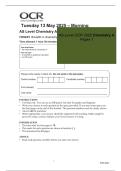
A-Level OCR 2025 Chemistry A Paper 3
Friday 20 June 2025 – Morning
A Level Chemistry A
H432/03 Unified chemistry
Time allowed: 1 hour 30 minutes
1
Turn over
, 2
BLANK PAGE
DO NOT WRITE ON THIS PAGE
© OCR 2025
, 3
1 This question is about spectra.
(a) The mass spectrum for Br2 has peaks at m/z values of 79, 81, 158, 160 and 162.
The peaks at m/z 79 and 81 have virtually the same relative abundance.
(i) Complete the table to show the number of protons, neutrons and electrons in the particles that
cause the peaks at m/z 79 and 81.
Number of Number of Number of
m/z
protons neutrons electrons
79
81
[2]
(ii) Explain why there are peaks with m/z values of 158, 160 and 162 and predict their relative
abundances.
Explanation ......................................................................................................................................
..........................................................................................................................................................
..........................................................................................................................................................
..........................................................................................................................................................
Relative abundances .......................................................................................................................
..........................................................................................................................................................
..........................................................................................................................................................
[3]
(b) This question looks at proton NMR spectra of dibromoalkanes.
Predict the following.
Compound Number of peaks CH2 splitting pattern(s)
BrCH2CH2Br
BrCH2CH2CH2Br
[3]
© OCR 2025 Turn over
DIUCSCKSV
Oxford Cambridge and RSA
EFXCMJHVHJHK J HUHIU THWHGH IKJHKMN 0099999993333833333333333333763729NSKCC7S8WW
KJGFXDF KGRTFOG5T4WTGYGFDUDUYAKJDHUYGYWU63YHDHVYDTFC VRO98763T2G FDM98763TGVE
F0V8C7T6FTVFBMM L04623T4VGF97T6FVEHDFBS
A-Level OCR 2025 Chemistry A Paper 3
Friday 20 June 2025 – Morning
A Level Chemistry A
H432/03 Unified chemistry
Time allowed: 1 hour 30 minutes
1
Turn over
, 2
BLANK PAGE
DO NOT WRITE ON THIS PAGE
© OCR 2025
, 3
1 This question is about spectra.
(a) The mass spectrum for Br2 has peaks at m/z values of 79, 81, 158, 160 and 162.
The peaks at m/z 79 and 81 have virtually the same relative abundance.
(i) Complete the table to show the number of protons, neutrons and electrons in the particles that
cause the peaks at m/z 79 and 81.
Number of Number of Number of
m/z
protons neutrons electrons
79
81
[2]
(ii) Explain why there are peaks with m/z values of 158, 160 and 162 and predict their relative
abundances.
Explanation ......................................................................................................................................
..........................................................................................................................................................
..........................................................................................................................................................
..........................................................................................................................................................
Relative abundances .......................................................................................................................
..........................................................................................................................................................
..........................................................................................................................................................
[3]
(b) This question looks at proton NMR spectra of dibromoalkanes.
Predict the following.
Compound Number of peaks CH2 splitting pattern(s)
BrCH2CH2Br
BrCH2CH2CH2Br
[3]
© OCR 2025 Turn over