Oxford Cambridge and RSA
jhgfdzxchhfxdckodrxfcjjtrxfcgvhjjjjjjjuhjvvukuhhhhhhhhhhhhhhhhhhhhhhhhhhytrsefuydexfguytr
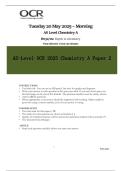
Tuesday 20 May 2025 – Morning
AS Level Chemistry A
H032/02 Depth in chemistry
Time allowed: 1 hour 30 minutes
syujhn jhfgfcvufg
Tghds dchdgfdgf dfdhdhdg ddudyfv ddduygd fdiuygv dsmdj8uv dsiyve disyghsjcc wxvg woxvgsd sicyv
Iuytredfdfghuytdetcvhioo[-0987654w33esdxvcvhy5xefbui4wjfhj
wssggvmgv dsyd dnsicydg
Jytsioiuytrsdtyuiuytresefcvbnmopolkjhszxdfcvbop987rezdxfhjkp;l’;lljkhuyuhgcesdfghklhgkjh
AS-Level OCR 2025 Chemistry A Paper 2
Juytdf7l65efghghj9
Kuytrdxcjoiuytkjhdfuh,jytrxcgvhbng
INSTRUCTIONS
• Use black ink. You can use an HB pencil, but only for graphs and diagrams.
• Write your answer to each question in the space provided. If you need extra space use
the lined pages at the end of this booklet. The question numbers must be clearly shown.
• Answer all the questions.
• Where appropriate, your answer should be supported with working. Marks might be
given for using a correct method, even if your answer is wrong.
INFORMATION
• The total mark for this paper is 70.
• The marks for each question are shown in brackets [ ].
• Quality of extended response will be assessed in questions marked with an asterisk (*).
• This document has 24 pages.
ADVICE
• Read each question carefully before you start your answer.
1
Turn over
, 2
1 A student is investigating the enthalpy change of neutralisation for a strong acid and a strong
alkali.
(a) Explain what is meant by an alkali.
..........................................................................................................................................................
...................................................................................................................................................................... [1]
(b) Write the ionic equation for the neutralisation reaction between an acid and an alkali.
...................................................................................................................................................................... [1]
(c) The student mixes 40.0 cm3 of 1.40 mol dm–3 HCl and 40.0 cm3 of 1.40 mol dm–3 NaOH.
The temperature rises by 9.40 °C
(i) Calculate the enthalpy change of neutralisation, in kJ mol–1.
Give your answer to 3 significant figures.
Assume that the density of all solutions and the specific heat capacity, c, of the reaction mixture
is the same as for water.
Enthalpy change of neutralisation = ........................................... kJ mol–1 [4]
© OCR 2025
, 3
(ii) The student repeats the experiment using the same volume and concentration of NaOH but
using 20.0 cm3 of 2.80 mol dm–3 HCl instead of 40.0 cm3 of 1.40 mol dm–3 HCl .
The temperature rise is greater than 9.4 °C.
Explain why.
..........................................................................................................................................................
..........................................................................................................................................................
..........................................................................................................................................................
..........................................................................................................................................................
..........................................................................................................................................................
..........................................................................................................................................................
...................................................................................................................................................................... [2]
© OCR 2025 Turn over
jhgfdzxchhfxdckodrxfcjjtrxfcgvhjjjjjjjuhjvvukuhhhhhhhhhhhhhhhhhhhhhhhhhhytrsefuydexfguytr
Tuesday 20 May 2025 – Morning
AS Level Chemistry A
H032/02 Depth in chemistry
Time allowed: 1 hour 30 minutes
syujhn jhfgfcvufg
Tghds dchdgfdgf dfdhdhdg ddudyfv ddduygd fdiuygv dsmdj8uv dsiyve disyghsjcc wxvg woxvgsd sicyv
Iuytredfdfghuytdetcvhioo[-0987654w33esdxvcvhy5xefbui4wjfhj
wssggvmgv dsyd dnsicydg
Jytsioiuytrsdtyuiuytresefcvbnmopolkjhszxdfcvbop987rezdxfhjkp;l’;lljkhuyuhgcesdfghklhgkjh
AS-Level OCR 2025 Chemistry A Paper 2
Juytdf7l65efghghj9
Kuytrdxcjoiuytkjhdfuh,jytrxcgvhbng
INSTRUCTIONS
• Use black ink. You can use an HB pencil, but only for graphs and diagrams.
• Write your answer to each question in the space provided. If you need extra space use
the lined pages at the end of this booklet. The question numbers must be clearly shown.
• Answer all the questions.
• Where appropriate, your answer should be supported with working. Marks might be
given for using a correct method, even if your answer is wrong.
INFORMATION
• The total mark for this paper is 70.
• The marks for each question are shown in brackets [ ].
• Quality of extended response will be assessed in questions marked with an asterisk (*).
• This document has 24 pages.
ADVICE
• Read each question carefully before you start your answer.
1
Turn over
, 2
1 A student is investigating the enthalpy change of neutralisation for a strong acid and a strong
alkali.
(a) Explain what is meant by an alkali.
..........................................................................................................................................................
...................................................................................................................................................................... [1]
(b) Write the ionic equation for the neutralisation reaction between an acid and an alkali.
...................................................................................................................................................................... [1]
(c) The student mixes 40.0 cm3 of 1.40 mol dm–3 HCl and 40.0 cm3 of 1.40 mol dm–3 NaOH.
The temperature rises by 9.40 °C
(i) Calculate the enthalpy change of neutralisation, in kJ mol–1.
Give your answer to 3 significant figures.
Assume that the density of all solutions and the specific heat capacity, c, of the reaction mixture
is the same as for water.
Enthalpy change of neutralisation = ........................................... kJ mol–1 [4]
© OCR 2025
, 3
(ii) The student repeats the experiment using the same volume and concentration of NaOH but
using 20.0 cm3 of 2.80 mol dm–3 HCl instead of 40.0 cm3 of 1.40 mol dm–3 HCl .
The temperature rise is greater than 9.4 °C.
Explain why.
..........................................................................................................................................................
..........................................................................................................................................................
..........................................................................................................................................................
..........................................................................................................................................................
..........................................................................................................................................................
..........................................................................................................................................................
...................................................................................................................................................................... [2]
© OCR 2025 Turn over