TOBU – Summaries week 1
Structure & Function
Introduction:
-> What is an organisation?
- a group of people cooperating to achieve a common goal
Organisations are needed for certain tasks that cannot be completed by one person.
An organisation is led by the management.
- Normally the owners or most senior persons in the organisation
The survival of organisations is often dependent on their ability to deal with external
influences. How they attune to this can be an outcome of strategic management.
- The process of careful consideration of appropriate responses to the environment.
Two approaches to strategic management:
- Classic school
Strategic management = strategic planning. To strike a balance between strength &
weaknesses, and threats & opportunities.
- Second modern approach
Strategic management = strategic thinking. To put visions into practice.
The classical approach to strategic management:
- Main issue: positioning the organisation in relation to the environment. Do this by
analyse the strengths and weaknesses of the organisation. Then determine possible
opportunities and threats. After that: make plans and use a certain strategy.
The three phases of strategic management:
1. Situational Analysis
2. Strategy formation
3. Planning and implementation
Situational analysis
-> SWOT = Strengths, weaknesses (=internal analyse), opportunities and threats (external
analyse).
Definition of the current vision, aims & strategy. The vision of an organisation is their
mission and their principles combined!
Vision of a management tool: the 7-s model
1. Structure
-> the way elements of the organisation relate to each other
, 2. Systems
-> information and communication
3. Managerial style
-> the behaviour of the management
4. Staff
-> how the organisation pays attention to their human resources
5. Key skills
-> capabilities within the organisation
6. Strategies
-> what the organisation needs to do to reach their goal
7. Shared values
-> the vision
Principles = the norms and values of an organisation which can be compared to the societal
norms and values.
Organisational goals are based on the vision. The relationship between organisation,
employees and the management.
Some examples of goals:
- Balance of interests
- Quality
- Efficiency
- Image
In organisation, several groups and teams can be formed. We divide them into:
- Formal groups
= within the structure of an organisation. They can be permanent (like a
management team) or temporary (like a task force for a certain project).
- Informal groups
= outside the structure of an organisation. They are based on friendship & common
interests and host activities apart from work.
- Virtual groups
= via online communication, there’s no need to meet each other in person. This
concept can be useful for multinationals with employees in various different
countries.
Horizontal groups = all the members of the group are from the same hierarchical level.
Vertical groups = the members of the group can originate from different hierarchical levels.
Mixed groups = the members are from horizontal and vertical groups.
Self-governing teams have members that are responsible for their activities as a group. The
opposite is a more traditional or functional teams who are led by an executive who is
responsible for management tasks.
, By using self-governing teams, various objectives can be reached:
1. The management can work more effective and efficient
2. The quality of work improves
-> team members are responsible for their own tasks, but also for the tasks from
the team as a whole
3. Learning organisation
Creativity and learning capacity are put to a good use
The 5 stages of group development:
1. Forming
-> The members get to know each other
2. Storming
-> The members use their knowledge and insights and impose these on the tasks of
the group. Subgroups can now be formed.
3. Norming
-> Unity and agreements are formed
4. Performing
-> Effective teamwork is used to deliver a good performance. Organising is key to
fulfil the purpose as best as possible.
5. Adjourning
-> The purpose has been achieved
Management
-> Directing the organisation
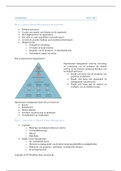
There are three levels of management:
- Top-level management
-> Provide leadership to the organisation
- Middle management
-> Directing the activities of the operational levels
- Lower management
-> Heads of departments, group managers etc.
(Modern organisations mostly don’t use lower management)
The management is there to formulate tasks (mostly top-level) and to execute tasks (mostly
middle level).
There are two types of managers:
- Functional managers
Relate to the performance of a single activity within an organisation
- General managers
They might be responsible for all the activities within a certain part of the
organisation.
The structure of an organisation has become more flat through the assimilation of lower
and middle management. Also, the classical leadership-style of the managers is transformed
into a more coaching and guiding management style.
Structure & Function
Introduction:
-> What is an organisation?
- a group of people cooperating to achieve a common goal
Organisations are needed for certain tasks that cannot be completed by one person.
An organisation is led by the management.
- Normally the owners or most senior persons in the organisation
The survival of organisations is often dependent on their ability to deal with external
influences. How they attune to this can be an outcome of strategic management.
- The process of careful consideration of appropriate responses to the environment.
Two approaches to strategic management:
- Classic school
Strategic management = strategic planning. To strike a balance between strength &
weaknesses, and threats & opportunities.
- Second modern approach
Strategic management = strategic thinking. To put visions into practice.
The classical approach to strategic management:
- Main issue: positioning the organisation in relation to the environment. Do this by
analyse the strengths and weaknesses of the organisation. Then determine possible
opportunities and threats. After that: make plans and use a certain strategy.
The three phases of strategic management:
1. Situational Analysis
2. Strategy formation
3. Planning and implementation
Situational analysis
-> SWOT = Strengths, weaknesses (=internal analyse), opportunities and threats (external
analyse).
Definition of the current vision, aims & strategy. The vision of an organisation is their
mission and their principles combined!
Vision of a management tool: the 7-s model
1. Structure
-> the way elements of the organisation relate to each other
, 2. Systems
-> information and communication
3. Managerial style
-> the behaviour of the management
4. Staff
-> how the organisation pays attention to their human resources
5. Key skills
-> capabilities within the organisation
6. Strategies
-> what the organisation needs to do to reach their goal
7. Shared values
-> the vision
Principles = the norms and values of an organisation which can be compared to the societal
norms and values.
Organisational goals are based on the vision. The relationship between organisation,
employees and the management.
Some examples of goals:
- Balance of interests
- Quality
- Efficiency
- Image
In organisation, several groups and teams can be formed. We divide them into:
- Formal groups
= within the structure of an organisation. They can be permanent (like a
management team) or temporary (like a task force for a certain project).
- Informal groups
= outside the structure of an organisation. They are based on friendship & common
interests and host activities apart from work.
- Virtual groups
= via online communication, there’s no need to meet each other in person. This
concept can be useful for multinationals with employees in various different
countries.
Horizontal groups = all the members of the group are from the same hierarchical level.
Vertical groups = the members of the group can originate from different hierarchical levels.
Mixed groups = the members are from horizontal and vertical groups.
Self-governing teams have members that are responsible for their activities as a group. The
opposite is a more traditional or functional teams who are led by an executive who is
responsible for management tasks.
, By using self-governing teams, various objectives can be reached:
1. The management can work more effective and efficient
2. The quality of work improves
-> team members are responsible for their own tasks, but also for the tasks from
the team as a whole
3. Learning organisation
Creativity and learning capacity are put to a good use
The 5 stages of group development:
1. Forming
-> The members get to know each other
2. Storming
-> The members use their knowledge and insights and impose these on the tasks of
the group. Subgroups can now be formed.
3. Norming
-> Unity and agreements are formed
4. Performing
-> Effective teamwork is used to deliver a good performance. Organising is key to
fulfil the purpose as best as possible.
5. Adjourning
-> The purpose has been achieved
Management
-> Directing the organisation
There are three levels of management:
- Top-level management
-> Provide leadership to the organisation
- Middle management
-> Directing the activities of the operational levels
- Lower management
-> Heads of departments, group managers etc.
(Modern organisations mostly don’t use lower management)
The management is there to formulate tasks (mostly top-level) and to execute tasks (mostly
middle level).
There are two types of managers:
- Functional managers
Relate to the performance of a single activity within an organisation
- General managers
They might be responsible for all the activities within a certain part of the
organisation.
The structure of an organisation has become more flat through the assimilation of lower
and middle management. Also, the classical leadership-style of the managers is transformed
into a more coaching and guiding management style.