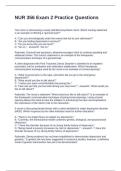
NUR 356 Exam 2 Practice Questions
The nurse is interviewing a newly admitted psychiatric client. Which nursing statement
is an example of offering a "general lead"?
A. "Can you chronologically order the events that led to your admission?"
B. "Are you feeling depressed or anxious?"
C. "Do you know why you are here?"
D. "Go on." - answerD. "Go on."
Rationale: General lead questions: allows/encourages client to continue speaking and
elaborate further. The nurse's statement is an example of the therapeutic
communication technique of a general lead.
A client diagnosed with Post Traumatic Stress Disorder is admitted to an inpatient
psychiatric unit for evaluation and medication stabilization. Which therapeutic
communication technique used by the nurse is an example of a broad opening?
A. "What occurred prior to the rape, and when did you go to the emergency
department?"
B. "What would you like to talk about?"
C. "I notice you seem uncomfortable discussing this."
D. "How can we help you feel safe during your stay here?" - answerB. "What would you
like to talk about?"
Rationale: The nurse's statement "What would you like to talk about?" is an example of
the therapeutic communication technique of giving broad openings. Using a broad
opening allows the client to take the initiative in introducing the topic and emphasizes
the importance of the client's role in the interaction.
A nurse is discussing family history with a client admitted for major depressive disorder
(MDD). Which response by the client indicates need for further education?
A. "There is no single theory to explain my depression."
B. "Currently, the transactional model combines genetic, biological, and psychosocial
influences."
C. "I have this disorder because of my strong family history of depression."
D. "Being raised in poverty increases my risk for depression." - answerC. "I have this
disorder because of my strong family history of depression."
Rationale: Strong evidence has not been established to demonstrate depression and
genetics. "A genetic link has been suggested in numerous studies; however, a definitive
mode of genetic transmission has yet to be demonstrated."
,The nurse is nurse is teaching a client who is being started on imipramine (Tofranil)
about the medication. The nurse should inform the client to expect maximum desired
effects at which time period following initiation of the medication?
A. During the first week.
B. In 2-3 weeks.
C. During the sixth week.
D. In 2 months. - answerB. In 2-3 weeks.
Rationale: Imipramine medication teaching: Antidepressant and nerve pain medication;
the maximum therapeutic effects of imipramine may not occur for 2-3 weeks after the
medication has been initiated.
A nurse suspects that the client is experiencing delirium. What manifestations might the
client present with? (Select all that apply)
A. Hyperactivity
B. Agitation
C. Hallucinations
D. Increased focus
E. Anxiety - answerA. Hyperactivity
B. Agitation
C. Hallucinations
E. Anxiety
Rationale: Delirium is an abrupt change in the brain that causes mental confusion and
emotional disruption. It makes it difficult to think, remember, sleep, pay attention, and
more. You might experience delirium during alcohol withdrawal, after surgery, or with
dementia.
Nursing assessment of the client with delirium will reveal either hyperactivity and
agitation or apathy with a decrease in activity and hallucinations may occur.
A client was diagnosed with depression resulting from the loss of her twin sister in a
skiing accident. Her parents reported that all the client has done since the accident was
lay in her bed and cry, asking why she survived the accident. The physician prescribed
Prozac to treat the depression and suggested that the parents "keep a close eye on
her." After a week, the client began to show some signs of improvement, even coming
out of her room to eat with the family. After 2 months, the client committed suicide
despite seeming to come out of the depression. What is the likeliest reason?
A. A preexisting mental illness was compounded by the death of her sister
B. The Prozac prescription was not effective
C. The client was not kept under direct supervision
, D. Suicide risk can increase early in treatment with antidepressants - answerD. Suicide
risk can increase early in treatment with antidepressants
Rationale: Suicide risk may increase early in treatment with antidepressants. One
possible reason is that as an individual's energy returns, he or she may have an
increased ability to act out self-destructive wishes. Prozac prescription was effective in
elevating the client's mood. Direct supervision may have prevented the suicide;
however, the most likely reason for the increased risk was related to treatment with an
antidepressant.
A nurse discovers a client's suicide note that details the time, place, and means to
commit suicide. Which is the priority nursing intervention and the rationale for this
action?
A. Calling an emergency treatment team meeting, because the client's threat must be
addressed
B. Establishing room restrictions, because the client's threat is an attempt to manipulate
the staff
C. Placing this client on one-to-one suicide precautions, because the more specific the
plan, the more likely the client will attempt suicide
D. Administering lorazepam prn, because the client is angry about the discovery of the
note - answerC. Placing this client on one-to-one suicide precautions, because the more
specific the plan, the more likely the client will attempt suicide
Rationale: The priority nursing action is to place the client on one-to-one suicide
precautions. A client with a specific plan is at very high risk of attempting suicide. The
appropriate nursing diagnosis for this client is "risk for suicide."
A client is newly committed to an inpatient psychiatric unit. Which nursing intervention
best lowers this client's risk for suicide?
A. Encouraging participation in the milieu to promote hope
B. Developing a strong personal relationship with the client
C. Observing the client at intervals determined by assessed data
D. Encouraging and redirecting the client to concentrate on happier times - answerC.
Observing the client at intervals determined by assessed data
Rationale: The nurse should observe the actively suicidal client continuously for the first
hour after admission. After a full assessment the treatment team will determine the
observation status of the client. Observation of the client allows the nurse to interrupt
any observed suicidal behaviors.
A nurse is developing a plan of care for a suicidal client. Which documented intervention
should the nurse implement first?
A. Observe the client.
The nurse is interviewing a newly admitted psychiatric client. Which nursing statement
is an example of offering a "general lead"?
A. "Can you chronologically order the events that led to your admission?"
B. "Are you feeling depressed or anxious?"
C. "Do you know why you are here?"
D. "Go on." - answerD. "Go on."
Rationale: General lead questions: allows/encourages client to continue speaking and
elaborate further. The nurse's statement is an example of the therapeutic
communication technique of a general lead.
A client diagnosed with Post Traumatic Stress Disorder is admitted to an inpatient
psychiatric unit for evaluation and medication stabilization. Which therapeutic
communication technique used by the nurse is an example of a broad opening?
A. "What occurred prior to the rape, and when did you go to the emergency
department?"
B. "What would you like to talk about?"
C. "I notice you seem uncomfortable discussing this."
D. "How can we help you feel safe during your stay here?" - answerB. "What would you
like to talk about?"
Rationale: The nurse's statement "What would you like to talk about?" is an example of
the therapeutic communication technique of giving broad openings. Using a broad
opening allows the client to take the initiative in introducing the topic and emphasizes
the importance of the client's role in the interaction.
A nurse is discussing family history with a client admitted for major depressive disorder
(MDD). Which response by the client indicates need for further education?
A. "There is no single theory to explain my depression."
B. "Currently, the transactional model combines genetic, biological, and psychosocial
influences."
C. "I have this disorder because of my strong family history of depression."
D. "Being raised in poverty increases my risk for depression." - answerC. "I have this
disorder because of my strong family history of depression."
Rationale: Strong evidence has not been established to demonstrate depression and
genetics. "A genetic link has been suggested in numerous studies; however, a definitive
mode of genetic transmission has yet to be demonstrated."
,The nurse is nurse is teaching a client who is being started on imipramine (Tofranil)
about the medication. The nurse should inform the client to expect maximum desired
effects at which time period following initiation of the medication?
A. During the first week.
B. In 2-3 weeks.
C. During the sixth week.
D. In 2 months. - answerB. In 2-3 weeks.
Rationale: Imipramine medication teaching: Antidepressant and nerve pain medication;
the maximum therapeutic effects of imipramine may not occur for 2-3 weeks after the
medication has been initiated.
A nurse suspects that the client is experiencing delirium. What manifestations might the
client present with? (Select all that apply)
A. Hyperactivity
B. Agitation
C. Hallucinations
D. Increased focus
E. Anxiety - answerA. Hyperactivity
B. Agitation
C. Hallucinations
E. Anxiety
Rationale: Delirium is an abrupt change in the brain that causes mental confusion and
emotional disruption. It makes it difficult to think, remember, sleep, pay attention, and
more. You might experience delirium during alcohol withdrawal, after surgery, or with
dementia.
Nursing assessment of the client with delirium will reveal either hyperactivity and
agitation or apathy with a decrease in activity and hallucinations may occur.
A client was diagnosed with depression resulting from the loss of her twin sister in a
skiing accident. Her parents reported that all the client has done since the accident was
lay in her bed and cry, asking why she survived the accident. The physician prescribed
Prozac to treat the depression and suggested that the parents "keep a close eye on
her." After a week, the client began to show some signs of improvement, even coming
out of her room to eat with the family. After 2 months, the client committed suicide
despite seeming to come out of the depression. What is the likeliest reason?
A. A preexisting mental illness was compounded by the death of her sister
B. The Prozac prescription was not effective
C. The client was not kept under direct supervision
, D. Suicide risk can increase early in treatment with antidepressants - answerD. Suicide
risk can increase early in treatment with antidepressants
Rationale: Suicide risk may increase early in treatment with antidepressants. One
possible reason is that as an individual's energy returns, he or she may have an
increased ability to act out self-destructive wishes. Prozac prescription was effective in
elevating the client's mood. Direct supervision may have prevented the suicide;
however, the most likely reason for the increased risk was related to treatment with an
antidepressant.
A nurse discovers a client's suicide note that details the time, place, and means to
commit suicide. Which is the priority nursing intervention and the rationale for this
action?
A. Calling an emergency treatment team meeting, because the client's threat must be
addressed
B. Establishing room restrictions, because the client's threat is an attempt to manipulate
the staff
C. Placing this client on one-to-one suicide precautions, because the more specific the
plan, the more likely the client will attempt suicide
D. Administering lorazepam prn, because the client is angry about the discovery of the
note - answerC. Placing this client on one-to-one suicide precautions, because the more
specific the plan, the more likely the client will attempt suicide
Rationale: The priority nursing action is to place the client on one-to-one suicide
precautions. A client with a specific plan is at very high risk of attempting suicide. The
appropriate nursing diagnosis for this client is "risk for suicide."
A client is newly committed to an inpatient psychiatric unit. Which nursing intervention
best lowers this client's risk for suicide?
A. Encouraging participation in the milieu to promote hope
B. Developing a strong personal relationship with the client
C. Observing the client at intervals determined by assessed data
D. Encouraging and redirecting the client to concentrate on happier times - answerC.
Observing the client at intervals determined by assessed data
Rationale: The nurse should observe the actively suicidal client continuously for the first
hour after admission. After a full assessment the treatment team will determine the
observation status of the client. Observation of the client allows the nurse to interrupt
any observed suicidal behaviors.
A nurse is developing a plan of care for a suicidal client. Which documented intervention
should the nurse implement first?
A. Observe the client.