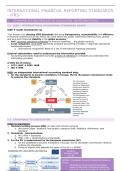
INTERNATIONAL FINANCIAL REPORTING STANDARDS
- IFRS
1 STANDARD SETTING PROCESS TO LEGISLATION- BE/INTERNATIONAL.
1.1 IASB – INTERNATIONAL ACCOUNTING STANDARDS BOARD
IASB maakt standaarden op
“Our mission is to develop IFRS Standards that bring transparency, accountability and efficiency
to financial markets around the world. Our work serves the public interest by fostering trust, growth
and long-term financial stability in the global economy.”
Aim: converge standards worldwide (ie financial reporting … the global economy
Local companies: local GAAP (generally accepted accounting principles = algemeen aanvaarde
boekhoudprincipes)
o International companies? Need for a set of international reporting standards
External stakeholders need to understand the information provided.
Accounting standards (legislation) provide a frame of reference to interpret and understand the
information provided.
A little bit of history:
1973: IASC 2001: IASB
IAS IFRS
IASB: an independant international accounting standard body
for the standards to become mandatory in Europe, the EC (European commission) needs
to endorse the standards.
1.2 STANDARDS TO LEGISLATION
Steps to legislation:
1. Standard setting process IASB: an open and inclusive process
a. discussion paper, feedback, new project, exposure draft, feedback, refinement, new
standard
2. Standards – interpretations
a. IAS / IFRS = standards
b. IFRIC / SIC = interpretations of standards
3. For the EU endorsement by the European commission (EC)
a. for the standards to become mandatory in Europe, the EC (European commission) needs to
endorse the standards.
b. Group of experts who defends the views of the EU => EFRAG
Relation
between IASB
and EC
EFRAG – European Financial Reporting Advisory
Group
- developing and promoting European
views in the field of financial reporting
- ensuring views are properly considered
,1.3 BELGIUM / INTERNATIONAL (EU AND OUTSIDE EU)
1.3.1 BE GAAP (WETGEVING JAARREKENING BELGIË)
Principles in Belgium:
Corporate Law (Dutch: Wetboek vennootschappen en verenigingen – WET = parlement)
Royal Decree (Dutch: Koninklijk Besluit 29/04/2019– uitvoeringsbesluit regering/Koning)
Interpretations (CBN - commissie boekhoudkundige normen)
Application on = all statutory accounts of all companies in BE as well as their consolidated
accounts (choice), except if shares quoted at stock exchange.
1.3.2 BELGIUM / INT . (EU, …)
EU: all companies quoted at stock exchange = IFRS is mandatory (make up consolidated
account),
others = to be decided locally
Current IFRS in the EU: Regulation* (EC) n r. 1126/2008
BE: consolidated financial statements (if not quoted)
= choice! BE GAAP or IFRS decision to made by board of directors (= bestuursorgaan).
BUT! Once IFRS = irrevocable decision, ie for the rest of your reporting days
*A "regulation" (Dutch: verordening) is a binding legislative act. It must be applied in its entirety across
the EU.
2 THE FRAMEWORK (REFERENTIEKADER)
IASB framework - principle based
Objective of financial statements
Underlying assumptions
Qualitative characteristics of FS
Elements of FS
Concept of capital and capital maintenance
The framework is not a standard!, but principles to be applied when developing standards,
and when interpreting standards.
Framework:
sets out the concepts that underlie the financial standards
guides the IASB in developing new and revising existing standards
Ensures internal consistency within the IASB standards
Source for preparers or auditors of FS to interpret standards
2.1 OBJECTIVE OF FINANCIAL STATEMENTS (FS)
To provide information about :
Financial position
Performance
Changes in financial position
of an entity that is useful to a wide range of users in making economic decisions (GPFS General
purpose FS), decisions about providing resources to an entity, evaluating management’s stewardship of
the entity’s resources.
GPFS (general purpose financial statements): a report intended to meet the information needs
that are common toa wide range of users, not able to obtain tailormade reports.
GPFS are not designed to show the value of a reporting entity, but provide information to help…
2.2 UNDERLYING ASSUMPTIONS
Accrual basis : effects of transactions and events are recognized when they occur (and not
cash is received or paid).
(Accrual accounting (= register transactions when they actually happen) <> cash accounting (=
transaction registered as soon as cash received))
, Going Concern : it is assumed the entity has neither the intention nor the need to liquidate materially
the scale of its operations, but will continue in operation for the foreseable future.
If not the case : valuation of assets is based on liquidation value (which gives a complete different
view)
2.3 QUALITATIVE CHARACTERISTICS THAT DETERMINE USEFULNESS FS
Understandability (begrijpbaar): a person with reasonable knowledge should be able to
understand the information presented.
Relevance (relevantie): ONLY material items need to be presented (otherwise ‘ essence gets lost in
details), and ALL material items need to be presented.
Reliability (betrouwbaar): free from material error and bias
Materiality: omission or misstatement could influence economic decisions of users of the
information
Materiële fout
Comparability (vergelijkbaarheid):
comparable through time and across entities (and thus : if other valuation rules etc >>
explain impact in the notes)
Consistancy in presentation from one reporting period to another
2.4 ELEMENTS OF FS : DEFINITION, (DE)RECOGNITION, AND MEASUREMENT
Definition:
Asset: a resource, controlled by the entity, as a result of past events, and of which future economic
benefits are expected to flow to the entity
Liability : a present obligation of the entity, arising from past events, the settlement of which is
expected to result in an outflow from the entity of resources embodying economic benefits
Equity: residual interest in the assets of the entity after deducting all its liabilities.
Income: increase in economic benefits during the accounting period in the form of inflows or
enhancements of assets or decreases of liabilities that results in increases in equity...
Expenses : decreases in economic benefits during the accounting period in the form of outflows or
depletions of assets or incurrences of liabilities that result in decreases in equity…
Recognition in FS if (more than 50% chance that):
Probable that any future economic benefits associated with the item will flow to or from the
entity
That item has a cost or value that can be measured with reliability.
‘Control’ important : links the economic resource to the entity
Measurement:
Historical cost (most common)
Current value (fair value, value in use for assets or fulfilment value for liabilities) (= marktwaarde)
2.5 CONCEPT OF CAPITAL AND CAPITAL MAINTENANCE (VERMOGEN EN
VERMOGENSBEHOUD)
Financial concept of capital : defined in monetary terms as the net assets or equity of the entity.
Physical concept of capital : defined in physical terms as the physical production capacity of the
entity.
Principle difference between the two concepts : effects of changes in the prices of assets and
liabilities of the entity profit or loss through income statement of directly into equity.
Notice : … ROA, ROCE, ROE, … ratios (= winstbegrip gaan plaatsen tegenover input die nodig was
hiervoor)
Any amount over and above that required to maintain the capital at the beginning of the
period is profit.
Under the financial capital maintenance concept : a profit is earned if the financial amount of net
assets at the end of the period exceeds the financial amount of net assets at the beginning of the
period
Thus, increases in the prices of assets (holding gains) are conceptually profits (income statement).
- IFRS
1 STANDARD SETTING PROCESS TO LEGISLATION- BE/INTERNATIONAL.
1.1 IASB – INTERNATIONAL ACCOUNTING STANDARDS BOARD
IASB maakt standaarden op
“Our mission is to develop IFRS Standards that bring transparency, accountability and efficiency
to financial markets around the world. Our work serves the public interest by fostering trust, growth
and long-term financial stability in the global economy.”
Aim: converge standards worldwide (ie financial reporting … the global economy
Local companies: local GAAP (generally accepted accounting principles = algemeen aanvaarde
boekhoudprincipes)
o International companies? Need for a set of international reporting standards
External stakeholders need to understand the information provided.
Accounting standards (legislation) provide a frame of reference to interpret and understand the
information provided.
A little bit of history:
1973: IASC 2001: IASB
IAS IFRS
IASB: an independant international accounting standard body
for the standards to become mandatory in Europe, the EC (European commission) needs
to endorse the standards.
1.2 STANDARDS TO LEGISLATION
Steps to legislation:
1. Standard setting process IASB: an open and inclusive process
a. discussion paper, feedback, new project, exposure draft, feedback, refinement, new
standard
2. Standards – interpretations
a. IAS / IFRS = standards
b. IFRIC / SIC = interpretations of standards
3. For the EU endorsement by the European commission (EC)
a. for the standards to become mandatory in Europe, the EC (European commission) needs to
endorse the standards.
b. Group of experts who defends the views of the EU => EFRAG
Relation
between IASB
and EC
EFRAG – European Financial Reporting Advisory
Group
- developing and promoting European
views in the field of financial reporting
- ensuring views are properly considered
,1.3 BELGIUM / INTERNATIONAL (EU AND OUTSIDE EU)
1.3.1 BE GAAP (WETGEVING JAARREKENING BELGIË)
Principles in Belgium:
Corporate Law (Dutch: Wetboek vennootschappen en verenigingen – WET = parlement)
Royal Decree (Dutch: Koninklijk Besluit 29/04/2019– uitvoeringsbesluit regering/Koning)
Interpretations (CBN - commissie boekhoudkundige normen)
Application on = all statutory accounts of all companies in BE as well as their consolidated
accounts (choice), except if shares quoted at stock exchange.
1.3.2 BELGIUM / INT . (EU, …)
EU: all companies quoted at stock exchange = IFRS is mandatory (make up consolidated
account),
others = to be decided locally
Current IFRS in the EU: Regulation* (EC) n r. 1126/2008
BE: consolidated financial statements (if not quoted)
= choice! BE GAAP or IFRS decision to made by board of directors (= bestuursorgaan).
BUT! Once IFRS = irrevocable decision, ie for the rest of your reporting days
*A "regulation" (Dutch: verordening) is a binding legislative act. It must be applied in its entirety across
the EU.
2 THE FRAMEWORK (REFERENTIEKADER)
IASB framework - principle based
Objective of financial statements
Underlying assumptions
Qualitative characteristics of FS
Elements of FS
Concept of capital and capital maintenance
The framework is not a standard!, but principles to be applied when developing standards,
and when interpreting standards.
Framework:
sets out the concepts that underlie the financial standards
guides the IASB in developing new and revising existing standards
Ensures internal consistency within the IASB standards
Source for preparers or auditors of FS to interpret standards
2.1 OBJECTIVE OF FINANCIAL STATEMENTS (FS)
To provide information about :
Financial position
Performance
Changes in financial position
of an entity that is useful to a wide range of users in making economic decisions (GPFS General
purpose FS), decisions about providing resources to an entity, evaluating management’s stewardship of
the entity’s resources.
GPFS (general purpose financial statements): a report intended to meet the information needs
that are common toa wide range of users, not able to obtain tailormade reports.
GPFS are not designed to show the value of a reporting entity, but provide information to help…
2.2 UNDERLYING ASSUMPTIONS
Accrual basis : effects of transactions and events are recognized when they occur (and not
cash is received or paid).
(Accrual accounting (= register transactions when they actually happen) <> cash accounting (=
transaction registered as soon as cash received))
, Going Concern : it is assumed the entity has neither the intention nor the need to liquidate materially
the scale of its operations, but will continue in operation for the foreseable future.
If not the case : valuation of assets is based on liquidation value (which gives a complete different
view)
2.3 QUALITATIVE CHARACTERISTICS THAT DETERMINE USEFULNESS FS
Understandability (begrijpbaar): a person with reasonable knowledge should be able to
understand the information presented.
Relevance (relevantie): ONLY material items need to be presented (otherwise ‘ essence gets lost in
details), and ALL material items need to be presented.
Reliability (betrouwbaar): free from material error and bias
Materiality: omission or misstatement could influence economic decisions of users of the
information
Materiële fout
Comparability (vergelijkbaarheid):
comparable through time and across entities (and thus : if other valuation rules etc >>
explain impact in the notes)
Consistancy in presentation from one reporting period to another
2.4 ELEMENTS OF FS : DEFINITION, (DE)RECOGNITION, AND MEASUREMENT
Definition:
Asset: a resource, controlled by the entity, as a result of past events, and of which future economic
benefits are expected to flow to the entity
Liability : a present obligation of the entity, arising from past events, the settlement of which is
expected to result in an outflow from the entity of resources embodying economic benefits
Equity: residual interest in the assets of the entity after deducting all its liabilities.
Income: increase in economic benefits during the accounting period in the form of inflows or
enhancements of assets or decreases of liabilities that results in increases in equity...
Expenses : decreases in economic benefits during the accounting period in the form of outflows or
depletions of assets or incurrences of liabilities that result in decreases in equity…
Recognition in FS if (more than 50% chance that):
Probable that any future economic benefits associated with the item will flow to or from the
entity
That item has a cost or value that can be measured with reliability.
‘Control’ important : links the economic resource to the entity
Measurement:
Historical cost (most common)
Current value (fair value, value in use for assets or fulfilment value for liabilities) (= marktwaarde)
2.5 CONCEPT OF CAPITAL AND CAPITAL MAINTENANCE (VERMOGEN EN
VERMOGENSBEHOUD)
Financial concept of capital : defined in monetary terms as the net assets or equity of the entity.
Physical concept of capital : defined in physical terms as the physical production capacity of the
entity.
Principle difference between the two concepts : effects of changes in the prices of assets and
liabilities of the entity profit or loss through income statement of directly into equity.
Notice : … ROA, ROCE, ROE, … ratios (= winstbegrip gaan plaatsen tegenover input die nodig was
hiervoor)
Any amount over and above that required to maintain the capital at the beginning of the
period is profit.
Under the financial capital maintenance concept : a profit is earned if the financial amount of net
assets at the end of the period exceeds the financial amount of net assets at the beginning of the
period
Thus, increases in the prices of assets (holding gains) are conceptually profits (income statement).