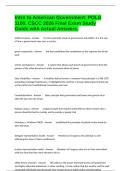
Intro to American Government: POLS
1100. CSCC 2026 Final Exam Study
Guide with Actual Answers.
political science - Answer It is the systematic study of government and politics. It is the way
of how a government rules over a country.
great compromise - Answer this had established the constitution as the supreme law of the
land.
checks and balances - Answer A system that allows each branch of government to limit the
powers of the other branches in order to prevent abuse of power
Shay's Rebellion - Answer A rebellion led by farmers in western Massachusetts in 1786-1787,
protesting mortgage foreclosures. It highlighted the need for a strong national government just
as the call for the Constitutional Convention went out.
Constitutionalism - Answer Basic principle that government and those who govern must
obey the law; the rule of law
Habeus Corpus - Answer a legal principle that requires authorities to show reasons why a
person should be held in custody and to provide a speedy trial
Marubury v. Madison (1803) - Answer established the principle of judicial review made by
John Marshall.
delegate representation model - Answer Members of Congress who attempt to vote
reflecting the views of their constituents.
trustee representation model - Answer Members of Congress who act on their own beliefs
with the view that they were elected to do so.
elitist theory of power - Answer This refers to the power exercised by the well positioned
and highly influential individuals. In other wording, it is the notion that the wealthy and the well
connected individuals exercise power over certain areas of public policy and lawmaking.
,majority rules in the way how policies are being made. It is a term used to describe situations in
which political leaders act on behalf of the majority.
pluralist theory of power - Answer They are the interest groups that can compete with other
groups to form new policies like lobbying, NRS, and Pro Choice organizations. In wording from
the textbook, it is a theory of American politics that holds societies interests are substantially
represented through the activities of groups.
social contract theory - Answer It is the way that people have the right to live free with the
rights to life, liberty, property, and the pursuit of happiness. It is a voluntary agreement among
the people collectively to remove them from the state of nature to form a government that
provides security.
popular sovereignty - Answer People have the right to voice their opinions to the local, state,
and federal government. People have the supreme level of authority, they have their right to
vote, people have the right to elect representatives, senators, the president, the vice president,
and have the right to chat with them about their performance and to get any public policy
changes.
political equality - Answer It is the right of every person to equal protection under the laws
and equal access to society's opportunities and public facilities.
political liberty - Answer This is the principle that individuals should be free to act and think
as they choose, provided that they do not infringe unreasonably on the rights and the freedoms
of others.
John Locke's Theory on political power - Answer He had believed that there had to be limited
government to protect people's individual rights. Citizens are the source of the government
itself. If the government violates the citizen's natural rights, then the people themselves have
the right to take out the government and create a new one. The government acts like a blank
slate and people of the citizenry have to be educated in order to make changes to the
government and public policy.
Thomas Hobbes theory on political power - Answer He had believed that the government
needed to have only one ruler, as he had mentioned the ruler as the Leviathan, the one ruler
made by god to represent all of the people. He also had mentioned that nature is bleak and
humans live like "war against the all"
, constitutional democracy - Answer It is a government that is constitutional in its provisions
for minority rights and its rule by law; democratic in its provisions for the majority influence
through elections; and a republic in its mix of deliberative institutions, which check each other.
tyranny of the majority - Answer This is the potential of the majority to monopolize its
power for its own gain and to the detriment of the minority rights and interests.
Declaration of Independence - Answer This was the document that was made by the
members of the Continental Congress to officially break away with the Country of Great Britain.
This document had stated that "all men are created equal, with certain unalienable rights," and
people have the right to life, liberty, and the pursuit of happiness.
Federalist Papers - Answer They were a series of essays made by Alexander Hamilton, John
Jay, and John Adams had written these essays under the pen name of Publius. These essays had
been about how the government of early America should be run.
supremacy clause - Answer They are the powers that are shared with the states and the
federal government. If the federal government passes a law that conflicts with a state law, the
federal law has the power to override the state law. Makes the constitution have the power of
the supreme law of the land.
necessary and proper clause - Answer This enables Congress to pass special laws to require
other parts of the federal government to prosecute or adjust particular claims. Congress is
allowed to make these changes that are necessary to change the ways of the government for
the better of the country.
federalism - Answer It is a governmental system in which authority is divided between two
sovereign levels of government: national and regional.
state centered federalism - Answer This is where the states create their own laws for the
federal government to interpret. This was the type of federalism under the Articles of
Confederation.
nation centered federalism - Answer It is the belief that the nation is the basis of the federal
system and federal authority was possible and desirable. The federal government can work with
the states and the states can work with the federal government. The federal government and
the state governments are allowed to make their own laws, but if the federal government
makes a law that conflicts with a state law, the federal government's law overrides the state law.
1100. CSCC 2026 Final Exam Study
Guide with Actual Answers.
political science - Answer It is the systematic study of government and politics. It is the way
of how a government rules over a country.
great compromise - Answer this had established the constitution as the supreme law of the
land.
checks and balances - Answer A system that allows each branch of government to limit the
powers of the other branches in order to prevent abuse of power
Shay's Rebellion - Answer A rebellion led by farmers in western Massachusetts in 1786-1787,
protesting mortgage foreclosures. It highlighted the need for a strong national government just
as the call for the Constitutional Convention went out.
Constitutionalism - Answer Basic principle that government and those who govern must
obey the law; the rule of law
Habeus Corpus - Answer a legal principle that requires authorities to show reasons why a
person should be held in custody and to provide a speedy trial
Marubury v. Madison (1803) - Answer established the principle of judicial review made by
John Marshall.
delegate representation model - Answer Members of Congress who attempt to vote
reflecting the views of their constituents.
trustee representation model - Answer Members of Congress who act on their own beliefs
with the view that they were elected to do so.
elitist theory of power - Answer This refers to the power exercised by the well positioned
and highly influential individuals. In other wording, it is the notion that the wealthy and the well
connected individuals exercise power over certain areas of public policy and lawmaking.
,majority rules in the way how policies are being made. It is a term used to describe situations in
which political leaders act on behalf of the majority.
pluralist theory of power - Answer They are the interest groups that can compete with other
groups to form new policies like lobbying, NRS, and Pro Choice organizations. In wording from
the textbook, it is a theory of American politics that holds societies interests are substantially
represented through the activities of groups.
social contract theory - Answer It is the way that people have the right to live free with the
rights to life, liberty, property, and the pursuit of happiness. It is a voluntary agreement among
the people collectively to remove them from the state of nature to form a government that
provides security.
popular sovereignty - Answer People have the right to voice their opinions to the local, state,
and federal government. People have the supreme level of authority, they have their right to
vote, people have the right to elect representatives, senators, the president, the vice president,
and have the right to chat with them about their performance and to get any public policy
changes.
political equality - Answer It is the right of every person to equal protection under the laws
and equal access to society's opportunities and public facilities.
political liberty - Answer This is the principle that individuals should be free to act and think
as they choose, provided that they do not infringe unreasonably on the rights and the freedoms
of others.
John Locke's Theory on political power - Answer He had believed that there had to be limited
government to protect people's individual rights. Citizens are the source of the government
itself. If the government violates the citizen's natural rights, then the people themselves have
the right to take out the government and create a new one. The government acts like a blank
slate and people of the citizenry have to be educated in order to make changes to the
government and public policy.
Thomas Hobbes theory on political power - Answer He had believed that the government
needed to have only one ruler, as he had mentioned the ruler as the Leviathan, the one ruler
made by god to represent all of the people. He also had mentioned that nature is bleak and
humans live like "war against the all"
, constitutional democracy - Answer It is a government that is constitutional in its provisions
for minority rights and its rule by law; democratic in its provisions for the majority influence
through elections; and a republic in its mix of deliberative institutions, which check each other.
tyranny of the majority - Answer This is the potential of the majority to monopolize its
power for its own gain and to the detriment of the minority rights and interests.
Declaration of Independence - Answer This was the document that was made by the
members of the Continental Congress to officially break away with the Country of Great Britain.
This document had stated that "all men are created equal, with certain unalienable rights," and
people have the right to life, liberty, and the pursuit of happiness.
Federalist Papers - Answer They were a series of essays made by Alexander Hamilton, John
Jay, and John Adams had written these essays under the pen name of Publius. These essays had
been about how the government of early America should be run.
supremacy clause - Answer They are the powers that are shared with the states and the
federal government. If the federal government passes a law that conflicts with a state law, the
federal law has the power to override the state law. Makes the constitution have the power of
the supreme law of the land.
necessary and proper clause - Answer This enables Congress to pass special laws to require
other parts of the federal government to prosecute or adjust particular claims. Congress is
allowed to make these changes that are necessary to change the ways of the government for
the better of the country.
federalism - Answer It is a governmental system in which authority is divided between two
sovereign levels of government: national and regional.
state centered federalism - Answer This is where the states create their own laws for the
federal government to interpret. This was the type of federalism under the Articles of
Confederation.
nation centered federalism - Answer It is the belief that the nation is the basis of the federal
system and federal authority was possible and desirable. The federal government can work with
the states and the states can work with the federal government. The federal government and
the state governments are allowed to make their own laws, but if the federal government
makes a law that conflicts with a state law, the federal government's law overrides the state law.