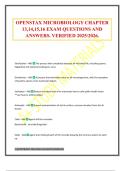
OPENSTAX MICROBIOLOGY CHAPTER
13,14,15,16 EXAM QUESTIONS AND
ANSWERS. VERIFIED 2025/2026.
Sterilization - ANS The process that completely destroys all microbial life, including spores.
Vegetative cell, bacterial endospore, virus
Disinfection - ANS A process that eliminates many or all microorganisms, with the exception
of bacteria spores, from inanimate objects
Sanitation - ANS Reduce microbial load of an inanimate item to safe public health levels
**use heat or antimicrobial{
Antiseptic - ANS Prevent contamination of sterile surface, remove microbes from skin &
tissues
Cidal - ANS Agents kill the microbes
Bactericidal , virucidal,fungicidal
Static - ANS Agent that inhibit growth of the microbe allowing the immune system to catch
up
1 @COPYRIGHT 2025/2026 ALLRIGHTS RESERVED.
, Decimal Reduction Time (DRT) - ANS the time, in minutes, in which 90% of a population of
bacteria at a given temperature will be killed
Methods of microbial control - ANS physical and chemical
Physical methods of microbial control - ANS Exposure to extremes of heat
Exposure to extremes of cold
Desiccation
Filtration
Osmotic pressure
Radiation
Chemical Methods of Microbial Control - ANS concentration of disinfectant, organic matter,
pH, time
Fermentation microbial control - ANS Process by which cells release energy in the absence of
oxygen
osmotic pressure microbial control - ANS uses high concentrations of sugar and salt to inhibit
microbial growth. removes water so microbes cant function
septicemia - ANS growth of bacteria in the blood
Low temperature microbial control - ANS inhibits microbial growth (refrigeration, deep
freezing, lyophilization)
High pressure microbial control - ANS denatures proteins
2 @COPYRIGHT 2025/2026 ALLRIGHTS RESERVED.
13,14,15,16 EXAM QUESTIONS AND
ANSWERS. VERIFIED 2025/2026.
Sterilization - ANS The process that completely destroys all microbial life, including spores.
Vegetative cell, bacterial endospore, virus
Disinfection - ANS A process that eliminates many or all microorganisms, with the exception
of bacteria spores, from inanimate objects
Sanitation - ANS Reduce microbial load of an inanimate item to safe public health levels
**use heat or antimicrobial{
Antiseptic - ANS Prevent contamination of sterile surface, remove microbes from skin &
tissues
Cidal - ANS Agents kill the microbes
Bactericidal , virucidal,fungicidal
Static - ANS Agent that inhibit growth of the microbe allowing the immune system to catch
up
1 @COPYRIGHT 2025/2026 ALLRIGHTS RESERVED.
, Decimal Reduction Time (DRT) - ANS the time, in minutes, in which 90% of a population of
bacteria at a given temperature will be killed
Methods of microbial control - ANS physical and chemical
Physical methods of microbial control - ANS Exposure to extremes of heat
Exposure to extremes of cold
Desiccation
Filtration
Osmotic pressure
Radiation
Chemical Methods of Microbial Control - ANS concentration of disinfectant, organic matter,
pH, time
Fermentation microbial control - ANS Process by which cells release energy in the absence of
oxygen
osmotic pressure microbial control - ANS uses high concentrations of sugar and salt to inhibit
microbial growth. removes water so microbes cant function
septicemia - ANS growth of bacteria in the blood
Low temperature microbial control - ANS inhibits microbial growth (refrigeration, deep
freezing, lyophilization)
High pressure microbial control - ANS denatures proteins
2 @COPYRIGHT 2025/2026 ALLRIGHTS RESERVED.