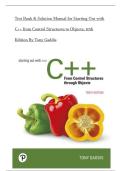
Test Bank & Solution Manual for Starting Out with
C++ from Control Structures to Objects, 10th
Edition By Tony Gaddis
,Test Bank & Solution Manual for Starting Out with C++ from Control Structures to Objects, 10th Edition By
Tony Gaddis
Starting Out with C++ from Control Structures to Objects, 10e (Gaddis)
Chapter 1 Introduction to Computers and Programming
TRUE/FALSE
1. Software engineering is a field that encompasses designing, writing, testing, debugging, documenting,
modifying, and maintaining computer programs.
ANS: T
2. Pseudocode is a form of a program statement that will always evaluate to "false."
ANS: F
3. In programming, the terms "line" and "statement" always mean the same thing.
ANS: F
4. In C++, key words are written in all lowercase letters.
ANS: T
5. The preprocessor executes after the compiler.
ANS: F
6. Machine language is an example of a high-level language.
ANS: F
7. A CPU only understands machine language instructions.
ANS: T
8. Programs are often referred to as hardware.
ANS: F
9. The CPU is the most important component in a computer because without it, the computer could not
run software.
ANS: T
10. The term "bit" stands for binary digit.
ANS: T
,MULTIPLE CHOICE
1. What does the term hardware refer to?
a. The relative difficulty of writing computer programs
b. The physical components that make up a computer
c. The way a computer's storage space is organized
d. The logical flow of instructions
e. None of these
ANS: B
2. A(n) is a set of instructions that the computer follows to solve a problem.
a. compiler
b. linker
c. program
d. operator
e. None of these
ANS: C
3. Computer programs are also known as
a. hardware
b. firmware
c. software
d. Any of these
e. None of these
ANS: C
4. At the heart of a computer is its central processing unit. The CPU's job is:
a. To fetch instructions
b. To carry out the operations commanded by the instructions
c. To produce some outcome or resultant information
d. All of these
e. None of these
ANS: D
5. A computer stores a program while it is running
a. in main memory
b. on a hard disk
c. on the computer monitor
d. in the CPU
e. None of these
ANS: A
6. The decodes an instruction and generates an electronic signal.
a. Arithmetic and Logic Unit
b. Main memory
c. BIOS
d. Control Unit
e. None of these
, ANS: D
7. The CPU's control unit retrieves the next instruction in a sequence of program instructions from main
memory in the stage.
a. fetch
b. decode
c. execute
d. portability
ANS: A
8. During which stage does the central processing unit analyze the instruction and encode it in the form
of a number, and then generate an electronic signal?
a. fetch
b. decode
c. execute
d. portability
ANS: B
9. The two parts of the CPU are
a. the output device and the input device
b. the software and the hardware
c. the Control Unit and the Arithmetic and Logic Unit
d. the single-task device and the multi-task device
e. None of these
ANS: C
10. A volatile type of memory that is used for temporary storage is
a. an address
b. the ALU
c. RAM
d. a disk drive
e. None of these
ANS: C
11. The purpose of a memory address is:
a. to identify the location of a byte in memory
b. to prevent multitasking
c. to obtain an algorithm
d. to improve the speed of processing
e. None of these
ANS: A
12. Programs are normally stored in and loaded into main memory as needed.
a. the input device
b. the output device
c. secondary storage
d. the CPU
C++ from Control Structures to Objects, 10th
Edition By Tony Gaddis
,Test Bank & Solution Manual for Starting Out with C++ from Control Structures to Objects, 10th Edition By
Tony Gaddis
Starting Out with C++ from Control Structures to Objects, 10e (Gaddis)
Chapter 1 Introduction to Computers and Programming
TRUE/FALSE
1. Software engineering is a field that encompasses designing, writing, testing, debugging, documenting,
modifying, and maintaining computer programs.
ANS: T
2. Pseudocode is a form of a program statement that will always evaluate to "false."
ANS: F
3. In programming, the terms "line" and "statement" always mean the same thing.
ANS: F
4. In C++, key words are written in all lowercase letters.
ANS: T
5. The preprocessor executes after the compiler.
ANS: F
6. Machine language is an example of a high-level language.
ANS: F
7. A CPU only understands machine language instructions.
ANS: T
8. Programs are often referred to as hardware.
ANS: F
9. The CPU is the most important component in a computer because without it, the computer could not
run software.
ANS: T
10. The term "bit" stands for binary digit.
ANS: T
,MULTIPLE CHOICE
1. What does the term hardware refer to?
a. The relative difficulty of writing computer programs
b. The physical components that make up a computer
c. The way a computer's storage space is organized
d. The logical flow of instructions
e. None of these
ANS: B
2. A(n) is a set of instructions that the computer follows to solve a problem.
a. compiler
b. linker
c. program
d. operator
e. None of these
ANS: C
3. Computer programs are also known as
a. hardware
b. firmware
c. software
d. Any of these
e. None of these
ANS: C
4. At the heart of a computer is its central processing unit. The CPU's job is:
a. To fetch instructions
b. To carry out the operations commanded by the instructions
c. To produce some outcome or resultant information
d. All of these
e. None of these
ANS: D
5. A computer stores a program while it is running
a. in main memory
b. on a hard disk
c. on the computer monitor
d. in the CPU
e. None of these
ANS: A
6. The decodes an instruction and generates an electronic signal.
a. Arithmetic and Logic Unit
b. Main memory
c. BIOS
d. Control Unit
e. None of these
, ANS: D
7. The CPU's control unit retrieves the next instruction in a sequence of program instructions from main
memory in the stage.
a. fetch
b. decode
c. execute
d. portability
ANS: A
8. During which stage does the central processing unit analyze the instruction and encode it in the form
of a number, and then generate an electronic signal?
a. fetch
b. decode
c. execute
d. portability
ANS: B
9. The two parts of the CPU are
a. the output device and the input device
b. the software and the hardware
c. the Control Unit and the Arithmetic and Logic Unit
d. the single-task device and the multi-task device
e. None of these
ANS: C
10. A volatile type of memory that is used for temporary storage is
a. an address
b. the ALU
c. RAM
d. a disk drive
e. None of these
ANS: C
11. The purpose of a memory address is:
a. to identify the location of a byte in memory
b. to prevent multitasking
c. to obtain an algorithm
d. to improve the speed of processing
e. None of these
ANS: A
12. Programs are normally stored in and loaded into main memory as needed.
a. the input device
b. the output device
c. secondary storage
d. the CPU