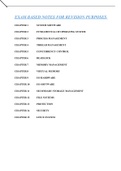
EXAM BASED NOTES FOR REVISION PURPOSES
CHAPTER 1 SYSTEM SOFTWARE
CHAPTER 2 FUNDAMENTAL OF OPERATING SYSTEM
CHAPTER 3 PROCESS MANAGEMENT
CHAPTER 4 THREAD MANAGEMENT
CHAPTER 5 CONCURRENCY CONTROL
CHAPTER 6 DEADLOCK
CHAPTER 7 MEMORY MANAGEMENT
CHAPTER 8 VIRTUAL MEMORY
CHAPTER 9 I/O HARDWARE
CHAPTER 10 I/O SOFTWARE
CHAPTER 11 SECONDARY STORAGE MANAGEMENT
CHAPTER 12 FILE SYSTEMS
CHAPTER 13 PROTECTION
CHAPTER 14 SECURITY
CHAPTER 15 LINUX SYSTEM
, CHAPTER 1
SYSTEM SOFTWARE
Unit Structure
1.0 Objectives
1.1 Introduction
1.2 Operating System
1.2.1 Definition of operating system
1.2.2 Functions of Operating System
1.2.3 Operating System as User Interface
1.3 I/O System Management
1.4 Assembler
1.5 Compiler
1.6 Loader
1.7 History of Operating System
1.8 Summary
1.9 Model Question
,1.0 Objectives
After going through this unit, you will be able to:
Describe Basic Organization of Computer Systems
Define Operating system, functions, history and Evolution
Define assembler, linker, loader, compiler
1.1 Introduction
An operating system act as an intermediary between the user of a computer
and computer hardware. The purpose of an operating system is to provide an
environment in which a user can execute programs in a convenient and efficient
manner.
An operating system is a software that manages the computer hardware. The
hardware must provide appropriate mechanisms to ensure the correct operation of
the computer system and to prevent user programs from interfering with the proper
operation of the system.
1.2 Operating System
1.2.1 Definition of Operating System:
, An Operating system is a program that controls the execution of application
programs and acts as an interface between the user of a computer and the
computer hardware.
A more common definition is that the operating system is the one program
running at all times on the computer (usually called the kernel), with all else
being applications programs.
An Operating system is concerned with the allocation of resources and
services, such as memory, processors, devices and information. The
Operating System correspondingly includes programs to manage these
resources, such as a traffic controller, a scheduler, memory management
module, I/O programs, and a file system.
1.2.2 Functions of Operating System
Operating system performs three functions:
1. Convenience: An OS makes a computer more convenient to use.
2. Efficiency: An OS allows the computer system resources to be used in an
efficient manner.
3. Ability to Evolve: An OS should be constructed in such a way as to permit
the effective development, testing and introduction of new system functions
without at the same time interfering with service.
CHAPTER 1 SYSTEM SOFTWARE
CHAPTER 2 FUNDAMENTAL OF OPERATING SYSTEM
CHAPTER 3 PROCESS MANAGEMENT
CHAPTER 4 THREAD MANAGEMENT
CHAPTER 5 CONCURRENCY CONTROL
CHAPTER 6 DEADLOCK
CHAPTER 7 MEMORY MANAGEMENT
CHAPTER 8 VIRTUAL MEMORY
CHAPTER 9 I/O HARDWARE
CHAPTER 10 I/O SOFTWARE
CHAPTER 11 SECONDARY STORAGE MANAGEMENT
CHAPTER 12 FILE SYSTEMS
CHAPTER 13 PROTECTION
CHAPTER 14 SECURITY
CHAPTER 15 LINUX SYSTEM
, CHAPTER 1
SYSTEM SOFTWARE
Unit Structure
1.0 Objectives
1.1 Introduction
1.2 Operating System
1.2.1 Definition of operating system
1.2.2 Functions of Operating System
1.2.3 Operating System as User Interface
1.3 I/O System Management
1.4 Assembler
1.5 Compiler
1.6 Loader
1.7 History of Operating System
1.8 Summary
1.9 Model Question
,1.0 Objectives
After going through this unit, you will be able to:
Describe Basic Organization of Computer Systems
Define Operating system, functions, history and Evolution
Define assembler, linker, loader, compiler
1.1 Introduction
An operating system act as an intermediary between the user of a computer
and computer hardware. The purpose of an operating system is to provide an
environment in which a user can execute programs in a convenient and efficient
manner.
An operating system is a software that manages the computer hardware. The
hardware must provide appropriate mechanisms to ensure the correct operation of
the computer system and to prevent user programs from interfering with the proper
operation of the system.
1.2 Operating System
1.2.1 Definition of Operating System:
, An Operating system is a program that controls the execution of application
programs and acts as an interface between the user of a computer and the
computer hardware.
A more common definition is that the operating system is the one program
running at all times on the computer (usually called the kernel), with all else
being applications programs.
An Operating system is concerned with the allocation of resources and
services, such as memory, processors, devices and information. The
Operating System correspondingly includes programs to manage these
resources, such as a traffic controller, a scheduler, memory management
module, I/O programs, and a file system.
1.2.2 Functions of Operating System
Operating system performs three functions:
1. Convenience: An OS makes a computer more convenient to use.
2. Efficiency: An OS allows the computer system resources to be used in an
efficient manner.
3. Ability to Evolve: An OS should be constructed in such a way as to permit
the effective development, testing and introduction of new system functions
without at the same time interfering with service.