
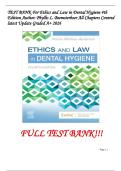
TEST BANK For Ethics and Law in Dental Hygiene 4th
Edition Author: Phyllis L. Beemsterboer All Chapters Covered
latest Update Graded A+ 2026
FULL TEST BANK!!!
Page | 1
,TABLE OF CONTENTS
Section I — Ethics
1. Ethics and Professionalism
2. Ethical Theory and Philosophy
3. Ethical Principles and Values
4. Social Responsibility
5. Codes of Ethics
Appendix 5-1: American Dental Hygienists’ Association Code of Ethics
for Dental Hygienists
6. Ethical Decision Making in Dental Hygiene and Dentistry
Section II — Law
7. Society and the State Dental Practice Act
8. Dental Hygienist–Patient Relationship
9. Dental Hygienist–Dentist-Employer Relationship
10. Risk Management
Section III — Simulations and Applications
Case Studies, Activities, and Testlets
Page | 2
, Chapter 01: Ethics and Professionalism
MULTIPLE CHOICE
1. When was the inception of the profession of dental hygiene?
a. In ancient Greece
b. In the early 1800s
c. In the early 1900s
d. In 1979 CORRECT
ANSWER: C
The scope of practice of a dental hygienist was first established by law in Connecticut in 1915. Alfred C. Fones
taught his dental assistant, Irene Newman, to treat patients and to teach them to maintain their mouths in a clean
state. In 1913, Fones established the first school for dental hygienists in Bridgeport, Connecticut. The first oath
written for dental hygienists called upon Apollo and Hygeia, who were the Greek god and goddess of health,
respectively. A modernized version of the first oath was adopted by the Board of Trustees of the American Dental
Hygienists’ Association (ADHA) in 1979.
DIF: Recall REF: p. 3 OBJ: 1
TOP: 7.0 Professional Responsibility | 7.1 Ethical Principles, including informed consent
2. Which member of the dental team is the primary oral preventive therapist?
a. Dentist
b. Dental hygienist
c. Dental assistant
d. Receptionist
Page | 3
, CORRECT ANSWER: B
The dental hygienist is the oral preventive therapist in the dental office. The dentists who pioneered this special field
of endeavor had a vision of the day when dental disease could be prevented by following a system of treatment and
cleanliness. The dentist is primarily concerned with restorative treatment, although he or she also shares in preventing
oral disease. The dental assistant assists the dentist and may assist the dental hygienist as well. The receptionist
greets patients and may help with the business and financial aspects of the practice.
DIF: Recall REF: p. 4 OBJ: 1
Page | 4
Edition Author: Phyllis L. Beemsterboer All Chapters Covered
latest Update Graded A+ 2026
FULL TEST BANK!!!
Page | 1
,TABLE OF CONTENTS
Section I — Ethics
1. Ethics and Professionalism
2. Ethical Theory and Philosophy
3. Ethical Principles and Values
4. Social Responsibility
5. Codes of Ethics
Appendix 5-1: American Dental Hygienists’ Association Code of Ethics
for Dental Hygienists
6. Ethical Decision Making in Dental Hygiene and Dentistry
Section II — Law
7. Society and the State Dental Practice Act
8. Dental Hygienist–Patient Relationship
9. Dental Hygienist–Dentist-Employer Relationship
10. Risk Management
Section III — Simulations and Applications
Case Studies, Activities, and Testlets
Page | 2
, Chapter 01: Ethics and Professionalism
MULTIPLE CHOICE
1. When was the inception of the profession of dental hygiene?
a. In ancient Greece
b. In the early 1800s
c. In the early 1900s
d. In 1979 CORRECT
ANSWER: C
The scope of practice of a dental hygienist was first established by law in Connecticut in 1915. Alfred C. Fones
taught his dental assistant, Irene Newman, to treat patients and to teach them to maintain their mouths in a clean
state. In 1913, Fones established the first school for dental hygienists in Bridgeport, Connecticut. The first oath
written for dental hygienists called upon Apollo and Hygeia, who were the Greek god and goddess of health,
respectively. A modernized version of the first oath was adopted by the Board of Trustees of the American Dental
Hygienists’ Association (ADHA) in 1979.
DIF: Recall REF: p. 3 OBJ: 1
TOP: 7.0 Professional Responsibility | 7.1 Ethical Principles, including informed consent
2. Which member of the dental team is the primary oral preventive therapist?
a. Dentist
b. Dental hygienist
c. Dental assistant
d. Receptionist
Page | 3
, CORRECT ANSWER: B
The dental hygienist is the oral preventive therapist in the dental office. The dentists who pioneered this special field
of endeavor had a vision of the day when dental disease could be prevented by following a system of treatment and
cleanliness. The dentist is primarily concerned with restorative treatment, although he or she also shares in preventing
oral disease. The dental assistant assists the dentist and may assist the dental hygienist as well. The receptionist
greets patients and may help with the business and financial aspects of the practice.
DIF: Recall REF: p. 4 OBJ: 1
Page | 4


