

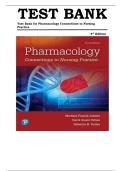
TEST BANK
Test Bank for Pharmacology Connections to Nursing
Practice
4th Edition
ST
O
IC
,Michael Adams & Carol Urban: Pharmacology-Connections to Nursing Practice
Chapter 1
The nurse is teaching a pharmacology class to a group of student nurses. Which key events does the nurse include
in the history of pharmacology?
Note: Credit will be given only if all correct choices and no incorrect choices are selected.
Standard Text: Select all that apply.
1. Early researchers used themselves and animals as test subjects.
2. Pharmacologists began to synthesize drugs in the laboratory in the 20th century.
3. Modern pharmacology began in the mid-1600s.
4. The first drugs included morphine, cocaine, and penicillin.
ST
5. The Dark Ages provided much useful information that we still use today.
Correct Answer: 1,2
Rationale 1: Early researchers did use themselves and animals as test subjects.
O
Rationale 2: Pharmacologists did begin to synthesize drugs in the laboratory in the 20th century.
IC
Rationale 3: Modern pharmacology began in the 1800s, not 1600s.
Rationale 4: The first drugs included morphine and cocaine, but not penicillin.
Rationale 5: Little is known about pharmacology during the Dark Ages.
Global Rationale: The nurse would state that early researchers did use themselves and animals as test subjects;
pharmacologists did begin to synthesize drugs in the laboratory in the 20th century; and modern pharmacology
began in the 1800s, not 1600s. The first drugs included morphine and cocaine, but not penicillin. Little is known
about pharmacology during the Dark Ages.
Question 2
Type: MCSA
Although all areas of medicine, including pharmacology, have made great advances in the last century, the early
roots of pharmacology still apply for the nurse and other health professionals. What were the early roots of
pharmacology?
1. Applying products to relieve human suffering
2. Creating new drugs as quickly as possible
,3. Finding medicinal alternatives to plants
4. Understanding how drugs take their effects
Correct Answer: 1
Rationale 1: The early root of pharmacology was to relieve human suffering.
Rationale 2: The early root of pharmacology was not to create new drugs quickly.
Rationale 3: Early pharmacology involved using plants to relieve symptoms of suffering.
Rationale 4: The early root of pharmacology was not to understand how drugs take their effects.
Global Rationale: The early root of pharmacology was to relieve human suffering, not to create new drugs
quickly or to understand how drugs take their effects. Early pharmacology did involve using plants to relieve
symptoms of suffering.
Question 3
Type: MCSA
ST
Although many substances can be considered drugs, which drug definition is the most appropriate?
1. Any substance that is found in nature or that normally occurs in the body
2. Any substance that is synthesized and tested in the laboratory setting
O
3. Any substance that is taken to prevent, cure, or reduce symptoms of a medical condition
IC
4. Any substance that can be isolated from natural substances in nature
Correct Answer: 3
Rationale 1: A drug is not a substance that is found in nature or that normally occurs in the human body.
Rationale 2: A drug is not only a substance that is synthesized and tested.
Rationale 3: A drug is considered to be any substance that is taken to prevent, cure, or reduce symptoms of a
medical condition.
Rationale 4: A drug is not only a substance isolated from natural substances.
Global Rationale: A drug is considered to be any substance that is taken to prevent, cure, or reduce symptoms of
a medical condition. A drug is not a substance that is found in nature or that normally occurs in the human body; it
is not any substance that is synthesized and tested in the laboratory setting, nor is it only a substance isolated from
natural substances.
Question 4
Type: MCSA
Pharmacotherapy is a critical intervention for many conditions, and a key part of nursing intervention. Which
statement best describes pharmacotherapy?
, 1. The study of medicine and drug therapy
2. The application of natural substances to cure diseases
3. The application of drugs for the prevention and treatment of disease and human suffering
4. Understanding the difference between trade and generic medications
Correct Answer: 3
Rationale 1: Pharmacotherapy is not just the study of medicine and drug therapy.
Rationale 2: Pharmacotherapy is not the application of natural substances to cure diseases.
Rationale 3: Pharmacotherapy is the application of drugs for the prevention and treatment of diseases and human
suffering.
Rationale 4: Pharmacotherapy comprises more than understanding the difference between trade and generic
drugs.
Global Rationale: Pharmacotherapy is the application of drugs for the prevention and treatment of diseases and
human suffering. It is not just the study of medicine and drug therapy nor is it the application of natural substances
ST
to cure diseases. Pharmacotherapy comprises more than understanding the difference between trade and generic
drugs.
Question 5
Type: MCSA
O
Which principle best describes what the nurse is expected to understand when administering medication to a
client?
IC
1. The pharmacotherapeutics for all of the medications
2. The most common side effects of the drug’s prototype
3. The trade and generic names for all of the medications
4. The cost of the drug therapy
Correct Answer: 1
Rationale 1: The nurse should understand the pharmacotherapeutics for all medications that the client is
receiving.
Rationale 2: The nurse should understand much more about a drug than just the common side effects of the
drug’s prototype.
Rationale 3: The nurse should understand much more about a drug than just its trade and generic names.
Rationale 4: The cost of drug therapy is not a principle of drug administration.
Test Bank for Pharmacology Connections to Nursing
Practice
4th Edition
ST
O
IC
,Michael Adams & Carol Urban: Pharmacology-Connections to Nursing Practice
Chapter 1
The nurse is teaching a pharmacology class to a group of student nurses. Which key events does the nurse include
in the history of pharmacology?
Note: Credit will be given only if all correct choices and no incorrect choices are selected.
Standard Text: Select all that apply.
1. Early researchers used themselves and animals as test subjects.
2. Pharmacologists began to synthesize drugs in the laboratory in the 20th century.
3. Modern pharmacology began in the mid-1600s.
4. The first drugs included morphine, cocaine, and penicillin.
ST
5. The Dark Ages provided much useful information that we still use today.
Correct Answer: 1,2
Rationale 1: Early researchers did use themselves and animals as test subjects.
O
Rationale 2: Pharmacologists did begin to synthesize drugs in the laboratory in the 20th century.
IC
Rationale 3: Modern pharmacology began in the 1800s, not 1600s.
Rationale 4: The first drugs included morphine and cocaine, but not penicillin.
Rationale 5: Little is known about pharmacology during the Dark Ages.
Global Rationale: The nurse would state that early researchers did use themselves and animals as test subjects;
pharmacologists did begin to synthesize drugs in the laboratory in the 20th century; and modern pharmacology
began in the 1800s, not 1600s. The first drugs included morphine and cocaine, but not penicillin. Little is known
about pharmacology during the Dark Ages.
Question 2
Type: MCSA
Although all areas of medicine, including pharmacology, have made great advances in the last century, the early
roots of pharmacology still apply for the nurse and other health professionals. What were the early roots of
pharmacology?
1. Applying products to relieve human suffering
2. Creating new drugs as quickly as possible
,3. Finding medicinal alternatives to plants
4. Understanding how drugs take their effects
Correct Answer: 1
Rationale 1: The early root of pharmacology was to relieve human suffering.
Rationale 2: The early root of pharmacology was not to create new drugs quickly.
Rationale 3: Early pharmacology involved using plants to relieve symptoms of suffering.
Rationale 4: The early root of pharmacology was not to understand how drugs take their effects.
Global Rationale: The early root of pharmacology was to relieve human suffering, not to create new drugs
quickly or to understand how drugs take their effects. Early pharmacology did involve using plants to relieve
symptoms of suffering.
Question 3
Type: MCSA
ST
Although many substances can be considered drugs, which drug definition is the most appropriate?
1. Any substance that is found in nature or that normally occurs in the body
2. Any substance that is synthesized and tested in the laboratory setting
O
3. Any substance that is taken to prevent, cure, or reduce symptoms of a medical condition
IC
4. Any substance that can be isolated from natural substances in nature
Correct Answer: 3
Rationale 1: A drug is not a substance that is found in nature or that normally occurs in the human body.
Rationale 2: A drug is not only a substance that is synthesized and tested.
Rationale 3: A drug is considered to be any substance that is taken to prevent, cure, or reduce symptoms of a
medical condition.
Rationale 4: A drug is not only a substance isolated from natural substances.
Global Rationale: A drug is considered to be any substance that is taken to prevent, cure, or reduce symptoms of
a medical condition. A drug is not a substance that is found in nature or that normally occurs in the human body; it
is not any substance that is synthesized and tested in the laboratory setting, nor is it only a substance isolated from
natural substances.
Question 4
Type: MCSA
Pharmacotherapy is a critical intervention for many conditions, and a key part of nursing intervention. Which
statement best describes pharmacotherapy?
, 1. The study of medicine and drug therapy
2. The application of natural substances to cure diseases
3. The application of drugs for the prevention and treatment of disease and human suffering
4. Understanding the difference between trade and generic medications
Correct Answer: 3
Rationale 1: Pharmacotherapy is not just the study of medicine and drug therapy.
Rationale 2: Pharmacotherapy is not the application of natural substances to cure diseases.
Rationale 3: Pharmacotherapy is the application of drugs for the prevention and treatment of diseases and human
suffering.
Rationale 4: Pharmacotherapy comprises more than understanding the difference between trade and generic
drugs.
Global Rationale: Pharmacotherapy is the application of drugs for the prevention and treatment of diseases and
human suffering. It is not just the study of medicine and drug therapy nor is it the application of natural substances
ST
to cure diseases. Pharmacotherapy comprises more than understanding the difference between trade and generic
drugs.
Question 5
Type: MCSA
O
Which principle best describes what the nurse is expected to understand when administering medication to a
client?
IC
1. The pharmacotherapeutics for all of the medications
2. The most common side effects of the drug’s prototype
3. The trade and generic names for all of the medications
4. The cost of the drug therapy
Correct Answer: 1
Rationale 1: The nurse should understand the pharmacotherapeutics for all medications that the client is
receiving.
Rationale 2: The nurse should understand much more about a drug than just the common side effects of the
drug’s prototype.
Rationale 3: The nurse should understand much more about a drug than just its trade and generic names.
Rationale 4: The cost of drug therapy is not a principle of drug administration.


