

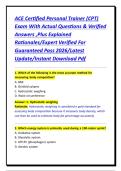
ACE Certified Personal Trainer (CPT)
Exam With Actual Questions & Verified
Answers ,Plus Explained
Rationales/Expert Verified For
Guaranteed Pass 2026/Latest
Update/Instant Download Pdf
1. Which of the following is the most accurate method for
measuring body composition?
A. BMI
B. Skinfold calipers
C. Hydrostatic weighing
D. Waist circumference
Answer: C. Hydrostatic weighing
Rationale: Hydrostatic weighing is considered a gold standard for
assessing body composition because it measures body density, which
can then be used to estimate body fat percentage accurately.
2. Which energy system is primarily used during a 100-meter sprint?
A. Oxidative system
B. Glycolytic system
C. ATP-PC (phosphagen) system
D. Aerobic system
,Answer: C. ATP-PC (phosphagen) system
Rationale: The ATP-PC system provides immediate energy for high-
intensity, short-duration activities lasting up to 10 seconds, such as a
100-meter sprint.
3. Which of the following is an example of a closed-chain exercise?
A. Leg extension
B. Leg press
C. Bicep curl
D. Bench press
Answer: B. Leg press
Rationale: Closed-chain exercises involve movements where the distal
segment (hands or feet) is fixed, as in a leg press or squat.
4. What is the primary function of slow-twitch muscle fibers (Type
I)?
A. Generate maximal force quickly
B. Support aerobic endurance
C. Fatigue rapidly
D. Produce high-intensity power
Answer: B. Support aerobic endurance
Rationale: Type I fibers are oxidative, resistant to fatigue, and ideal
for prolonged aerobic activities.
5. What is the recommended frequency of cardiovascular exercise
for general health according to the ACE guidelines?
A. 1–2 days per week
B. 3–5 days per week
,C. 6–7 days per week
D. Daily, with no rest
Answer: B. 3–5 days per week
Rationale: ACE recommends 3–5 days per week of moderate-intensity
cardiovascular activity for overall health benefits.
6. Which of the following is a contraindication for resistance
training?
A. Mild muscle soreness
B. Uncontrolled hypertension
C. Proper warm-up performed
D. Recent low-intensity exercise
Answer: B. Uncontrolled hypertension
Rationale: Clients with uncontrolled hypertension may be at
increased risk of cardiovascular events during resistance training,
making it a contraindication.
7. Which principle refers to gradually increasing stress to stimulate
adaptation?
A. Specificity
B. Overload
C. Reversibility
D. Individualization
Answer: B. Overload
Rationale: The overload principle states that to improve fitness, the
body must be challenged beyond its usual level.
, 8. Which of the following heart rate calculations estimates
maximum heart rate?
A. 220 − age
B. 200 − age
C. 180 − age
D. 210 − age
Answer: A. 220 − age
Rationale: The traditional method for estimating maximum heart
rate is 220 minus the individual's age.
9. A client performing a squat correctly demonstrates which
movement at the knee?
A. Flexion during descent, extension during ascent
B. Extension during descent, flexion during ascent
C. Only flexion
D. Only extension
Answer: A. Flexion during descent, extension during ascent
Rationale: During a squat, the knees flex as the client lowers and
extend as the client rises.
10. What is the primary role of carbohydrates in exercise
performance?
A. Build muscle tissue
B. Provide quick energy
C. Enhance flexibility
D. Reduce joint stress
Exam With Actual Questions & Verified
Answers ,Plus Explained
Rationales/Expert Verified For
Guaranteed Pass 2026/Latest
Update/Instant Download Pdf
1. Which of the following is the most accurate method for
measuring body composition?
A. BMI
B. Skinfold calipers
C. Hydrostatic weighing
D. Waist circumference
Answer: C. Hydrostatic weighing
Rationale: Hydrostatic weighing is considered a gold standard for
assessing body composition because it measures body density, which
can then be used to estimate body fat percentage accurately.
2. Which energy system is primarily used during a 100-meter sprint?
A. Oxidative system
B. Glycolytic system
C. ATP-PC (phosphagen) system
D. Aerobic system
,Answer: C. ATP-PC (phosphagen) system
Rationale: The ATP-PC system provides immediate energy for high-
intensity, short-duration activities lasting up to 10 seconds, such as a
100-meter sprint.
3. Which of the following is an example of a closed-chain exercise?
A. Leg extension
B. Leg press
C. Bicep curl
D. Bench press
Answer: B. Leg press
Rationale: Closed-chain exercises involve movements where the distal
segment (hands or feet) is fixed, as in a leg press or squat.
4. What is the primary function of slow-twitch muscle fibers (Type
I)?
A. Generate maximal force quickly
B. Support aerobic endurance
C. Fatigue rapidly
D. Produce high-intensity power
Answer: B. Support aerobic endurance
Rationale: Type I fibers are oxidative, resistant to fatigue, and ideal
for prolonged aerobic activities.
5. What is the recommended frequency of cardiovascular exercise
for general health according to the ACE guidelines?
A. 1–2 days per week
B. 3–5 days per week
,C. 6–7 days per week
D. Daily, with no rest
Answer: B. 3–5 days per week
Rationale: ACE recommends 3–5 days per week of moderate-intensity
cardiovascular activity for overall health benefits.
6. Which of the following is a contraindication for resistance
training?
A. Mild muscle soreness
B. Uncontrolled hypertension
C. Proper warm-up performed
D. Recent low-intensity exercise
Answer: B. Uncontrolled hypertension
Rationale: Clients with uncontrolled hypertension may be at
increased risk of cardiovascular events during resistance training,
making it a contraindication.
7. Which principle refers to gradually increasing stress to stimulate
adaptation?
A. Specificity
B. Overload
C. Reversibility
D. Individualization
Answer: B. Overload
Rationale: The overload principle states that to improve fitness, the
body must be challenged beyond its usual level.
, 8. Which of the following heart rate calculations estimates
maximum heart rate?
A. 220 − age
B. 200 − age
C. 180 − age
D. 210 − age
Answer: A. 220 − age
Rationale: The traditional method for estimating maximum heart
rate is 220 minus the individual's age.
9. A client performing a squat correctly demonstrates which
movement at the knee?
A. Flexion during descent, extension during ascent
B. Extension during descent, flexion during ascent
C. Only flexion
D. Only extension
Answer: A. Flexion during descent, extension during ascent
Rationale: During a squat, the knees flex as the client lowers and
extend as the client rises.
10. What is the primary role of carbohydrates in exercise
performance?
A. Build muscle tissue
B. Provide quick energy
C. Enhance flexibility
D. Reduce joint stress


