
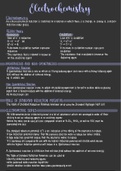
Electrochemistry
Electrochemistry
An electrochemical reaction is classified as a reaction in which there is a change in charge ie . a REDOX
reaction takes place .
RED X Theory
Reduction Oxidation
Gain of is reduction Loss of e- is oxidation
-
e
•
A Xt te
-
A X
-
e OR
-
t
' a
-
Bt t B I It e
-
e
° -
•
A decrease in oxidation number represents A increase in oxidation number represents
•
'
reduction oxidation
The substance that is reduced is The substance that is oxidised is known the
• °
known as as
as the oxidising agent Reducing agent
Spontaneous and non-spontaneous
spontaneous Reaction
A spontaneous reaction is one in which a strong oxidising agent OA reacts with a strong reducing agent
RA without the addition of external energy .
eg A voltaic cell
.
Non -
Spontaneous Reaction
A non spontaneous reaction is one in which an oxidising agent OA is forced to oxidise while
-
a reducing
agent RA is forced to reduce with the addition of external energy .
eg An electrolytic cell
.
Table of standard reduction potential
the table of Standard Reduction Potentials have been set up using the Standard Hydrogen Half cell .
Electromotive series
•
An et et ro motive series reactivity series is a list of substances which are arranged in order of their
ability to act as reducing agents or as oxidising agents .
•
Before the table can be used all ionic compounds as well as H2S 04 HN Os as well as HCl must be
, ,,
dissociated into ions .
The standard reduction potential Eo is an indication of the ability of the substance to reduce .
A low reduction potential implies that the substance does not want to reduce but rather oxidise
•
.
A high reduction potential implies that the substance wants to reduce
•
It 2 substances compared the one with the highest reduction potential will oxidise while the one
•
are
with the highest reduction potential will reduce in a spontaneous reaction .
A spontaneous reaction is a reaction that will take place without the addition of external energy .
The Table of Standard Reduction Potentials can be used to :
identify oxidising and reducing agents
•
write balanced redox reaction equations
predict whether a redox reaction takes place spontaneously or not
•
Electrochemistry
An electrochemical reaction is classified as a reaction in which there is a change in charge ie . a REDOX
reaction takes place .
RED X Theory
Reduction Oxidation
Gain of is reduction Loss of e- is oxidation
-
e
•
A Xt te
-
A X
-
e OR
-
t
' a
-
Bt t B I It e
-
e
° -
•
A decrease in oxidation number represents A increase in oxidation number represents
•
'
reduction oxidation
The substance that is reduced is The substance that is oxidised is known the
• °
known as as
as the oxidising agent Reducing agent
Spontaneous and non-spontaneous
spontaneous Reaction
A spontaneous reaction is one in which a strong oxidising agent OA reacts with a strong reducing agent
RA without the addition of external energy .
eg A voltaic cell
.
Non -
Spontaneous Reaction
A non spontaneous reaction is one in which an oxidising agent OA is forced to oxidise while
-
a reducing
agent RA is forced to reduce with the addition of external energy .
eg An electrolytic cell
.
Table of standard reduction potential
the table of Standard Reduction Potentials have been set up using the Standard Hydrogen Half cell .
Electromotive series
•
An et et ro motive series reactivity series is a list of substances which are arranged in order of their
ability to act as reducing agents or as oxidising agents .
•
Before the table can be used all ionic compounds as well as H2S 04 HN Os as well as HCl must be
, ,,
dissociated into ions .
The standard reduction potential Eo is an indication of the ability of the substance to reduce .
A low reduction potential implies that the substance does not want to reduce but rather oxidise
•
.
A high reduction potential implies that the substance wants to reduce
•
It 2 substances compared the one with the highest reduction potential will oxidise while the one
•
are
with the highest reduction potential will reduce in a spontaneous reaction .
A spontaneous reaction is a reaction that will take place without the addition of external energy .
The Table of Standard Reduction Potentials can be used to :
identify oxidising and reducing agents
•
write balanced redox reaction equations
predict whether a redox reaction takes place spontaneously or not
•


