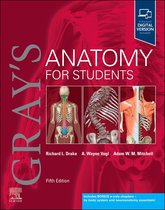
GRAY'S ANATOMY FOR STUDENTS
5TH EDITION
• AUTHOR(S)RICHARD L. DRAKE
TEST BANK
1
Reference
Ch. 1 — The Body — What is anatomy?
Stem (2–4 sentences)
A 58-year-old patient presents after a fall with progressively
increasing difficulty performing coordinated hand movements
on the affected side. The clinician suspects a lesion that
interrupts the relationship between structural components
responsible for fine motor control. Based on anatomical
reasoning, which description most appropriately links
anatomical levels to the observed functional impairment?
Options
A. A lesion confined to the synovial capsule of the wrist will
impair central motor planning and coordinated hand
movement.
,B. Damage to the corticospinal fibers in the internal capsule can
disrupt upper motor neuron influence over distal limb muscles,
causing impaired fine motor coordination.
C. A pathology limited to the distal phalanx will alter cortical
somatotopy and produce loss of coordinated hand movements.
D. Disruption of the skin dermatomes overlying the hand will
abolish voluntary motor output and coordinated movement.
Correct answer
B
Rationales
Correct (B): Damage to corticospinal fibers in the internal
capsule interrupts descending upper motor neuron signals to
spinal motor circuits controlling distal limb musculature,
producing weakness, loss of dexterity, and impaired fine motor
coordination—this links system (central nervous system) →
structure (internal capsule) → function (motor control). This
interpretation aligns with Gray’s emphasis on hierarchical
anatomy (organ systems → tissues → cells) and structure–
function relationships. Google Books
Incorrect (A): A synovial capsule lesion causes local joint
pain/stiffness but does not disrupt central motor pathways
responsible for motor planning.
Incorrect (C): Distal phalanx injury is peripheral and will affect
local mechanics/sensation; it does not reorganize cortical
somatotopy sufficiently to explain new, generalized loss of
coordinated hand movement.
,Incorrect (D): Dermatomal skin disruption affects sensory input;
while sensory loss can modify coordination, it does not abolish
voluntary motor output by itself.
Teaching point
Link lesion location in CNS to impairments in distal motor
function.
Citation (Simplified APA)
Drake, R. L. (2024). Gray’s Anatomy for Students (5th Ed.). Ch. 1.
Google Books
2
Reference
Ch. 1 — The Body — What is anatomy?
Stem
During bedside teaching, a student is asked to explain why
understanding microstructure (histology) is essential when
predicting tissue response to ischemia. Which reasoning best
connects anatomical scale to a physiologic outcome?
Options
A. Knowledge of tissue gross shape alone is sufficient to predict
cellular tolerance to hypoxia.
B. Understanding capillary density and cell metabolic demands
at microscopic level predicts regional susceptibility to ischemic
injury.
C. Only organ-level vascular supply maps (large arteries)
, determine ischemic vulnerability; microstructure is irrelevant.
D. Surface anatomy accurately indicates microvascular
distribution and thus ischemic risk.
Correct answer
B
Rationales
Correct (B): Microstructural features such as capillary density,
cell type, and metabolic rate determine oxygen delivery and
consumption at the tissue level—this anatomy-to-physiology
link explains why some tissues tolerate ischemia better (e.g.,
cartilage vs. myocardium). Gray’s underscores that different
anatomical scales inform functional predictions. Google Books
Incorrect (A): Gross shape alone misses critical microvascular
and cellular determinants of ischemic tolerance.
Incorrect (C): Large-vessel anatomy is important but
insufficient—microcirculation defines tissue-level oxygen
delivery.
Incorrect (D): Surface anatomy does not reliably reflect
microvascular density.
Teaching point
Microstructure (capillary density, cell type) predicts regional
ischemic vulnerability.
Citation (Simplified APA)
Drake, R. L. (2024). Gray’s Anatomy for Students (5th Ed.). Ch. 1.
Google Books
5TH EDITION
• AUTHOR(S)RICHARD L. DRAKE
TEST BANK
1
Reference
Ch. 1 — The Body — What is anatomy?
Stem (2–4 sentences)
A 58-year-old patient presents after a fall with progressively
increasing difficulty performing coordinated hand movements
on the affected side. The clinician suspects a lesion that
interrupts the relationship between structural components
responsible for fine motor control. Based on anatomical
reasoning, which description most appropriately links
anatomical levels to the observed functional impairment?
Options
A. A lesion confined to the synovial capsule of the wrist will
impair central motor planning and coordinated hand
movement.
,B. Damage to the corticospinal fibers in the internal capsule can
disrupt upper motor neuron influence over distal limb muscles,
causing impaired fine motor coordination.
C. A pathology limited to the distal phalanx will alter cortical
somatotopy and produce loss of coordinated hand movements.
D. Disruption of the skin dermatomes overlying the hand will
abolish voluntary motor output and coordinated movement.
Correct answer
B
Rationales
Correct (B): Damage to corticospinal fibers in the internal
capsule interrupts descending upper motor neuron signals to
spinal motor circuits controlling distal limb musculature,
producing weakness, loss of dexterity, and impaired fine motor
coordination—this links system (central nervous system) →
structure (internal capsule) → function (motor control). This
interpretation aligns with Gray’s emphasis on hierarchical
anatomy (organ systems → tissues → cells) and structure–
function relationships. Google Books
Incorrect (A): A synovial capsule lesion causes local joint
pain/stiffness but does not disrupt central motor pathways
responsible for motor planning.
Incorrect (C): Distal phalanx injury is peripheral and will affect
local mechanics/sensation; it does not reorganize cortical
somatotopy sufficiently to explain new, generalized loss of
coordinated hand movement.
,Incorrect (D): Dermatomal skin disruption affects sensory input;
while sensory loss can modify coordination, it does not abolish
voluntary motor output by itself.
Teaching point
Link lesion location in CNS to impairments in distal motor
function.
Citation (Simplified APA)
Drake, R. L. (2024). Gray’s Anatomy for Students (5th Ed.). Ch. 1.
Google Books
2
Reference
Ch. 1 — The Body — What is anatomy?
Stem
During bedside teaching, a student is asked to explain why
understanding microstructure (histology) is essential when
predicting tissue response to ischemia. Which reasoning best
connects anatomical scale to a physiologic outcome?
Options
A. Knowledge of tissue gross shape alone is sufficient to predict
cellular tolerance to hypoxia.
B. Understanding capillary density and cell metabolic demands
at microscopic level predicts regional susceptibility to ischemic
injury.
C. Only organ-level vascular supply maps (large arteries)
, determine ischemic vulnerability; microstructure is irrelevant.
D. Surface anatomy accurately indicates microvascular
distribution and thus ischemic risk.
Correct answer
B
Rationales
Correct (B): Microstructural features such as capillary density,
cell type, and metabolic rate determine oxygen delivery and
consumption at the tissue level—this anatomy-to-physiology
link explains why some tissues tolerate ischemia better (e.g.,
cartilage vs. myocardium). Gray’s underscores that different
anatomical scales inform functional predictions. Google Books
Incorrect (A): Gross shape alone misses critical microvascular
and cellular determinants of ischemic tolerance.
Incorrect (C): Large-vessel anatomy is important but
insufficient—microcirculation defines tissue-level oxygen
delivery.
Incorrect (D): Surface anatomy does not reliably reflect
microvascular density.
Teaching point
Microstructure (capillary density, cell type) predicts regional
ischemic vulnerability.
Citation (Simplified APA)
Drake, R. L. (2024). Gray’s Anatomy for Students (5th Ed.). Ch. 1.
Google Books