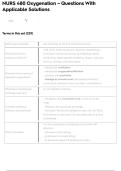
NURS 480 Oxygenation – Questions With
Applicable Solutions
Save
Terms in this set (229)
Define gas exchange the exchange of O2 and CO2 at the alveoli
SOB, DOR, DOE, tachypnea, dyspnea, nasal flaring,
What are the s/s of accessory muscle use, pursed lip breathing, tripod
respiratory distress? positioning, diaphragmatic breathing, fatigue, cyanosis,
anxious, restless, confused, pallor
- inadequate ventilation
- inadequate oxygenation/diffusion
What are some causes of
- problem with perfusion
impaired oxygenation?
- damage at alveolar level (decreased surfactant,
excess fluid, infection i.e pus, exudate, consolidation)
What does impaired gas s/s of respiratory distress
exchange look like?
- Ventilation: the movement of air in and out of the
lungs
Contrast ventilation, - Diffusion: the actual gas exchange
diffusion, and perfusion - Perfusion: The blood available to carry O2 rich RBCs
from alveoli to cells and CO2 saturated cells to alveoli
to eliminate
It is the combination of ipratropium bromide with
albuterol.
What is DuoNeb? - albuterol is short acting
- ipratropium is longer acting
- as albuterol wears off, ipratropium peaks
, - low phos; weakened diaphragm muscles
- fibrotic lungs
What are some conditions - damaged thoracic cage
that lead to ventilation - brain injury
problems? - poor neuro status
- respiratory disease
- fatigue/anxiety
- Low Hb (like in CKD)
What are some conditions
- inability of Hb to bind with O2 (high vs low affinity);
leading to oxygen
seen with carbon monoxide
transport problems?
- sickle cell
1. combustion
2. oxygen-induced hypoventilation (reason why we
don't want COPD patients at 100% O2)
Know some of the
3. oxygen toxicity
complications of O2
4. Absorption atelectasis (new onset of
delivery
crackles/decreased breath sounds)
5. Drying of mucous membranes
6. Infection (keep nasal cannula clean)
What is absorption New onset of crackles/decreased breath sounds
atelectasis? following O2 delivery
What is hypercarbia? retention of CO2
What is CO2 narcosis? Loss of sensitivity to high levels of CO2
- nasal cannula
List the noninvasive - face mask (simple, partial, nonrebreather)
methods of supplemental - High flow nasal cannula (vapotherm)
O2 - venturi mask
- BiPap and CPap
What are some nursing mobility, epistaxis, pressure ulcers
considerations for high flow
nasal cannula?
, •Respiratory diseases
•Neuromuscular diseases
•Diaphragmatic weakness
•Bronchiolitis
•Pneumonia
•Sleep-related breathing disorders
What kinds of patients need •Obstructive sleep apnea syndrome
BiPAP or CPAP? •Hypoxia
•Hypercapnia
•Acute respiratory failure
•Acute asthma
•Cystic fibrosis
•Alternative to intubation, if applicable, or as support
after intubation
CPAP: delivers same pressures on inspiration and
expiration
CPAP vs. BiPAP
BiPAP: High pressures with inspiration, lower pressures
with expiration
• respiratory arrest
• apnea
• uncontrolled vomiting
What are the absolute • inability to protect the airway
contraindications for • untreated pneumothorax
CPAP? • acute upper gastrointestinal bleeding
• recent gastric, laryngeal, or esophageal surgery
• facial or airway trauma.
• sometimes hemodynamic instability
(Artificial/invasive airways)
- endotracheal tube
List the invasive
- nasotracheal tube
supplemental O2
- tracheostomy
- laryngeal mask airway (LMA)
What are the advantages of no tracheal injury during tube installation and removal,
LMA compared to tracheal less airway stimulation, less invasion of the airway tissue,
intubation? easier installation, and efficient establishment
Applicable Solutions
Save
Terms in this set (229)
Define gas exchange the exchange of O2 and CO2 at the alveoli
SOB, DOR, DOE, tachypnea, dyspnea, nasal flaring,
What are the s/s of accessory muscle use, pursed lip breathing, tripod
respiratory distress? positioning, diaphragmatic breathing, fatigue, cyanosis,
anxious, restless, confused, pallor
- inadequate ventilation
- inadequate oxygenation/diffusion
What are some causes of
- problem with perfusion
impaired oxygenation?
- damage at alveolar level (decreased surfactant,
excess fluid, infection i.e pus, exudate, consolidation)
What does impaired gas s/s of respiratory distress
exchange look like?
- Ventilation: the movement of air in and out of the
lungs
Contrast ventilation, - Diffusion: the actual gas exchange
diffusion, and perfusion - Perfusion: The blood available to carry O2 rich RBCs
from alveoli to cells and CO2 saturated cells to alveoli
to eliminate
It is the combination of ipratropium bromide with
albuterol.
What is DuoNeb? - albuterol is short acting
- ipratropium is longer acting
- as albuterol wears off, ipratropium peaks
, - low phos; weakened diaphragm muscles
- fibrotic lungs
What are some conditions - damaged thoracic cage
that lead to ventilation - brain injury
problems? - poor neuro status
- respiratory disease
- fatigue/anxiety
- Low Hb (like in CKD)
What are some conditions
- inability of Hb to bind with O2 (high vs low affinity);
leading to oxygen
seen with carbon monoxide
transport problems?
- sickle cell
1. combustion
2. oxygen-induced hypoventilation (reason why we
don't want COPD patients at 100% O2)
Know some of the
3. oxygen toxicity
complications of O2
4. Absorption atelectasis (new onset of
delivery
crackles/decreased breath sounds)
5. Drying of mucous membranes
6. Infection (keep nasal cannula clean)
What is absorption New onset of crackles/decreased breath sounds
atelectasis? following O2 delivery
What is hypercarbia? retention of CO2
What is CO2 narcosis? Loss of sensitivity to high levels of CO2
- nasal cannula
List the noninvasive - face mask (simple, partial, nonrebreather)
methods of supplemental - High flow nasal cannula (vapotherm)
O2 - venturi mask
- BiPap and CPap
What are some nursing mobility, epistaxis, pressure ulcers
considerations for high flow
nasal cannula?
, •Respiratory diseases
•Neuromuscular diseases
•Diaphragmatic weakness
•Bronchiolitis
•Pneumonia
•Sleep-related breathing disorders
What kinds of patients need •Obstructive sleep apnea syndrome
BiPAP or CPAP? •Hypoxia
•Hypercapnia
•Acute respiratory failure
•Acute asthma
•Cystic fibrosis
•Alternative to intubation, if applicable, or as support
after intubation
CPAP: delivers same pressures on inspiration and
expiration
CPAP vs. BiPAP
BiPAP: High pressures with inspiration, lower pressures
with expiration
• respiratory arrest
• apnea
• uncontrolled vomiting
What are the absolute • inability to protect the airway
contraindications for • untreated pneumothorax
CPAP? • acute upper gastrointestinal bleeding
• recent gastric, laryngeal, or esophageal surgery
• facial or airway trauma.
• sometimes hemodynamic instability
(Artificial/invasive airways)
- endotracheal tube
List the invasive
- nasotracheal tube
supplemental O2
- tracheostomy
- laryngeal mask airway (LMA)
What are the advantages of no tracheal injury during tube installation and removal,
LMA compared to tracheal less airway stimulation, less invasion of the airway tissue,
intubation? easier installation, and efficient establishment