MDC III Exam 2 Study Guide: Respiratory
Disorders EXAM 2025 COMPLETE EXAM
QUESTIONS AND ACCURATE ANSWERS
|ALREADY PASSED!!
Save
Practice questions for this set
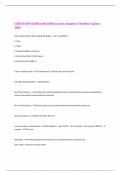
Learn 1 /7 Study with Learn
Disrupt inflammatory mediator production in airways.
Choose an answer
1 Gas Exchange 2 Course Crackles
3 Corticosteroids 4 Tuberculosis Testing
Don't know?
Terms in this set (185)
, Oxygen and carbon dioxide
transport via ventilation and
Gas Exchange
diffusion.
Perfusion Arterial blood flow from heart to tissues.
Central Perfusion Oxygenation of major body organs by blood.
Peripheral Perfusion Blood flow to peripheral tissues from heart.
Lung Sounds Normal breath sounds indicating respiratory health.
Bronchial Sounds Heard over larger airways near sternum.
Broncho Vesicular Sounds Softer sounds between 1st and 2nd interspaces.
Vesicular Sounds Normal sounds over most lung fields.
Adventitious Sounds Abnormal lung sounds indicating respiratory issues.
Rales Crackling sounds from fluid in smaller airways.
Ronchi Snoring sounds from mucus in larger airways.
Wheeze High-pitched sound from bronchial restriction.
Course Crackles Lower pitched sounds cleared by coughing.
Stridor High-pitched sound from upper airway obstruction.
Cyanosis, accessory muscle use, and tripod
Respiratory Distress Signs
positioning.
ABG Normal Ranges pH: 7.35-7.45, PaCO₂: 35-45, HCO₃: 21-28.
Acidosis Blood pH below normal range.
Alkalosis Blood pH above normal range.
Respiratory Acidosis Decreased pH with increased CO₂ levels.
PaO₂ Normal Range Normal levels are 80-100 mmHg.
SpO₂ Normal Range Normal oxygen saturation is at least 95%.
Disorders EXAM 2025 COMPLETE EXAM
QUESTIONS AND ACCURATE ANSWERS
|ALREADY PASSED!!
Save
Practice questions for this set
Learn 1 /7 Study with Learn
Disrupt inflammatory mediator production in airways.
Choose an answer
1 Gas Exchange 2 Course Crackles
3 Corticosteroids 4 Tuberculosis Testing
Don't know?
Terms in this set (185)
, Oxygen and carbon dioxide
transport via ventilation and
Gas Exchange
diffusion.
Perfusion Arterial blood flow from heart to tissues.
Central Perfusion Oxygenation of major body organs by blood.
Peripheral Perfusion Blood flow to peripheral tissues from heart.
Lung Sounds Normal breath sounds indicating respiratory health.
Bronchial Sounds Heard over larger airways near sternum.
Broncho Vesicular Sounds Softer sounds between 1st and 2nd interspaces.
Vesicular Sounds Normal sounds over most lung fields.
Adventitious Sounds Abnormal lung sounds indicating respiratory issues.
Rales Crackling sounds from fluid in smaller airways.
Ronchi Snoring sounds from mucus in larger airways.
Wheeze High-pitched sound from bronchial restriction.
Course Crackles Lower pitched sounds cleared by coughing.
Stridor High-pitched sound from upper airway obstruction.
Cyanosis, accessory muscle use, and tripod
Respiratory Distress Signs
positioning.
ABG Normal Ranges pH: 7.35-7.45, PaCO₂: 35-45, HCO₃: 21-28.
Acidosis Blood pH below normal range.
Alkalosis Blood pH above normal range.
Respiratory Acidosis Decreased pH with increased CO₂ levels.
PaO₂ Normal Range Normal levels are 80-100 mmHg.
SpO₂ Normal Range Normal oxygen saturation is at least 95%.