

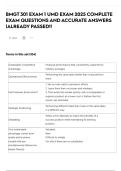
BMGT 301 EXAM 1 UMD EXAM 2025 COMPLETE
EXAM QUESTIONS AND ACCURATE ANSWERS
|ALREADY PASSED!!
Save
Terms in this set (104)
Sustainable Competitive Financial performance that consistently outperforms
Advantage industry averages
Performing the same tasks better than rivals perform
Operational Effectiveness
them.
1. Savvy rivals watch a pioneer's efforts
2. Learn from their successes and missteps
Fast Follower Exists when? 3. Then enter the market quickly with a comparable or
superior product at a lower cost 4. Before the first
mover can dominate.
Performing different tasks than rivals or the same tasks
Strategic Positioning
in a different way.
When a firm attempts to match the benefits of a
Straddling success position while maintaining its existing
position.
True sustainable Valuable
advantage comes from Rare
assets and business Difficult to imitate
models that are For which there are no substitutes.
simultaneously (Resource-
based Theory):
, 1. Imitation-Resistant Value Chains: Others find hard to
replicate
2. Brand: Proxy for quality and inspires trust
3. Scale: Advantages related to size; economies of
scale
4. Switching Costs and Data: Costs consumer incur by
switching providers
Powerful resources
5. Differentiation: Be different; move away from being
commoditized
6. Network Effects: When the value of a product or
service increases as its number of users expands.
7. Distribution Channels: The path through which
products or services get to customers
8. Patents.
a. Enabling an imitation resistant value chain
b. Strengthening a firm's brand
Technology can play a key c. Collecting useful data
role in creating and d. Establishing switching costs
reinforcing assets for e. Creating a network effect
sustainable advantage. f. Creating or enhancing a firm's scale advantage
This includes: g. Enabling product or service differentiationh.
Offering an opportunity to leverage unique
distribution channels.
Information Inputs: Transactions; daily events
Transaction Processing Information Outputs: Detailed reports; lists;
Systems (TPS) summaries
Users: Operations personnel; first-line supervisors
Information Inputs: Summary transaction data; high-
Management Information volume data; simple models
Systems (MIS) Information Outputs: Summary and exception reports
Users: Middle managers
Information Inputs: Optimized for data analysis,
Decision Support Systems analytic models and data analysis tools.
(DSS) Information Outputs: Interactive; simulations; analysis
Users: Professionals, staff managers
, Information Inputs: Aggregate data; external, internal
Executive Support Information Outputs: Projections; responses to
Systems (ESS) queries
Users: Senior managers
---highlights specific activities in the business where
competitive strategies can best be applied and where
information systems will most likely have a strategic
impact and identifies specific, critical leverage points
where a firm can use information technology most
effectively to enhance its competitive position..
---views the firm as a series of basic activities that add
a margin of value to a firm's products or services. The
Define and describe the activities are categorized as either primary or support
value chain model. activities.
---Primary activities are most directly related to
production and distribution of the firm's products and
services, which create value for the customer.
---Support activities make the delivery of primary
activities possible and consist of organization
infrastructure
---linked to the value chains of its suppliers,
distributors, and customers.
EXAM QUESTIONS AND ACCURATE ANSWERS
|ALREADY PASSED!!
Save
Terms in this set (104)
Sustainable Competitive Financial performance that consistently outperforms
Advantage industry averages
Performing the same tasks better than rivals perform
Operational Effectiveness
them.
1. Savvy rivals watch a pioneer's efforts
2. Learn from their successes and missteps
Fast Follower Exists when? 3. Then enter the market quickly with a comparable or
superior product at a lower cost 4. Before the first
mover can dominate.
Performing different tasks than rivals or the same tasks
Strategic Positioning
in a different way.
When a firm attempts to match the benefits of a
Straddling success position while maintaining its existing
position.
True sustainable Valuable
advantage comes from Rare
assets and business Difficult to imitate
models that are For which there are no substitutes.
simultaneously (Resource-
based Theory):
, 1. Imitation-Resistant Value Chains: Others find hard to
replicate
2. Brand: Proxy for quality and inspires trust
3. Scale: Advantages related to size; economies of
scale
4. Switching Costs and Data: Costs consumer incur by
switching providers
Powerful resources
5. Differentiation: Be different; move away from being
commoditized
6. Network Effects: When the value of a product or
service increases as its number of users expands.
7. Distribution Channels: The path through which
products or services get to customers
8. Patents.
a. Enabling an imitation resistant value chain
b. Strengthening a firm's brand
Technology can play a key c. Collecting useful data
role in creating and d. Establishing switching costs
reinforcing assets for e. Creating a network effect
sustainable advantage. f. Creating or enhancing a firm's scale advantage
This includes: g. Enabling product or service differentiationh.
Offering an opportunity to leverage unique
distribution channels.
Information Inputs: Transactions; daily events
Transaction Processing Information Outputs: Detailed reports; lists;
Systems (TPS) summaries
Users: Operations personnel; first-line supervisors
Information Inputs: Summary transaction data; high-
Management Information volume data; simple models
Systems (MIS) Information Outputs: Summary and exception reports
Users: Middle managers
Information Inputs: Optimized for data analysis,
Decision Support Systems analytic models and data analysis tools.
(DSS) Information Outputs: Interactive; simulations; analysis
Users: Professionals, staff managers
, Information Inputs: Aggregate data; external, internal
Executive Support Information Outputs: Projections; responses to
Systems (ESS) queries
Users: Senior managers
---highlights specific activities in the business where
competitive strategies can best be applied and where
information systems will most likely have a strategic
impact and identifies specific, critical leverage points
where a firm can use information technology most
effectively to enhance its competitive position..
---views the firm as a series of basic activities that add
a margin of value to a firm's products or services. The
Define and describe the activities are categorized as either primary or support
value chain model. activities.
---Primary activities are most directly related to
production and distribution of the firm's products and
services, which create value for the customer.
---Support activities make the delivery of primary
activities possible and consist of organization
infrastructure
---linked to the value chains of its suppliers,
distributors, and customers.


