TMU LAW 122 Business Law Midterm & Final Exam Study Guide: Key Legal Concepts
2025 Toronto Metropolitan University
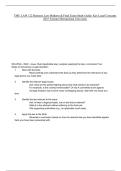
SOLVING - IRAC - Issue, Rule (Applicable law), analysis (applying the law), conclusion Four
Steps of Answering a Legal Question
1 Start with the facts:
◦ Read carefully and understand the facts as they determine the relevance of any
legal points you make later.
2 Identify the relevant legal issues:
◦ Ask: what are the parties fighting about and what needs to be resolved?
◦ For example, is the contract enforceable? Or has A committed a tort against
◦ As legal analysis may involve many overlapping issues, deal with one issue at a
time
3 Identify the law relevant to the issue:
◦ Ask: Is there a legal principle, rule or test that is relevant?
◦ State it in the abstract without referring to the facts yet.
◦ Cite supporting authorities (e.g., an applicable court case).
4 Apply the law to the facts:
◦ Generate a conclusion based on how the relevant law you have identified applies
facts you have been presented with.
,Module 1: Introduction to the study of law
The Nature of Law
Why Study law
• decision making abilities affect a business' success and failure rate
• Negative consequences: for example, the decision for a manufacturing plant to
dump pollutants into the environment could result in liability for damage caused by these
pollutants
• Positive consequences: for example, the decision to bind someone to their
promise to buy the services you are offering could ensure that that person’s promises to make
such a purchase will be kept
• Business decisions can trigger legal consequences and those legal consequences can
themselves have a direct effect on profits and losses
• Liability may be imposed for poor decisions and opportunities may be exploited by good
decisions
Law as a form of risk management
• law sets framework for risk associated with running a business
4 types of risk management strategies businesses can take
● Risk Avoidance (Eliminate risk).
◦ How? e.g. Withdrawing dangerous products from the market.
● Risk Reduction (Minimize risk)
◦ How? e.g. Modify product to reduce danger.
● Risk Shifting (Make risk someone else’s problem)
◦ How? e.g. Buy liability insurance for losses caused by danger/negligence
● Risk Acceptance (Live with the risk)
◦ How? e.g. Do nothing
Risk Management process
3 steps include:
● Identification: recognize legal risks
◦ “Can we be held liable for this?”
● Evaluation: assessment of legal risks
◦ “What are the chances of something going wrong?”
● Response: reaction to legal risks
◦ “What are we going to do about it?”
,The Nature of Law Generally: Laws vs. Rules
Law - A set of principles and rules that can be enforced by courts
• All laws are rules but not all rules are laws
• Study and practice of law is therefore a way of thinking or reasoning about these
principles and rules
• The fact that a law is not enforced does not mean that it cannot be enforced
• Why and how are very important in law
Ethical Reasoning: Law vs. Morality
• what is ethical might not be what is legal, as law and morality are not the same thing
• moral wrongs may be informally sanctioned (for example, you may not go to jail but you
may lose friends over unethical behaviour); and
• legal wrongs can be formally sanctioned (for example, if you are found guilty of a
criminal offence, you could go to jail).
4 models of ethical reasoning
1. Consequences: we should promote good consequences and avoid bad ones, for all
concerned, in the long run (in other words, happiness is good; pain is bad!).
2. Justice and Fairness: we should make sure that good and bad consequences are
distributed fairly. We should pay our debts and treat cases alike.
3. Rights and Duties: we should protect rights and perform duties. These are often “nearly
absolute.”
4. Character/Virtue: we should consider what kind of people we want to be, and what
example we want to set.
Common Law vs Civil law
Common law, which is the regime in Ontario and the rest of Canada other than Quebec.
◦ This is a legal regime based on dispute-based, judge-made laws.
◦ Common law originated in England.
◦ As well as being the legal regime used in most of Canada, it is also the legal
regime used in England (where it originated), Australia and New Zealand.
Civil law, which is the regime in Quebec.
◦ This is a legal regime based on a civil code.
◦ Civil law originated in ancient Rome.
◦ As well as being the legal regime used in Quebec, it is also the legal regime used
in France, most of Europe and Louisiana.
◦ To give you a sense of just how comprehensive civil codes can be, you can
review the Civil Code of Quebec. Note that while the Civil Code of Quebec is incredibly
comprehensive, Quebec also has in force specific laws dealing with specific issues (e.g.,
securities law, consumer protection law, etc.) as all of the other provinces and territories do.
, Canada use certain federal laws throughout the country, regardless of the law used
• Criminal code
• Patent act
Public And Private law
“Public law” is a way of describing those laws that govern our relationship with the government
and with society as a whole. Examples include:
• Constitutional law
• Tax law
• Criminal law
“Private law,” in contrast, is a way of describing those laws that govern matters of private
concern and the relationships we have with other private individuals. Examples include:
• Tort law
• Contract law
• Property law
Hierarchy of the Sources of Law
Three sources of Law:
• The Constitution
• Legislation:
◦ i.e., laws created by Parliament (federal) or a legislature (provincial/territorial)
• Courts:
◦ interpret and apply the Constitution
◦ interpret and apply legislation
◦ create and apply “common law” (judge-made law)
The Constitution
• The Constitution has been designed to provide basic rules for the Canadian legal and
political systems. It does this in two main ways:
1 The Constitution is difficult to amend
◦ Specifically, the amending formula requires consent of both:
▪ Parliament; and
▪ Two-thirds of all provinces with at least 50% of population
2 The Constitution is the highest source of law in Canada
◦ In fact, section 52(1) of the Constitution Act, 1982 expressly states that any law
inconsistent with the Constitution has no force or effect.
Federalism and Division of Powers
• Canada is a federal country, which means that we have two constitutionally recognized
levels of government: federal and provincial (or territorial).
2025 Toronto Metropolitan University
SOLVING - IRAC - Issue, Rule (Applicable law), analysis (applying the law), conclusion Four
Steps of Answering a Legal Question
1 Start with the facts:
◦ Read carefully and understand the facts as they determine the relevance of any
legal points you make later.
2 Identify the relevant legal issues:
◦ Ask: what are the parties fighting about and what needs to be resolved?
◦ For example, is the contract enforceable? Or has A committed a tort against
◦ As legal analysis may involve many overlapping issues, deal with one issue at a
time
3 Identify the law relevant to the issue:
◦ Ask: Is there a legal principle, rule or test that is relevant?
◦ State it in the abstract without referring to the facts yet.
◦ Cite supporting authorities (e.g., an applicable court case).
4 Apply the law to the facts:
◦ Generate a conclusion based on how the relevant law you have identified applies
facts you have been presented with.
,Module 1: Introduction to the study of law
The Nature of Law
Why Study law
• decision making abilities affect a business' success and failure rate
• Negative consequences: for example, the decision for a manufacturing plant to
dump pollutants into the environment could result in liability for damage caused by these
pollutants
• Positive consequences: for example, the decision to bind someone to their
promise to buy the services you are offering could ensure that that person’s promises to make
such a purchase will be kept
• Business decisions can trigger legal consequences and those legal consequences can
themselves have a direct effect on profits and losses
• Liability may be imposed for poor decisions and opportunities may be exploited by good
decisions
Law as a form of risk management
• law sets framework for risk associated with running a business
4 types of risk management strategies businesses can take
● Risk Avoidance (Eliminate risk).
◦ How? e.g. Withdrawing dangerous products from the market.
● Risk Reduction (Minimize risk)
◦ How? e.g. Modify product to reduce danger.
● Risk Shifting (Make risk someone else’s problem)
◦ How? e.g. Buy liability insurance for losses caused by danger/negligence
● Risk Acceptance (Live with the risk)
◦ How? e.g. Do nothing
Risk Management process
3 steps include:
● Identification: recognize legal risks
◦ “Can we be held liable for this?”
● Evaluation: assessment of legal risks
◦ “What are the chances of something going wrong?”
● Response: reaction to legal risks
◦ “What are we going to do about it?”
,The Nature of Law Generally: Laws vs. Rules
Law - A set of principles and rules that can be enforced by courts
• All laws are rules but not all rules are laws
• Study and practice of law is therefore a way of thinking or reasoning about these
principles and rules
• The fact that a law is not enforced does not mean that it cannot be enforced
• Why and how are very important in law
Ethical Reasoning: Law vs. Morality
• what is ethical might not be what is legal, as law and morality are not the same thing
• moral wrongs may be informally sanctioned (for example, you may not go to jail but you
may lose friends over unethical behaviour); and
• legal wrongs can be formally sanctioned (for example, if you are found guilty of a
criminal offence, you could go to jail).
4 models of ethical reasoning
1. Consequences: we should promote good consequences and avoid bad ones, for all
concerned, in the long run (in other words, happiness is good; pain is bad!).
2. Justice and Fairness: we should make sure that good and bad consequences are
distributed fairly. We should pay our debts and treat cases alike.
3. Rights and Duties: we should protect rights and perform duties. These are often “nearly
absolute.”
4. Character/Virtue: we should consider what kind of people we want to be, and what
example we want to set.
Common Law vs Civil law
Common law, which is the regime in Ontario and the rest of Canada other than Quebec.
◦ This is a legal regime based on dispute-based, judge-made laws.
◦ Common law originated in England.
◦ As well as being the legal regime used in most of Canada, it is also the legal
regime used in England (where it originated), Australia and New Zealand.
Civil law, which is the regime in Quebec.
◦ This is a legal regime based on a civil code.
◦ Civil law originated in ancient Rome.
◦ As well as being the legal regime used in Quebec, it is also the legal regime used
in France, most of Europe and Louisiana.
◦ To give you a sense of just how comprehensive civil codes can be, you can
review the Civil Code of Quebec. Note that while the Civil Code of Quebec is incredibly
comprehensive, Quebec also has in force specific laws dealing with specific issues (e.g.,
securities law, consumer protection law, etc.) as all of the other provinces and territories do.
, Canada use certain federal laws throughout the country, regardless of the law used
• Criminal code
• Patent act
Public And Private law
“Public law” is a way of describing those laws that govern our relationship with the government
and with society as a whole. Examples include:
• Constitutional law
• Tax law
• Criminal law
“Private law,” in contrast, is a way of describing those laws that govern matters of private
concern and the relationships we have with other private individuals. Examples include:
• Tort law
• Contract law
• Property law
Hierarchy of the Sources of Law
Three sources of Law:
• The Constitution
• Legislation:
◦ i.e., laws created by Parliament (federal) or a legislature (provincial/territorial)
• Courts:
◦ interpret and apply the Constitution
◦ interpret and apply legislation
◦ create and apply “common law” (judge-made law)
The Constitution
• The Constitution has been designed to provide basic rules for the Canadian legal and
political systems. It does this in two main ways:
1 The Constitution is difficult to amend
◦ Specifically, the amending formula requires consent of both:
▪ Parliament; and
▪ Two-thirds of all provinces with at least 50% of population
2 The Constitution is the highest source of law in Canada
◦ In fact, section 52(1) of the Constitution Act, 1982 expressly states that any law
inconsistent with the Constitution has no force or effect.
Federalism and Division of Powers
• Canada is a federal country, which means that we have two constitutionally recognized
levels of government: federal and provincial (or territorial).