HRM 446 Exam 2 Questions with Correct Answers Latest Update 2025/2026
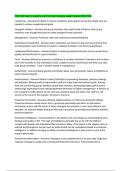
Leadership - Answers the ability to inspire confidence and support among the people who are
needed to achieve organizational goals
Emergent Leaders - Answers are group members who significantly influence other group
members even though they have not been assigned formal authority.
Management - Answers Produces order and consistency and predictability
Substitute for leadership - Answers Such substitutes are factors in the work environment that
provide guidance and incentives to perform, making the leader's role almost superfluous
Leadership Effectiveness - Answers Refers to attaining desired outcomes such as productivity,
quality and satisfaction in a given situation.
Trust - Answers defined as a person's confidence in another individual's intentions and motives
and in the sincerity of that individual's world. Leaders must be trustworthy, and they must also
trust group members. Trust is closely related to transparency
Authenticity - Answers Being genuine and honest about your personality, values, and beliefs as
well as having integrity.
Assertiveness - Answers Refers to being forthright in expressing demands, opinions, feelings
and attitudes. Being assertive helps leaders perform many tasks and achieve goals. Among
them are confronting group members about their mistakes, demanding higher performance,
setting high expectations and making legitimate demands on higher management. A director of
her company's mobile phone service unit was assertive when she said to her staff our cell
service is the worst in the industry. We have to improve.
Proactive Personality - Answers relatively stable tendency to effect environmental change.
Proactive behavior usually stems from a proactive personality and refers to self-iniated
anticipatory action with the intent of either changing the situation or one's own behavior and
attitudes. An effective leader therefore often has a proactive personality and therefore exhibits
proactive behavior.
Emotional Intelligence - Answers Refers to the ability to do such things as understanding one's
feelings and quality of life. This type of intelligence generally has to do with the ability to
connect with people and understand their emotions. Many of the topics in the chapter such as
warmth and throughout the text such as political skill can be considered related to emotional
intelligence. In addition to being an ability, emotional intelligence is also a trait or part of the
leader's personality.
Achievement Motivation - Answers Finding joy in accomplishment for its own sake. High level
coporate managers usually have a strong achievement motivation. Such people have a
, consistent desire to
achieve through their efforts and take responsiblity for success or failure.
Take Moderate risks that can be handled through their own efforts
Receive feed back on their level of performance
Introduce novel, innovative or creative solutions.
Plan and Set Goals
Insight - Answers A depth of understanding the requires considerable intution and common
sense. Intuition is often the mental process used to provide the understanding of a problem.
Insight helps speed decision making
Charisma - Answers a special quality of leaders whose purposes, powers, and extraordinary
determination differentiate them from others. In general, charismatic means to have a charming
and colorful personality such as that shown by many talk show hosts.
Transformational Leader - Answers One who brings about positive, major changes in an
organization. Many charismatic leaders, however are not transformational. Although they
inspire people, they may not bring about major organizational changes. As we look at the
characteristics of charismatic leaders. You will note that many of these characteristics apply to
leaders in general. First charmatic leaders are visionary because they offer an exciting image of
where the organization is headed and how to get there.
Consideration - Answers Is the degree to which the leader creates an environment of emotional
support, warmth, friendliness, and trust. The leader creates an environment by being friendly
and approachable, looking out for this environment by being friendly and approachable.
Intiating structure - Answers Means organizing and defining relationships in the group by
engaging in such activities as assigning specific tasks, specifying procedures to be followed,
scheduling work, and clarifying expectations for procedures to be followed, scheduling work,
and clarifying expectations for team members. A team leader who helped group members
establish realistic goals would be engaged in intiating structure. Other goals include production,
emphasis, and task orientation.
Servant Leader - Answers Serves constituents by working on their behalf to help them achieve
their goals, not the leader's own goals. The idea behind servant leadership, as formulated by
Robert K Greenleaf is that leadership it derives natually from a committment to service. Serving
others including employees, customers and community is the primary motivation for the servant
leader.
Leadership style - Answers the relatively consistent pattern of behavior that characterizes a
leader. Studying leadership style is an extension of understanding leadership behavior and
Leadership - Answers the ability to inspire confidence and support among the people who are
needed to achieve organizational goals
Emergent Leaders - Answers are group members who significantly influence other group
members even though they have not been assigned formal authority.
Management - Answers Produces order and consistency and predictability
Substitute for leadership - Answers Such substitutes are factors in the work environment that
provide guidance and incentives to perform, making the leader's role almost superfluous
Leadership Effectiveness - Answers Refers to attaining desired outcomes such as productivity,
quality and satisfaction in a given situation.
Trust - Answers defined as a person's confidence in another individual's intentions and motives
and in the sincerity of that individual's world. Leaders must be trustworthy, and they must also
trust group members. Trust is closely related to transparency
Authenticity - Answers Being genuine and honest about your personality, values, and beliefs as
well as having integrity.
Assertiveness - Answers Refers to being forthright in expressing demands, opinions, feelings
and attitudes. Being assertive helps leaders perform many tasks and achieve goals. Among
them are confronting group members about their mistakes, demanding higher performance,
setting high expectations and making legitimate demands on higher management. A director of
her company's mobile phone service unit was assertive when she said to her staff our cell
service is the worst in the industry. We have to improve.
Proactive Personality - Answers relatively stable tendency to effect environmental change.
Proactive behavior usually stems from a proactive personality and refers to self-iniated
anticipatory action with the intent of either changing the situation or one's own behavior and
attitudes. An effective leader therefore often has a proactive personality and therefore exhibits
proactive behavior.
Emotional Intelligence - Answers Refers to the ability to do such things as understanding one's
feelings and quality of life. This type of intelligence generally has to do with the ability to
connect with people and understand their emotions. Many of the topics in the chapter such as
warmth and throughout the text such as political skill can be considered related to emotional
intelligence. In addition to being an ability, emotional intelligence is also a trait or part of the
leader's personality.
Achievement Motivation - Answers Finding joy in accomplishment for its own sake. High level
coporate managers usually have a strong achievement motivation. Such people have a
, consistent desire to
achieve through their efforts and take responsiblity for success or failure.
Take Moderate risks that can be handled through their own efforts
Receive feed back on their level of performance
Introduce novel, innovative or creative solutions.
Plan and Set Goals
Insight - Answers A depth of understanding the requires considerable intution and common
sense. Intuition is often the mental process used to provide the understanding of a problem.
Insight helps speed decision making
Charisma - Answers a special quality of leaders whose purposes, powers, and extraordinary
determination differentiate them from others. In general, charismatic means to have a charming
and colorful personality such as that shown by many talk show hosts.
Transformational Leader - Answers One who brings about positive, major changes in an
organization. Many charismatic leaders, however are not transformational. Although they
inspire people, they may not bring about major organizational changes. As we look at the
characteristics of charismatic leaders. You will note that many of these characteristics apply to
leaders in general. First charmatic leaders are visionary because they offer an exciting image of
where the organization is headed and how to get there.
Consideration - Answers Is the degree to which the leader creates an environment of emotional
support, warmth, friendliness, and trust. The leader creates an environment by being friendly
and approachable, looking out for this environment by being friendly and approachable.
Intiating structure - Answers Means organizing and defining relationships in the group by
engaging in such activities as assigning specific tasks, specifying procedures to be followed,
scheduling work, and clarifying expectations for procedures to be followed, scheduling work,
and clarifying expectations for team members. A team leader who helped group members
establish realistic goals would be engaged in intiating structure. Other goals include production,
emphasis, and task orientation.
Servant Leader - Answers Serves constituents by working on their behalf to help them achieve
their goals, not the leader's own goals. The idea behind servant leadership, as formulated by
Robert K Greenleaf is that leadership it derives natually from a committment to service. Serving
others including employees, customers and community is the primary motivation for the servant
leader.
Leadership style - Answers the relatively consistent pattern of behavior that characterizes a
leader. Studying leadership style is an extension of understanding leadership behavior and