

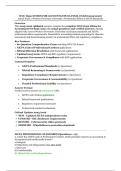
WGU D550 ETHICS FOR ACCOUNTANTS OA FINAL EXAM (2025/2026)
Actual Exam | Western Governors University | Professional Ethics & AICPA Standards
Overview
This 2025/2026 validated resource contains the complete WGU D550 Ethics for
Accountants OA final exam with actual questions and verified answers, directly
aligned with current Western Governors University curriculum standards and AICPA
professional ethics requirements. Essential for accounting students preparing for objective
assessment and demonstrating mastery in professional ethics and regulatory compliance.
Key Features
✓ 60-Question Comprehensive Exam matching WGU OA format
✓ AICPA Code of Professional Conduct applications
✓ Ethical Dilemma Resolution with framework applications
✓ Updated 2025/2026 AICPA and SEC regulatory requirements
✓ Corporate Governance & Compliance with SOX applications
Content Domains
• AICPA Professional Standards (15 Questions)
• Ethical Reasoning & Frameworks (12 Questions)
• Regulatory Compliance Requirements (12 Questions)
• Corporate Governance & Accountability (11 Questions)
• Fraud & Professional Liability (10 Questions)
Answer Format
Verified correct answers in bold green with:
• AICPA code citation applications
• Ethical framework justifications
• Regulatory requirement rationales
• Professional standard evaluations
Critical Updates 2025/2026
NEW - Updated AICPA independence rules
UPDATED - SEC disclosure requirements
REVISED - Cybersecurity ethics protocols
MODIFIED - Whistleblower protection standards
AICPA PROFESSIONAL STANDARDS (Questions 1–15)
1. Under the AICPA Code of Professional Conduct, which principle requires an accountant to
be impartial and intellectually honest?
a) Integrity
b) Objectivity and Independence (0.100.020)
c) Due Care
d) Confidentiality
b) Objectivity and Independence
, Rationale: Objectivity is the state of mind that allows CPAs to perform services without
being affected by influences that compromise professional judgment.
2. A CPA is offered tickets to a sold-out concert by the CFO of an audit client. The tickets
have a face value of $500 but are being scalped for $2,000. According to AICPA
independence rules, the CPA should:
a) Accept the tickets if used for personal enjoyment
b) Decline the gift because it is a prohibited gift from a client (1.280.040 - Gifts from
clients impair independence if significant)
c) Accept if disclosed in footnotes
d) Accept and report as income
b) Decline the gift because it is a prohibited gift from a client
Rationale: Gifts from clients can impair independence if they create a self-interest threat;
the fair value is irrelevant if the gift is significant in any amount.
3. Which threat to independence is created when a CPA’s spouse owns direct equity in an
audit client?
a) Advocacy threat
b) Self-interest threat (1.240.010 - Financial interest creates self-interest threat)
c) Self-review threat
d) Familiarity threat
b) Self-interest threat
Rationale: Direct financial interest in a client creates a self-interest threat because the CPA
(through spouse) benefits from client’s performance.
4. Under AICPA rules, independence is not required for:
a) Audits
b) Reviews
c) Compilations (AR-C 80 - Compilations do not provide assurance; no
independence requirement)
d) Agreed-upon procedures
c) Compilations
Rationale: Compilations present management’s financial statements without expressing
assurance; independence not required but disclosure if not independent.
5. A CPA discovers a material misstatement in last year’s audit that was missed. The
appropriate first step under the AICPA Code is:
a) Ignore it
b) Inform the client and recommend disclosure to users (1.400.100 - If material, advise
client to notify users)
c) Withdraw immediately
d) Report to SEC only
b) Inform the client and recommend disclosure to users
Rationale: If client refuses, consider withdrawing and/or notifying regulatory authorities.
6. Which AICPA principle requires CPAs to act in good faith and be truthful?
a) Integrity (0.300.030)
b) Confidentiality
c) Professional Behavior
d) Due Care
a) Integrity
Rationale: Integrity requires honesty and candid communication; subordinate principle of
objectivity.
Actual Exam | Western Governors University | Professional Ethics & AICPA Standards
Overview
This 2025/2026 validated resource contains the complete WGU D550 Ethics for
Accountants OA final exam with actual questions and verified answers, directly
aligned with current Western Governors University curriculum standards and AICPA
professional ethics requirements. Essential for accounting students preparing for objective
assessment and demonstrating mastery in professional ethics and regulatory compliance.
Key Features
✓ 60-Question Comprehensive Exam matching WGU OA format
✓ AICPA Code of Professional Conduct applications
✓ Ethical Dilemma Resolution with framework applications
✓ Updated 2025/2026 AICPA and SEC regulatory requirements
✓ Corporate Governance & Compliance with SOX applications
Content Domains
• AICPA Professional Standards (15 Questions)
• Ethical Reasoning & Frameworks (12 Questions)
• Regulatory Compliance Requirements (12 Questions)
• Corporate Governance & Accountability (11 Questions)
• Fraud & Professional Liability (10 Questions)
Answer Format
Verified correct answers in bold green with:
• AICPA code citation applications
• Ethical framework justifications
• Regulatory requirement rationales
• Professional standard evaluations
Critical Updates 2025/2026
NEW - Updated AICPA independence rules
UPDATED - SEC disclosure requirements
REVISED - Cybersecurity ethics protocols
MODIFIED - Whistleblower protection standards
AICPA PROFESSIONAL STANDARDS (Questions 1–15)
1. Under the AICPA Code of Professional Conduct, which principle requires an accountant to
be impartial and intellectually honest?
a) Integrity
b) Objectivity and Independence (0.100.020)
c) Due Care
d) Confidentiality
b) Objectivity and Independence
, Rationale: Objectivity is the state of mind that allows CPAs to perform services without
being affected by influences that compromise professional judgment.
2. A CPA is offered tickets to a sold-out concert by the CFO of an audit client. The tickets
have a face value of $500 but are being scalped for $2,000. According to AICPA
independence rules, the CPA should:
a) Accept the tickets if used for personal enjoyment
b) Decline the gift because it is a prohibited gift from a client (1.280.040 - Gifts from
clients impair independence if significant)
c) Accept if disclosed in footnotes
d) Accept and report as income
b) Decline the gift because it is a prohibited gift from a client
Rationale: Gifts from clients can impair independence if they create a self-interest threat;
the fair value is irrelevant if the gift is significant in any amount.
3. Which threat to independence is created when a CPA’s spouse owns direct equity in an
audit client?
a) Advocacy threat
b) Self-interest threat (1.240.010 - Financial interest creates self-interest threat)
c) Self-review threat
d) Familiarity threat
b) Self-interest threat
Rationale: Direct financial interest in a client creates a self-interest threat because the CPA
(through spouse) benefits from client’s performance.
4. Under AICPA rules, independence is not required for:
a) Audits
b) Reviews
c) Compilations (AR-C 80 - Compilations do not provide assurance; no
independence requirement)
d) Agreed-upon procedures
c) Compilations
Rationale: Compilations present management’s financial statements without expressing
assurance; independence not required but disclosure if not independent.
5. A CPA discovers a material misstatement in last year’s audit that was missed. The
appropriate first step under the AICPA Code is:
a) Ignore it
b) Inform the client and recommend disclosure to users (1.400.100 - If material, advise
client to notify users)
c) Withdraw immediately
d) Report to SEC only
b) Inform the client and recommend disclosure to users
Rationale: If client refuses, consider withdrawing and/or notifying regulatory authorities.
6. Which AICPA principle requires CPAs to act in good faith and be truthful?
a) Integrity (0.300.030)
b) Confidentiality
c) Professional Behavior
d) Due Care
a) Integrity
Rationale: Integrity requires honesty and candid communication; subordinate principle of
objectivity.


