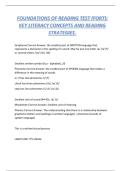
Grapheme Correct Answer: the smallest part of WRITTEN language that
represents a phoneme in the spelling of a word. May be just one letter /a/ /d/ /f/
or several letters /ch/ /sh/ /th/
Smallest written symbol (A,a - alphabet), 26
Phoneme Correct Answer: the smallest part of SPOKEN language that makes a
difference in the meaning of words.
ie: if has two phonemes /i/ /f/
check has three phonemes /ch/ /e/ /k/
stop has four phonemes /s/ /t/ /o/ /p/
Smallest unit of sound (44-45). /a/ /s/
Morpheme Correct Answer: Smallest unit of meaning
Phonics Correct Answer: The understanding that there is a relationship between
grapheme (letters and spellings in written language) + phoneme (sounds of
spoken language)
This is a written/visual process
LIGHTS ON! IT'S VISUAL
,Phonological Awareness Correct Answer: The broad term that includes phonemic
awareness and includes an awareness of various speech sounds such as syllables,
words, rime, onsets, and individual phonemes.
LIGHTS OUT! IT'S AUDITORY
Consonant blend Correct Answer: ____ are consonant pairs or clusters.
Two or three letters to blend to form new word but not a new sound.
These letters do NOT make a new sound when combined.
bl, sm, scr, gr, sl,
trick- the bl in blend is an example...notice that you still hear each sound "though
to the end".
/cl/ock
Consonant digraph (and trigraphs) Correct Answer: Two consonant letters
together make a NEW SOUND.
Trick- a digraPH makes me lauGH. The last two letters in digraph (ph) and in laugh
(gh) are connected to form two COMPLETELY NEW SOUNDS.
Two letters that represent one new sound.
/ch/eerful
,/th/ /sh/ /wh/
ch, ph, th, wh, tch
Onset Correct Answer: Is the initial consonant(s) sound of a syllable.
Parts of spoken language that are smaller than syllables but larger than
phonemes.
/f/at
/fl/at
at- no onset
Rime Correct Answer: Is the part of a syllable that contains the vowel and all that
follows it.
Parts of spoken language that are smaller than syllables but larger than
phonemes.
fl/at/
f/ate/
fl/at/t/er
at
Sight words Correct Answer: Words commonly seen in text and harder to decode.
because
friend
, there
when
Context clue Correct Answer: Using words around the main word to figure out
what it might mean or be (unskilled).
Analytic (implicit) Correct Answer: Children learn to analyze letter-sound
relationships in previously learned words. They do not pronounce sounds in
isolation
sat (remove s, add b)
bat (remove b, add c)
cat (remove c, add h)
hat
Synthetic (explicit) Correct Answer: The sounds associated with letters are
identified in isolation and then blended together to form words.
/b/ /a/ /t/
/c/ /a/ /t/
Alphabetic Principle Correct Answer: The understanding that there are systematic
and predictable relationships between WRITTEN letters and SPOKEN sounds.
Contribute greatly to children's ability to read words both insolation and
connected text.
Mnemonic device that supports our memory for specific words.
Fluency Correct Answer: Sufficient rate, phrasing, intonation, expression
(PROSODY) to support and reflect comprehension.
represents a phoneme in the spelling of a word. May be just one letter /a/ /d/ /f/
or several letters /ch/ /sh/ /th/
Smallest written symbol (A,a - alphabet), 26
Phoneme Correct Answer: the smallest part of SPOKEN language that makes a
difference in the meaning of words.
ie: if has two phonemes /i/ /f/
check has three phonemes /ch/ /e/ /k/
stop has four phonemes /s/ /t/ /o/ /p/
Smallest unit of sound (44-45). /a/ /s/
Morpheme Correct Answer: Smallest unit of meaning
Phonics Correct Answer: The understanding that there is a relationship between
grapheme (letters and spellings in written language) + phoneme (sounds of
spoken language)
This is a written/visual process
LIGHTS ON! IT'S VISUAL
,Phonological Awareness Correct Answer: The broad term that includes phonemic
awareness and includes an awareness of various speech sounds such as syllables,
words, rime, onsets, and individual phonemes.
LIGHTS OUT! IT'S AUDITORY
Consonant blend Correct Answer: ____ are consonant pairs or clusters.
Two or three letters to blend to form new word but not a new sound.
These letters do NOT make a new sound when combined.
bl, sm, scr, gr, sl,
trick- the bl in blend is an example...notice that you still hear each sound "though
to the end".
/cl/ock
Consonant digraph (and trigraphs) Correct Answer: Two consonant letters
together make a NEW SOUND.
Trick- a digraPH makes me lauGH. The last two letters in digraph (ph) and in laugh
(gh) are connected to form two COMPLETELY NEW SOUNDS.
Two letters that represent one new sound.
/ch/eerful
,/th/ /sh/ /wh/
ch, ph, th, wh, tch
Onset Correct Answer: Is the initial consonant(s) sound of a syllable.
Parts of spoken language that are smaller than syllables but larger than
phonemes.
/f/at
/fl/at
at- no onset
Rime Correct Answer: Is the part of a syllable that contains the vowel and all that
follows it.
Parts of spoken language that are smaller than syllables but larger than
phonemes.
fl/at/
f/ate/
fl/at/t/er
at
Sight words Correct Answer: Words commonly seen in text and harder to decode.
because
friend
, there
when
Context clue Correct Answer: Using words around the main word to figure out
what it might mean or be (unskilled).
Analytic (implicit) Correct Answer: Children learn to analyze letter-sound
relationships in previously learned words. They do not pronounce sounds in
isolation
sat (remove s, add b)
bat (remove b, add c)
cat (remove c, add h)
hat
Synthetic (explicit) Correct Answer: The sounds associated with letters are
identified in isolation and then blended together to form words.
/b/ /a/ /t/
/c/ /a/ /t/
Alphabetic Principle Correct Answer: The understanding that there are systematic
and predictable relationships between WRITTEN letters and SPOKEN sounds.
Contribute greatly to children's ability to read words both insolation and
connected text.
Mnemonic device that supports our memory for specific words.
Fluency Correct Answer: Sufficient rate, phrasing, intonation, expression
(PROSODY) to support and reflect comprehension.