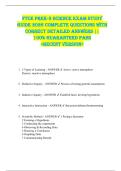
FTCE Prek-3 SCIENCE EXAM STUDY
GUIDE 2026 COMPLETE QUESTIONS WITH
CORRECT DETAILED ANSWERS ||
100% GUARANTEED PASS
<RECENT VERSION>
1. 2 Types of Learning - ANSWER ✔ Active: active atmosphere
Passive: inactive atmosphere
2. Deductive Inquiry - ANSWER ✔ Process of testing general assumptions
3. Inductive Inquiry - ANSWER ✔ Establish facts; develop hypothesis
4. Interactive Instruction - ANSWER ✔ discussion/debates/brainstorming
5. Scientific Method - ANSWER ✔ 1 Posing a Question
2 Forming a Hypothesis
3 Conducting the experiment
4 Observing & Recording Data
5 Drawing a Conclusion
6 Graphing Data
7 Communicating Results
,6. Lab Report includes - ANSWER ✔ Title: what is being studied
Abstract: Summary of the report
Purpose: state the problem
Hypothesis: educated guess (what's expected from the outcome)
7. Meter - ANSWER ✔ measure of length
8. Liter - ANSWER ✔ measure of volume
9. Gram - ANSWER ✔ measure of mass
10.Andreas Vesalius - ANSWER ✔ anatomist (anatomy)
11.Anton Van Leeuwenhoek - ANSWER ✔ father of microscopy
12.Observation - ANSWER ✔ Scientific inquiry begins with
13.Scientific Knowledge - ANSWER ✔ Empirical
14.Robert Hooke - ANSWER ✔ Developed the principal of elasticity that is
still used today
15.Utilitarianism - ANSWER ✔ A theory of ethics that prescribes the
quantitative maximization of good consequences for a population.
Is a form of consequentialism.
,16.Kantianism - ANSWER ✔ Theory by Immanuel Kant, a German
philosopher who lived from 1724-1804, which ascribes intrinsic value to
rational beings & is the philosophical foundation of contemporary human
rights.
17.Social contract theory - ANSWER ✔ View of the ancient Greeks that states
that a person's moral &/or political obligations are dependent upon a
contract or agreement among people to form society.
18.Venus - ANSWER ✔ Planet with retrograde rotation
19.Earth - ANSWER ✔ Considered a water planet, with 70% of its surface
covered by water.
20.Mercury - ANSWER ✔ The closest planet to the Sun. Its surface has craters
& rocks.
21.The law of Momentum Conservation - ANSWER ✔ states that when 2
objects collide in an isolated system, the total momentum of the 2 objects
before the collision is equal to the total momentum of the 2 objects after the
collision.
22.The law of Conservation of Energy - ANSWER ✔ states that energy can
neither be created nor destroyed.
23.Jupiter - ANSWER ✔ Largest planet in the solar system
, 24.Uranus - ANSWER ✔ 3rd largest planet in the solar system. It has
retrograde revolution.
25.Saturn - ANSWER ✔ 2nd largest planet in the solar system. It has rings of
ice, rock, & duct particles circling it.
26.Meteoroids - ANSWER ✔ Composed of particles of rock & metal of various
sizes.
27.Meteorites - ANSWER ✔ are meteors that strike Earth's surface.
28.Nonrenewable resource - ANSWER ✔ Replaced on a timescale that is very
long relative to human lifespans.
29.Gas - ANSWER ✔ Type of matter, extremely light & does not have any
weight.
30.Chemical property - ANSWER ✔ Ability of a substance to be changed into
a new substance.
31.Homeostasis - ANSWER ✔ Result of regulatory mechanisms that help
maintain an organism's internal environment within tolerable limits.
32.Phase of matter - ANSWER ✔ Solid
Liquid
Gas
GUIDE 2026 COMPLETE QUESTIONS WITH
CORRECT DETAILED ANSWERS ||
100% GUARANTEED PASS
<RECENT VERSION>
1. 2 Types of Learning - ANSWER ✔ Active: active atmosphere
Passive: inactive atmosphere
2. Deductive Inquiry - ANSWER ✔ Process of testing general assumptions
3. Inductive Inquiry - ANSWER ✔ Establish facts; develop hypothesis
4. Interactive Instruction - ANSWER ✔ discussion/debates/brainstorming
5. Scientific Method - ANSWER ✔ 1 Posing a Question
2 Forming a Hypothesis
3 Conducting the experiment
4 Observing & Recording Data
5 Drawing a Conclusion
6 Graphing Data
7 Communicating Results
,6. Lab Report includes - ANSWER ✔ Title: what is being studied
Abstract: Summary of the report
Purpose: state the problem
Hypothesis: educated guess (what's expected from the outcome)
7. Meter - ANSWER ✔ measure of length
8. Liter - ANSWER ✔ measure of volume
9. Gram - ANSWER ✔ measure of mass
10.Andreas Vesalius - ANSWER ✔ anatomist (anatomy)
11.Anton Van Leeuwenhoek - ANSWER ✔ father of microscopy
12.Observation - ANSWER ✔ Scientific inquiry begins with
13.Scientific Knowledge - ANSWER ✔ Empirical
14.Robert Hooke - ANSWER ✔ Developed the principal of elasticity that is
still used today
15.Utilitarianism - ANSWER ✔ A theory of ethics that prescribes the
quantitative maximization of good consequences for a population.
Is a form of consequentialism.
,16.Kantianism - ANSWER ✔ Theory by Immanuel Kant, a German
philosopher who lived from 1724-1804, which ascribes intrinsic value to
rational beings & is the philosophical foundation of contemporary human
rights.
17.Social contract theory - ANSWER ✔ View of the ancient Greeks that states
that a person's moral &/or political obligations are dependent upon a
contract or agreement among people to form society.
18.Venus - ANSWER ✔ Planet with retrograde rotation
19.Earth - ANSWER ✔ Considered a water planet, with 70% of its surface
covered by water.
20.Mercury - ANSWER ✔ The closest planet to the Sun. Its surface has craters
& rocks.
21.The law of Momentum Conservation - ANSWER ✔ states that when 2
objects collide in an isolated system, the total momentum of the 2 objects
before the collision is equal to the total momentum of the 2 objects after the
collision.
22.The law of Conservation of Energy - ANSWER ✔ states that energy can
neither be created nor destroyed.
23.Jupiter - ANSWER ✔ Largest planet in the solar system
, 24.Uranus - ANSWER ✔ 3rd largest planet in the solar system. It has
retrograde revolution.
25.Saturn - ANSWER ✔ 2nd largest planet in the solar system. It has rings of
ice, rock, & duct particles circling it.
26.Meteoroids - ANSWER ✔ Composed of particles of rock & metal of various
sizes.
27.Meteorites - ANSWER ✔ are meteors that strike Earth's surface.
28.Nonrenewable resource - ANSWER ✔ Replaced on a timescale that is very
long relative to human lifespans.
29.Gas - ANSWER ✔ Type of matter, extremely light & does not have any
weight.
30.Chemical property - ANSWER ✔ Ability of a substance to be changed into
a new substance.
31.Homeostasis - ANSWER ✔ Result of regulatory mechanisms that help
maintain an organism's internal environment within tolerable limits.
32.Phase of matter - ANSWER ✔ Solid
Liquid
Gas