

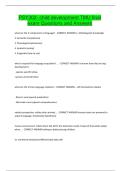
PSY302- child development TMU final
exam Questions and Answers
what are the 5 components of language? - CORRECT ANSWER-1. Metalinguistic knowledge
2. Semantic (morphemes)
3. Phonological (phonemes)
4. Syntactic (syntax)
5. Pragmatic (how to use)
what is required for language acquisition? ... - CORRECT ANSWER-a human brain (key to lang
development)
- species specific behav
-species universal behav
what are the 2 brain language relations? - CORRECT ANSWER-- Left hemisphere relation
- Broca's area (speech production)
- Wernicke's area (speech comprehension)
nativist perspective: unlike other animals... - CORRECT ANSWER-human brains are prewired to
acquire language. (modularity hypothesis)
human environment: Infant direct talk (IDT): the distinctive mode of speech that adults adopt
when... - CORRECT ANSWER-talking to babies/young children.
ex. emotional tone(warm/affectionate) baby talk.
,-infants prefer IDT
what are the 2 Main challenges for children? - CORRECT ANSWER-1. solve the word-
segmentation problem
2. figure out the meaning of words
ex. themaninthemoon (what child hears)
- the man in the moon (segmentation)
categorical perception: perceiving speech sounds as belonging to... - CORRECT ANSWER-discrete
phonemic categories (ex. P & B)
infants pick up on statistical regularities in speech: word segmentation at about... - CORRECT
ANSWER-8 months old
- 2 min test
- padoti (old)
-ladopa (new
what are the 3 stages of early language development? - CORRECT ANSWER-1. Prelinguistic
period
2. Holophrastic period
3. Telegraphic period
the prelinguistic period (10-13 months): - CORRECT ANSWER-- Cooing (2 months): vowel like
sounds (Ooooh)
- Babbling (6-10 months): syllables (mamamam)
, - Vocables (10-12): unique pattern of sounds to refer to objects/actions
holophrastic period: single word (12-24 months): - CORRECT ANSWER-- First word (10-15
months)
- Naming explosion (18-24 months) -10-20 words
- Vocabulary growth: exposure, parents' education
direct teaching practices: "look this is a feb? see? a feb"
fast mapping: rapidly learning a new word simply from the contrastive use of... - CORRECT
ANSWER-familiar and unfamiliar words (incidental exposure) - 2 year old can learn new words
from fast mapping!
incidental exposure: carey & barlett (1978): - CORRECT ANSWER-- 3 year old's were involved in
activities un related to word learning
- Experimenter asked children to get the "chromium tray, not the red one)
gavage problem: - CORRECT ANSWER-figuring out the meaning of new words
whole-object assumption: a novel word will refer to... - CORRECT ANSWER-a whole object, not a
part
mutual exclusivity assumption: a given entity has only one... - CORRECT ANSWER-name. (ex.
where is the blicket)
exam Questions and Answers
what are the 5 components of language? - CORRECT ANSWER-1. Metalinguistic knowledge
2. Semantic (morphemes)
3. Phonological (phonemes)
4. Syntactic (syntax)
5. Pragmatic (how to use)
what is required for language acquisition? ... - CORRECT ANSWER-a human brain (key to lang
development)
- species specific behav
-species universal behav
what are the 2 brain language relations? - CORRECT ANSWER-- Left hemisphere relation
- Broca's area (speech production)
- Wernicke's area (speech comprehension)
nativist perspective: unlike other animals... - CORRECT ANSWER-human brains are prewired to
acquire language. (modularity hypothesis)
human environment: Infant direct talk (IDT): the distinctive mode of speech that adults adopt
when... - CORRECT ANSWER-talking to babies/young children.
ex. emotional tone(warm/affectionate) baby talk.
,-infants prefer IDT
what are the 2 Main challenges for children? - CORRECT ANSWER-1. solve the word-
segmentation problem
2. figure out the meaning of words
ex. themaninthemoon (what child hears)
- the man in the moon (segmentation)
categorical perception: perceiving speech sounds as belonging to... - CORRECT ANSWER-discrete
phonemic categories (ex. P & B)
infants pick up on statistical regularities in speech: word segmentation at about... - CORRECT
ANSWER-8 months old
- 2 min test
- padoti (old)
-ladopa (new
what are the 3 stages of early language development? - CORRECT ANSWER-1. Prelinguistic
period
2. Holophrastic period
3. Telegraphic period
the prelinguistic period (10-13 months): - CORRECT ANSWER-- Cooing (2 months): vowel like
sounds (Ooooh)
- Babbling (6-10 months): syllables (mamamam)
, - Vocables (10-12): unique pattern of sounds to refer to objects/actions
holophrastic period: single word (12-24 months): - CORRECT ANSWER-- First word (10-15
months)
- Naming explosion (18-24 months) -10-20 words
- Vocabulary growth: exposure, parents' education
direct teaching practices: "look this is a feb? see? a feb"
fast mapping: rapidly learning a new word simply from the contrastive use of... - CORRECT
ANSWER-familiar and unfamiliar words (incidental exposure) - 2 year old can learn new words
from fast mapping!
incidental exposure: carey & barlett (1978): - CORRECT ANSWER-- 3 year old's were involved in
activities un related to word learning
- Experimenter asked children to get the "chromium tray, not the red one)
gavage problem: - CORRECT ANSWER-figuring out the meaning of new words
whole-object assumption: a novel word will refer to... - CORRECT ANSWER-a whole object, not a
part
mutual exclusivity assumption: a given entity has only one... - CORRECT ANSWER-name. (ex.
where is the blicket)


