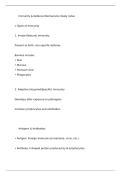
🦠 Immunity & Defence Mechanisms Study notes
◇ Types of Immunity
1. Innate (Natural) Immunity
Present at birth; non-specific defense.
Barriers include:
• Skin
• Mucous
• Stomach acid
• Phagocytes
2. Adaptive (Acquired/Specific) Immunity
Develops after exposure to pathogens.
Involves lymphocytes and antibodies.
🔹 Antigens & Antibodies
• Antigen: Foreign molecule (on bacteria, virus, etc.).
• Antibody: Y-shaped protein produced by B-lymphocytes.
, ◇ Functions of antibodies:
• Neutralize toxins
• Clump microbes
• Mark pathogens for phagocytosis
🔹 Immune Response
Primary Response:
• First exposure to antigen
• Slow and weak
Secondary Response:
• Subsequent exposures (due to memory cells)
• Faster, stronger, and longer-lasting
🔹 Types of Acquired Immunity
Active Immunity (body produces its own antibodies):
Natural: After infection.
Artificial: After vaccination.
• Passive Immunity (ready-made antibodies received):
• Natural: From mother → child (placenta, breast milk).
◇ Types of Immunity
1. Innate (Natural) Immunity
Present at birth; non-specific defense.
Barriers include:
• Skin
• Mucous
• Stomach acid
• Phagocytes
2. Adaptive (Acquired/Specific) Immunity
Develops after exposure to pathogens.
Involves lymphocytes and antibodies.
🔹 Antigens & Antibodies
• Antigen: Foreign molecule (on bacteria, virus, etc.).
• Antibody: Y-shaped protein produced by B-lymphocytes.
, ◇ Functions of antibodies:
• Neutralize toxins
• Clump microbes
• Mark pathogens for phagocytosis
🔹 Immune Response
Primary Response:
• First exposure to antigen
• Slow and weak
Secondary Response:
• Subsequent exposures (due to memory cells)
• Faster, stronger, and longer-lasting
🔹 Types of Acquired Immunity
Active Immunity (body produces its own antibodies):
Natural: After infection.
Artificial: After vaccination.
• Passive Immunity (ready-made antibodies received):
• Natural: From mother → child (placenta, breast milk).