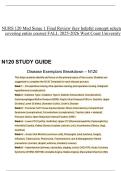
NURS 120 Med Surge 1 Final Review (key helpful concept selecte
covering entire course) FALL 2025-2026 West Coast University
N120 STUDY GUIDE
Disease Exemplars Breakdown – N120
This helps students identify and focus on the primary topics of the course. Students are
suggested to complete the N120 Template for each disease process.
Week 1 – Pre-operative nursing, intra-operative nursing, post-operative nursing, malignant
hyperthermia (complication)
Week 2 - Diabetes Type I, Diabetes Type II, Diabetic Ketoacidosis (Complication),
Gastroesophageal Reflux Disease (GERD), Peptic Ulcer Disease (PUD) vs. Gastritis, Upper
GI bleed, Lower GI bleed, Ulcerative Colitis, Crohn’s Disease
Week 3 – Fractures, Soft Tissue Injuries (Sprain, Strain, Dislocations), Compartment
Syndrome (complication), Fat embolism (complication), Traction (skin + skeletal),
Pressure Ulcers, Open Reduction Internal Fixation (ORIF).
Week 4 – Lower UTI (Cystitis, Urethritis), Upper UTI (Glomerulonephritis, Pyelonephritis),
Interstitial Cystitis, Kidney Stones (oxalate, calcium, uric), Incontinence (Stress, Urge,
Overflow)
Week 5 – Acute Viral Rhinitis (common cold), Pharyngitis (viral, bacteria, fungal),
Influenza, Tuberculosis, Pneumonia, Tracheostomy care & Management, Patient
precautions (contact, droplet, airborne, standard, reverse)
Week 6 – Hypertension (primary, secondary, staging, crisis), CAD, PVD, Acute Coronary
Syndrome (STEMI, NSTEMI, Unstable Angina, Stable Angina), Myocardial Infarction (MI),
,Normal EKG wave (reading the EKG + symptoms/interventions), Afibrillation (A-fib)
Week 7 – Anemia (Iron (Fe+) deficiency, pernicious, aplastic, sickle cell), Hematopoiesis,
Blood Transfusions, HIV - AIDS
Week 8 – Epilepsy (seizure classifications, types), Transient Ischemic Attack, Ischemic
Stroke, Hemorrhagic Stroke, Status Epilepticus (complication), Basic Management of
intracranial Pressure (ICP)
, NSG = Nursing
e.q. = for example
Underlined = said in class/ will be on test
N120 Class Prep Work Focus Questions
Week 1 Perioperative Care & Malignant Hyperthermia
REVIEW: key points slides
FOCUS QUESTIONS:
● What is the main duty of the nurse in the pre-operative stage?
○ Summarize NSG process in care of peri-op pts
○ Classify priorities in care of peri-op pts using NSG concepts (e.g. pain,
mobility, nutrition, oxygenation, perfusion, collaboration, etc.)
○ Identify interprofessional team management
○ Examine nutrition, development, & teaching needs of peri-op pts.
● What questions/assessments/evaluations will you ask/conduct on the patient
prior to surgery?
○ Have knowledge about nature of disorder for the surgery
○ Identify pt response to stress of surgery
○ Have knowledge about the results of pre-op diagnostic tests
■ What do vitals, lab values, pre existing conditions point to
● When do we begin teaching about intraoperative and postoperative
instructions?
○ During the pre-op
● What is the role of the scrub and circulating nurse and what is the difference
between the two?
○ Scrub = STERILE, assists surgeon, counts supplies
○ Circulating = non-sterile, “time-out”,
■ Pt advocate
■ Prepare supplies
, ■ TIME OUT = pt ID, surgical site (body part), surgical procedure
(procedure)
■ Hand off to PACU
● What are the different types of anesthetics and what nursing considerations
should you have?
○ Opioids
■ Morphine
■ Fentanyl
■ Dilaudid
■ Antidote for Opioid → Naloxone (Narcan)
○ Sedative/Depressant (relaxant)
■ Benzos (Benzodiazepines, Diazepam, Lorazepam)
● NSG Considerations
● Antidote → Flumazenil (Romazicon)
■ Midazolam (Versed)
○ Know Antidotes for Opioids & Benzos
■ Opioid antidote → narcan (naloxone)
■ Benzos antidote →flumazenil
○ Nausea
■ We want to use antiemetics (anti-nausea)
■ Ex: ondansetron (zofran)
○ Local Anesthesia
■ Lidocaine
■ Epidurals
○ Antibiotic
■ Cefazolin
● What can I anticipate from my patient postoperatively?
○ Expected and unexpected symptoms
■ Expected: Constipation (hypoactive BS), d/c urine output (800-1500
mL) in in the first 24hrs
■ Unexpected: Urinary retention (bladder scan, palpation).
● obese, immobile pt are most likely to have complications
● What complications am I trying to avoid and how can I prevent these
complications?
○ patient teaching about pain management and using pain scale
○ use of incentive spirometer
covering entire course) FALL 2025-2026 West Coast University
N120 STUDY GUIDE
Disease Exemplars Breakdown – N120
This helps students identify and focus on the primary topics of the course. Students are
suggested to complete the N120 Template for each disease process.
Week 1 – Pre-operative nursing, intra-operative nursing, post-operative nursing, malignant
hyperthermia (complication)
Week 2 - Diabetes Type I, Diabetes Type II, Diabetic Ketoacidosis (Complication),
Gastroesophageal Reflux Disease (GERD), Peptic Ulcer Disease (PUD) vs. Gastritis, Upper
GI bleed, Lower GI bleed, Ulcerative Colitis, Crohn’s Disease
Week 3 – Fractures, Soft Tissue Injuries (Sprain, Strain, Dislocations), Compartment
Syndrome (complication), Fat embolism (complication), Traction (skin + skeletal),
Pressure Ulcers, Open Reduction Internal Fixation (ORIF).
Week 4 – Lower UTI (Cystitis, Urethritis), Upper UTI (Glomerulonephritis, Pyelonephritis),
Interstitial Cystitis, Kidney Stones (oxalate, calcium, uric), Incontinence (Stress, Urge,
Overflow)
Week 5 – Acute Viral Rhinitis (common cold), Pharyngitis (viral, bacteria, fungal),
Influenza, Tuberculosis, Pneumonia, Tracheostomy care & Management, Patient
precautions (contact, droplet, airborne, standard, reverse)
Week 6 – Hypertension (primary, secondary, staging, crisis), CAD, PVD, Acute Coronary
Syndrome (STEMI, NSTEMI, Unstable Angina, Stable Angina), Myocardial Infarction (MI),
,Normal EKG wave (reading the EKG + symptoms/interventions), Afibrillation (A-fib)
Week 7 – Anemia (Iron (Fe+) deficiency, pernicious, aplastic, sickle cell), Hematopoiesis,
Blood Transfusions, HIV - AIDS
Week 8 – Epilepsy (seizure classifications, types), Transient Ischemic Attack, Ischemic
Stroke, Hemorrhagic Stroke, Status Epilepticus (complication), Basic Management of
intracranial Pressure (ICP)
, NSG = Nursing
e.q. = for example
Underlined = said in class/ will be on test
N120 Class Prep Work Focus Questions
Week 1 Perioperative Care & Malignant Hyperthermia
REVIEW: key points slides
FOCUS QUESTIONS:
● What is the main duty of the nurse in the pre-operative stage?
○ Summarize NSG process in care of peri-op pts
○ Classify priorities in care of peri-op pts using NSG concepts (e.g. pain,
mobility, nutrition, oxygenation, perfusion, collaboration, etc.)
○ Identify interprofessional team management
○ Examine nutrition, development, & teaching needs of peri-op pts.
● What questions/assessments/evaluations will you ask/conduct on the patient
prior to surgery?
○ Have knowledge about nature of disorder for the surgery
○ Identify pt response to stress of surgery
○ Have knowledge about the results of pre-op diagnostic tests
■ What do vitals, lab values, pre existing conditions point to
● When do we begin teaching about intraoperative and postoperative
instructions?
○ During the pre-op
● What is the role of the scrub and circulating nurse and what is the difference
between the two?
○ Scrub = STERILE, assists surgeon, counts supplies
○ Circulating = non-sterile, “time-out”,
■ Pt advocate
■ Prepare supplies
, ■ TIME OUT = pt ID, surgical site (body part), surgical procedure
(procedure)
■ Hand off to PACU
● What are the different types of anesthetics and what nursing considerations
should you have?
○ Opioids
■ Morphine
■ Fentanyl
■ Dilaudid
■ Antidote for Opioid → Naloxone (Narcan)
○ Sedative/Depressant (relaxant)
■ Benzos (Benzodiazepines, Diazepam, Lorazepam)
● NSG Considerations
● Antidote → Flumazenil (Romazicon)
■ Midazolam (Versed)
○ Know Antidotes for Opioids & Benzos
■ Opioid antidote → narcan (naloxone)
■ Benzos antidote →flumazenil
○ Nausea
■ We want to use antiemetics (anti-nausea)
■ Ex: ondansetron (zofran)
○ Local Anesthesia
■ Lidocaine
■ Epidurals
○ Antibiotic
■ Cefazolin
● What can I anticipate from my patient postoperatively?
○ Expected and unexpected symptoms
■ Expected: Constipation (hypoactive BS), d/c urine output (800-1500
mL) in in the first 24hrs
■ Unexpected: Urinary retention (bladder scan, palpation).
● obese, immobile pt are most likely to have complications
● What complications am I trying to avoid and how can I prevent these
complications?
○ patient teaching about pain management and using pain scale
○ use of incentive spirometer