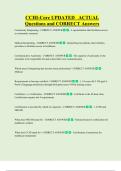
CCHI-Core UPDATED ACTUAL
Questions and CORRECT Answers
Community Interpreting - CORRECT ANSWER - A specialization that facilitates access
to community resources
Medical Interpreting - CORRECT ANSWER - Interpreting for patients, their families,
providers to facilitate access to healthcare
Communicative Autonomy - CORRECT ANSWER - The capacity of each party in the
encounter to be responsible for and control their own communication
Which area of interpreting has become more professional - CORRECT ANSWER -
Medical
Requirements to become certified - CORRECT ANSWER - 1. 18 years old 2. HS grad 3.
Proof of language proficiency through third party tester 4.40 hr training course
Certificate v.s. Certification - CORRECT ANSWER - Certificate is the 40 hour class,
Certification requires the 4 requirements
Certification is provided by which two agencies - CORRECT ANSWER - 1. CCHI and
NBCMI
What does NBCMI stand for - CORRECT ANSWER - National board of certification for
healthcare workers
What does CCHI stand for - CORRECT ANSWER - Certification Commission for
healthcare interpreters
,What are ethics vs standards - CORRECT ANSWER - Ethics-what we do Standards-how
we do them
Ethics are defined as - CORRECT ANSWER - A set of principles that govern the conduct
of practitioners of a profession
Standards of practice are defined as - CORRECT ANSWER - A set of formal guidelines
that practitioners use that offer clear strategies and course of action to support professional
conduct
What are the ethics that make up the code of ethics - CORRECT ANSWER - 1.
Confidentiality 2. Accuracy 3. Impartiality 4. professional conduct 5. Transparency 6.
intercultural communication 7. advocacy 8. professional boundaries 9. professional development
10. Direct communication
Do you interpret everything stated? - CORRECT ANSWER - yes
What three things should you do if you know the client - CORRECT ANSWER - 1.
disclose to all parties 2. Offer to withdraw 3. decide if you can be impartial
Three steps to the say no module - CORRECT ANSWER - 1. gracious 2. offer choices 3.
reason why
working language - CORRECT ANSWER - any language the interpreter works with
Source language - CORRECT ANSWER - language the interpreter interprets from
target language - CORRECT ANSWER - language you interpret in to
three stages of the encounter - CORRECT ANSWER - 1. pre prep/briefing 2.encounter 3.
debriefing
, 7 steps to the encounter - CORRECT ANSWER - 1. Prep 2. brief 3.professional intro 4.
interpreting 5. mediating 6. debriefing 7. analysis
4 interpreting protocols - CORRECT ANSWER - 1. positioning 2. professional intro 3.
first-person interpreting 4. turn-taking to manage flow
4 elements of the professional introduction - CORRECT ANSWER - 1. confidential 2. all
interpreted 3. speak to each other 4. pause for clarification
use third person interpreting when - CORRECT ANSWER - 1. children under 7 2.
dementia, intox, psychotic 3. emergencies
What steps to take if provider uses 3rd person - CORRECT ANSWER - 1. unobtrusive
position and avoid eye contact 2. clarify role 3. use a hand gesture to direct provider to client 4.
interpret in 3rd person 5. mediate outside of session to explain to provider that first person
promotes direct communication
chunking - CORRECT ANSWER - breaking down info into smaller parts that are easier to
remember
Imagery - CORRECT ANSWER - visualizing what you hear with who did what
three modes of interpreting - CORRECT ANSWER - 1. consecutive 2. simultanious 3.
sight translation
message transfer skills - CORRECT ANSWER - 1. parroting 2. paraphrasing 3. anticipate
4. message analysis
Eleven steps to sight translation - CORRECT ANSWER - 1. provider remains present 2.
Assess text with CALL model to see if you should translate 3. read text from start to finish 4. Id
Questions and CORRECT Answers
Community Interpreting - CORRECT ANSWER - A specialization that facilitates access
to community resources
Medical Interpreting - CORRECT ANSWER - Interpreting for patients, their families,
providers to facilitate access to healthcare
Communicative Autonomy - CORRECT ANSWER - The capacity of each party in the
encounter to be responsible for and control their own communication
Which area of interpreting has become more professional - CORRECT ANSWER -
Medical
Requirements to become certified - CORRECT ANSWER - 1. 18 years old 2. HS grad 3.
Proof of language proficiency through third party tester 4.40 hr training course
Certificate v.s. Certification - CORRECT ANSWER - Certificate is the 40 hour class,
Certification requires the 4 requirements
Certification is provided by which two agencies - CORRECT ANSWER - 1. CCHI and
NBCMI
What does NBCMI stand for - CORRECT ANSWER - National board of certification for
healthcare workers
What does CCHI stand for - CORRECT ANSWER - Certification Commission for
healthcare interpreters
,What are ethics vs standards - CORRECT ANSWER - Ethics-what we do Standards-how
we do them
Ethics are defined as - CORRECT ANSWER - A set of principles that govern the conduct
of practitioners of a profession
Standards of practice are defined as - CORRECT ANSWER - A set of formal guidelines
that practitioners use that offer clear strategies and course of action to support professional
conduct
What are the ethics that make up the code of ethics - CORRECT ANSWER - 1.
Confidentiality 2. Accuracy 3. Impartiality 4. professional conduct 5. Transparency 6.
intercultural communication 7. advocacy 8. professional boundaries 9. professional development
10. Direct communication
Do you interpret everything stated? - CORRECT ANSWER - yes
What three things should you do if you know the client - CORRECT ANSWER - 1.
disclose to all parties 2. Offer to withdraw 3. decide if you can be impartial
Three steps to the say no module - CORRECT ANSWER - 1. gracious 2. offer choices 3.
reason why
working language - CORRECT ANSWER - any language the interpreter works with
Source language - CORRECT ANSWER - language the interpreter interprets from
target language - CORRECT ANSWER - language you interpret in to
three stages of the encounter - CORRECT ANSWER - 1. pre prep/briefing 2.encounter 3.
debriefing
, 7 steps to the encounter - CORRECT ANSWER - 1. Prep 2. brief 3.professional intro 4.
interpreting 5. mediating 6. debriefing 7. analysis
4 interpreting protocols - CORRECT ANSWER - 1. positioning 2. professional intro 3.
first-person interpreting 4. turn-taking to manage flow
4 elements of the professional introduction - CORRECT ANSWER - 1. confidential 2. all
interpreted 3. speak to each other 4. pause for clarification
use third person interpreting when - CORRECT ANSWER - 1. children under 7 2.
dementia, intox, psychotic 3. emergencies
What steps to take if provider uses 3rd person - CORRECT ANSWER - 1. unobtrusive
position and avoid eye contact 2. clarify role 3. use a hand gesture to direct provider to client 4.
interpret in 3rd person 5. mediate outside of session to explain to provider that first person
promotes direct communication
chunking - CORRECT ANSWER - breaking down info into smaller parts that are easier to
remember
Imagery - CORRECT ANSWER - visualizing what you hear with who did what
three modes of interpreting - CORRECT ANSWER - 1. consecutive 2. simultanious 3.
sight translation
message transfer skills - CORRECT ANSWER - 1. parroting 2. paraphrasing 3. anticipate
4. message analysis
Eleven steps to sight translation - CORRECT ANSWER - 1. provider remains present 2.
Assess text with CALL model to see if you should translate 3. read text from start to finish 4. Id