

Written by students who passed Immediately available after payment Read online or as PDF Wrong document? Swap it for free 4.6 TrustPilot
logo-home
Document preview thumbnail
Preview 4 out of 73 pages
Exam (elaborations)

NCLEX -Practice questions and answers

Document preview thumbnail
Preview 4 out of 73 pages

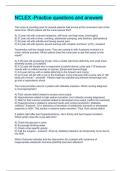
NCLEX -Practice questions and answers The nurse is providing care for several patients that arrived at the convenient care at the same time. Which patient will the nurse assess first? A) 15 year old with a severe headache, stiff neck, and high temp. [meningitis] B) 27 year old with a fever, vomiting, abdominal cramping, and diarrhea. [dehydration] C) 62 year old with arthritis and having severe pain. D) 43 year old with dysuria, severe burning with urination and fever. [UTI] A Paramedics call the charge nurse. They are coming in with 4 patients involved in a motor vehicle accident. Which patient does the nurse plan to see first based on the report? A) A 26 year old screaming of pain. Has a visible right knee deformity and weak lower extremity pulses. [circulation] B) A 22 year old female who is responsive to painful stimuli, pulse rate 118 beats per minute with no visible traumas or injuries. [intracranial hemorrhage] C) A 6 year old boy with a visible deformity to the forearm and crying. D) an 8 year old girl with a cut on the forehead, crying intensely with a pulse rate of 126 beats per minute. B - Patient might be experiencing internal hemorrhage and go into a hypovolemic shock The nurse provides care for a patient with diabetes insipidus. Which nursing diagnosis is most appropriate? A) Fluid volume deficit related to excess urine output. B) Hyponatremia related to high sodium excretion. [not a Nanda nursing diagnoses] C) Risk for fluid volume overload related to decreased urine output [ deficit not overload] D) Hyperglycemia is related to reduced insulin and cortisol production. [diabetes mellitus] A - DI is deficiency of secretion of antidiuretic hormone or decreased response to ADH. This results in massive water excretion. Thus, fluid volume deficit A patient right after post hypophysectomy. He is thirsty and has frequent urination. Which action does the nurse take first? A) Check the glucose in urine B) Encourage drinking water C) Check urine specific gravity D) Call the surgeon C -Post-op, diabetes insipidus can temporarily occur due to low ADH Which Outcome indicates that the intervention for a patient with syndrome of inappropriate antidiuretic hormone {SIADH} has been effective? A) Decreased serum osmolality B) Serum sodium is decreased C) Increased urine output D) Increased urine osmolality C- Increased urine output - sign that treatment is effective The nurse performs a newborn assessment. Which finding does the nurse report to the physician? A) Pink patch on the back of the neck B) Bluish skin over the sacral gluteal area C) A rectal temperature of 98*F D) A respiratory rate of 24 breaths per minute D: normal resp rate ~ 30-60; Pink patch ~ {stork bite} normal, bluish skin ~ {mangolian spots} normal;, Newborn 0-2yr old, Infants 1 yr old The oncology nurse is giving a teach about risk factors and demographics of lung cancer at a gathering at the local community clinic. Which group of individuals has the highest risk for lung cancer? A)African Americans B) Caucasians C) South East Asians D) Latins A The SpO2 of a lung cancer patient drops from 92% to 85% during ambulation. Which action does the nurse take next? A) This is a normal drop in response to activity with lung cancer patients B) Relocate the oximetry probe to the earlobe during activity C) Obtain an order for supplemental oxygen to be used during activity D) Obtain an order for ABGs to verify the arterial oxygen saturation C-supplemental o2 is needed to increase supply of oxygen during activity; the probe was reading well at 92%, no need to relocate The nurse moves a patient from the bed to a chair. Which technique does the nurse use to maintain proper body mechanics?(Select all that apply) A) A wide stance with one foot back and one to the front B )Use upper back muscles when pulling patient to a stand C) Position yourself between the chair and the patient D) Hold patient at arms length when standing E) Pivot toward the chair using leg muscles A,E A 50 year old patient who just had a heart attack. He is prescribed enteric coated aspirin. Which action does the nurse take in this situation? A) Administer the aspirin with a lot of water via nasogastric tube. B) Obtain a blood type and crossmatch for transfusion. C) Check his past medical history for peptic ulcer disease D) Get a 6 lead electrocardiogram prior to administering the aspirin C - peptic ulcer disease is a contraindication for non-enteric coated aspirin {normal can cause peptic ulcers}. Enteric coated meds can not be crushed & given through NG The patient gets his medication via NGT, which medication does the nurse need to call the provider for? A) KCL oral solution B) Phenytoin C) Captopril tablet D) Aspirin- EC D- Aspirin EC {enteric coated} should not be crushed The nurse provides pre-op teaching for a patient. Which kind of anesthesia alters the level of consciousness? (Select all that apply} A) General anesthesia B) Topical anesthesia C) Regional anesthesia D) local anesthesia E) conscious sedation A,E The nurse provides care for a patient who had an unexpected death during a night shift. The patient has many tubes and drains in place. The nurse is performing postmortem care of the deceased patient. Which action by the nurse is appropriate when managing the tubes prior to a scheduled autopsy? A) Discontinue tubes and drains and send to autopsy with the body B) Discontinue tubes and drains and put them in biohazardous bags C) Keep all tubes and drains in place in the patient's body D) Keep Iv tubes in place but remove drains. C -If an autopsy is to be performed, any tubes or drains will be left in place to be assessed and cultured, then removed by the medical examiner The nurse auscultates a patient's bowel sounds. Which finding is most important for the nurse to report to the physician? A) Bruit sound over the abdominal aorta B) Irregular bowel sounds C) Uninterrupted bowel sounds over the ileocecal area D) Absent bowel sounds for a whole 1 minute A- burit signifies a turbulence ~ Abdominal Aortic Aneurysm {AAA} - emergent; Listen for 3-5 minutes, small bowel sounds are continuous {fluid}, bowel are not "regular" A patient is scheduled to receive an IV antibiotic q 8 hours, next dose is at 2p.m. The patient is prescribed peak and trough blood levels. At which time does the nurse schedule the trough level to be drawn? A) 1430 B) 1500 C) 1330 D) 1400 C - a trough level is drawn approximately 30 minutes before the next scheduled dose Patient is getting gentamicin IV every 8 hours. The provider ordered a gentamicin peak. If the medication is administered at 10 am over one hour, at which time should the nurse draw the gentamicin peak? A) 10 am just before giving the dose B) 12 noon C) 11:30 am D) 5:30 pm just before the next due dose C - peak occurs 30 minutes after to completion of IV drug The nurse provides care to a new admission. Which action is the best example of culturally appropriate nursing intervention? A) Assign the family members to most of the patients personal care B) Take a permission before touching the patient for the physical assessment C) Keep a personal space of 3 feet when assessing the patient D) Keep in mind the patient's ethnicity as the most important factor in planning care B - many cultures consider it disrespectful to touch a patient without asking permission; in a NEW admission, the ethnicity is not the most important factor The nurse provides care for a patient with acute anxiety. What is most important for the nurse to assess the patient for? A) Respiratory alkalosis B) Respiratory acidosis C) Metabolic alkalosis D) Metabolic acidosis A - anxiety causes hyperventilation, which results in a loss of carbon dioxide. Respiratory alkalosis is caused by decreased carbon dioxide in the blood A patient who had gastric surgery 2 days ago has an NGT attached to intermittent suction. The patient had a large amount of secretions in the last day down in the suction bottle. Which ABGs result will the nurse expect to see? A) pH - 7.23, PaCO2 - 48 mmHG B) pH - 7.39, PaCO2 - 38 mmHg C) pH - 7.49, HCO - 30 mmol/L D) pH- 7.28, HCO - 20 mmol/L C - this ABG reflect metabolic alkalosis A patient states "I feel ugly because I lost my hair" after receiving chemotherapy for ovarian cancer. Which statement does the nurse say to help the patient cope with those feelings? A) "Lets see how you look with a shawl or hat" B) "Your hair will grow back 3-4 months after you finish treatment" C) "Some women shave their heads when this starts to happen" D) "Just think how it makes you not brushing your hair every day" A- the patient has feelings of a distrubed body image and low self esteem because of hair loss. The nurse needs to say something to improve those feelings. Suggesting a scarf or hat is appropriate. It will offer an immediate solution to the patient. C-Telling the pt that shaving her head will not help her cope with her current feelings right away , B dodges the empathy needed with this situation, D- is almost sarcastic The nurse provides care for a patient with facial, and neck burns. What is the best position for the patient? A) Prone with a rolled sheet under the head B) Supine with padding on the affected side C) Supine without pillows or padding D) Prone without extra padding around the head C- a supine position minimizes pressure and irritation to the burned areas, but burned areas may stick to pillows or padding. Pillows may cause contraction in patients with neck burns. While frying chicken, the hot oil fell on the patient's abdomen and thighs. Patient was diagnosed with 3rd degree burns while in the ED. Which finding will the nurse expect to observe during the emergent phase of the burn injury? A) High hematocrit B) Slow heart rate C) Elevated blood pressure D) Increased urinary output A - a large fluid shift will occur from intravascular to interstitial What is the single most important act the preceptor should emphasize on while orienting a new nurse on a burn unit? A) Put on PPE including head and shoe covers B) Make sure medical equipment is not shared between patient rooms C) Put patients with infection in private negative pressure rooms D) Wash hands thoroughly and consistently during your shift D- hand washing is the single most important act to prevent transmission of infection on a burn unit The nurse provides care for a 16-year old patient who is diagnosed with meningitis. The provider ordered intravenous and oral hydration. The nurse closely monitors the patient's fluid intake. Which serious complication does the nurse monitor for this patient? A) Heart failure B) Hypovolemic shock C) Cerebral edema D) Pulmonary edema C- because of the inflammation of the meninges, the patient is vulnerable to developing cerebral edema and increased intracranial pressure. Patient had a car accident, she is oriented to self but not to time and place. The patient complains of a severe headache and is restless. Which action does the nurse take first? A) Help the patient remember the current location and time of the day B) Put the patient in a vest restraint C) Neurological assessment every 15 minutes D) Give the patient PRN morphine and lorazepam C- Remember ADPIE, increased ICP is suspected. Confusion, restlessness, pupillary changes, and altered level of consciousness are the earliest signs A patient experiences a fever, headache, photophobia, and neck stiffness. Which transmission-based precaution will the nurse implement for this patient? A) Contact B) Airborne C) Droplet D) Standard C- the patient's symptoms are consistent with N. meningitis and droplet precautions should be used A patient had a car accident, is unconscious from a severe head injury and a back fracture. The patient has no ID on him, but needs emergency surgery. Which action is best for the nurse to take when obtaining informed consent for the surgery? A) Ask the ED provider to sign the informed consent B) Get an urgent court order for the surgery C) Transport the patient to the OR for surgery D) Request the police to locate the family and identify the patient C- Informed consent of an adult is not needed when in emergency situation, and delaying treatment could cause death of patient The nurse assess distended neck veins in a patient reporting shortness of breath and chest pain. Which problem is causing the Jugular Vein Distention? A) Dehydration B) Brain mass C) Fluid overload D) Electrolyte imbalance C- fluid overload causes increase of blood volume. This increase causes the veins to distend, most obviously in the neck veins. The RN is reviewing how to prevent medication error with a nursing student. Which response by the nursing student indicates that additional teaching is required? (Select all that apply) A) Preparing medications for patients independently B) Checking the MAR against the drug level at least two times prior to administering the medication C) Trusting the health care provider and not questioning a medication ordered D) Instant documentation of all medications when given E) Using two patient identifiers when administering medications B,C -Check the MAR at least 3x {pulling drug, preparing medication, at bedside}, verify orders A patient states: I promise not to touch the foley anymore, I don't want to be slapped. Which action does the nurse take first? A) A thorough neurological assessment B) Questioning the nursing assistive personnel if the patient was slapped when providing care C) Ask the patient where he got slapped and who did it D) Document the patient's exact words and inform your supervisor C - the nurse has to assess if an assault or battery occurred and by whom. This should be done prior to documentation and reporting the event to your manager. File an incident report no documentation in pt chart is needed. The nurse provides care for a patient receiving external radiation to the abdomen. Which action by the nurse is best? A) Do a thorough assessment and monitoring of the patient's skin B) Monitor white blood count and neutropenia C ) NPO 2 hours before procedure D) Dump the patient's urine in a specific lead-lined containers A- External radiation is damaging to the skin, must be assessed carefully, B is needed for chemo, c not necessary, d is for internal radiation The RN is reinforcing infection control guidelines to a group of nursing students. What data is most important for the nurse to include? A) Always wear a gown when assessing the BP of a patient with a methicillin- resistant Staphylococcus aureus (MRSA) infection B) The door of the patient's room with a C-diff should be closed at all times C) Patient with a hepatitis b infection should eat with disposable utensils D) Surgical mask should be worn when caring for a patient with pulmonary TB A- Contact precautions are used to control the spread of organisms that are acquired from direct or indirect contact, especially multidrug-resistant organisms such as MRSA A new NAP is on the unit, the nurse delegates finger-stick glucose check and then discovers that the NAP has never done this task before, and changes the assignment. Why did the nurse change the assignment? A) It is not the right supervision B) It's not the right person C) It's not the right circumstance D) It's not the right direction B- it is not the right person. Choosing the correct personnel to complete the task {nerve done it before}; Supervision {appropriate monitoring, intervention and follow up}, circumstance{using appropriate pt & setting to determine if it is right}, direction{giving the right direction for a task} The nurse delegates ambulating a patient 4 days after surgery to a nursing assistive personnel (NAP). Which type of delegation is the nurse following? A) Supervision B) Circumstance C) Person D) Communication B - the person is stable 4 days post op The nurse delegates tasks to a nursing assistive personnel for the first time. Which actions are appropriate for the nurse to implement? (Select all that apply) A) Explain to the NAP which tasks will be delegated B) Explain to the NAP how to report task completion C) Permit the NAP to decide which patient changes to report D) Allow the NAP to decide when tasks will be completed E) Explain to the NAP the expected task outcomes A,B,E The nurse reviews care needed for a patient 2 days post-operation.Which would the nurse delegate to nursing assistive personnel (NAP)?(Select all that apply) A) Apply T.E.D. stockings B) Measure height and weight and document it C) Educate on performing breathing exercise D) Check for urinary retention using a bladder ultrasound E) Assist in wearing a leg prosthesis A,B,E Which tasks can be delegated to a UAP? A) Inserting a foley catheter B) Measuring and recording the patient's output through a Foley catheter C) Teaching a patient how to care for a catheter after discharge D) Assessing for symptoms of a urinary tract infection? B- falls w/i the implementation phase of the nursing process and does not require nursing judgement. Evaluation of the intake & output must be done by the nurse The nurse is getting a 22 year old patient ready before surgery. What would the nurse delegate to the nursing assistive personnel? (SATA) A) Getting a clean catch urinalysis B) Taking vital signs C) Assess lung sounds D) Put on T.E.D. stockings E) Educate patient on correct technique to use incentive spirometer A,B,D The nurse provides care for multiple patients. Which tasks does the nurse delegate to the nursing assistive personnel?(SATA) A) Assess patient's pain level B) Teach patient how to perform crutches use C) Hand meal trays D) Give bath to a patient with a surgical site E) Get standard vital signs C,D,E The nurse is looking to prevent venous thromboembolism. Which action does the nurse delegate to the NAP? (SATA) a) Change the patient's position every 2 hours B) Help the patient ambulate as needed C) Give the patient education materials on venous thromboembolism D) Apply sequential compression devices E) Apply compression stockings A,B,D,E Which activity does the nurse delegate to nursing assistive personnel? (SATA) A) Teach the patient how to self-administer a small enema B) Take vital signs of a patient with contact precautions C) Take the patient's vital signs at 10 minutes from the blood transfusion start D) Reinforce the dressing of a pressure ulcer E) Help a patient with poor eyesight to get to the bathroom B,E The nurse provides care for an elderly patient with no past medical history.The nurse evaluates the patient's immunization status. Which of the patient's immunizations are up-to-date? (SATA) A) Receive his tetanus booster at age 60 B) Did not get the hepatitis A vaccine yet C) Last herpes zoster vaccine at age 60 D) Did not get the hepatitis B vaccine yet E) Got flu shot this season A,C,E - the pt has no medical history {not at risk does not need hep vaccine} The nurse provides care for the patient receiving radiation therapy for lung cancer. Which patient statement indicates to the nurse that further intervention is needed due to the side effects of radiation? (SATA) A) "I'm having difficulty swallowing" B) "I am missing days at work recently" C) "I haven't had a bowel movement in 4 days" D) "I have rash on my arm pits" E) "My hair is falling out in clumps" A,B,D - Radiation to lungs could be affecting tissues around the throat {airway}, the patient is fatigued, radiation therapy can cause rashes → deodorant is an irritant; constipation and alopecia is usually found in CHEMO pts When do you administer the Herpes live vaccine? A) 40-50 years B) 50-60 years C) 60 years C A patient, who takes medication for hypertension, complaints of a dry cough. Which medication will the nurse suspect is causing the cough? A) Amlodipine B) Lisinopril C) Verapamil D) Propranolol B - ACE inhibitors most common side effect is a non-productive cough During a patient education seminar about colorectal cancer. Which patient does the nurse identify as being at higher risk for colorectal cancer? A) A 20 year old patient who exercises regularly B) A 56 year old patient who follows a high fat diet C) A 32 year- old adult who has an uncle with colon cancer D) A 45 year old female who had hysterectomy 2 years ago B - the patient has a couple of risk factors, age 50 years old, and following a high fat diet; familial history of 1st degree relatives {parents, siblings} is a risk factor not an uncle. The nurse assesses a patient diagnosed with colorectal cancer. What symptoms does the nurse ask the patient during admission assessment? (SATA) A) Instant abdominal bloating B) Severe spasmodic abdominal pain C) Ribbonlike stools D) Rectal bleeding E) Diarrhea and/or constipation C,D,E - these are symptoms of colorectal cancer. Patients with colon cancer, especially those with cancer on right colon may experience colics, cramping and pain, left of colon {colorectal cancer}will not; Instant abdominal bloating is a sign for obstruction A patient with B-cell leukemia is getting high dose methotrexate. Which statement by the patient shows understanding of appropriate precautions? (SATA) A) Brushing and flossing my teeth twice a day is very important B) Visitors to my room should not bring flowers C) I will bring my own pillow and blanket from home because I can't sleep without them D) I will only shave with my personal electric razor E) I will only allow visitors who have a cold into my room if they wear a mask B,D- Methotrexate is a chemotherapy drug. Patients receiving chemo are recommended to use soft toothbrushes or sponges, never floss {high tendencies to bleeding}; flowers are a high medium for bacterial growth, pt are at high risk of infection The nurse provides care for the patient diagnosed with esophageal cancer. Which goal does the nurse establish in the plan of care? (SATA) A) Patient will be in complete remission of his cancer B) Patient will be able to eat without aspirating C) Patient's pain will be controlled D) Patient will maintain his baseline weight E) patient will consider hospice care B,C,D - these are appropriate goals for the nursing plan of care While administering blood for a patient, which action will the nurse take to maintain safety? (SATA) A) Verify patient's identification with at least two identifiers B) Give the blood unit as soon as it arrives on the unit C) Administer the blood unit within 2 hours for increased benefit D) During the first 15 minutes, stay with the patient E ) Get a PRN order for 1-2 liters of oxygen during the transfusion time A,B,D - verify identification with at least 2 identifiers, The RN should check vital signs every 5 minutes for the first 15 minutes, Blood should be administered within the first 30 minutes of the blood leaving the blood bank; blood should be given over 2-4 hours to reduce the risk of fluid overload, o2 is not routinely administered during blood transfusion The nurse provides care for a patient diagnosed with neonatal abstinence syndrome. A newborn is having drug withdrawal symptoms. What nursing interventions would the nurse include in the plan of care? (SATA) A) Swaddle the newborn in a flexed position B) Maintain the newborn in a prone position C) Frequently feed the newborn a high-calorie formula D) Station the newborn in a quiet area on the unit E) Dimmed light around newborn's crib provides a more peaceful environment A,D,E - swaddling the pt will comfort them {similar to when they were in utero} and in a flexed position will prevent startle, place newborn in a quiet, dimmed lighting area to prevent agitation; You do not place an infant prone unattended → SIDS, it is not necessary to frequently feed the newborn What potential long-term effects of fetal alcohol syndrome does the nurse include in teaching for pregnant women about alcohol consumption during pregnancy? (SATA) A) Delayed physical growth B) Facial deformities C) Respiratory depression D) Learning disabilities E) Hypotension A,C,D The nurse provides care to a newly diagnosed patient with schizophrenia who is prescribed chlorpromazine 25 mg PO TID. Which patient statement indicates a correct understanding of taking the medication? (SATA) A) I'll brush my teeth three times a day B) It will take 4-6 weeks for my medication to start working C) I may have a glass of wine each night because it is good for the heart D) I can drive myself to work on Monday E) I have to get blood levels regularly for a couple of months F) I will not worry about pink urine A,B,E,F - Chlorpromazine has a side effect of extremely dry mouth so oral hygiene is very important, phenothiazines take 4-6 weeks to see signs of improvement,chlorpromazine has an effect on white blood cells and can cause leukocytopenia, this medication is known to cause pink tinged urine; no alcohol, no heavy machinery {cars} on an antipsychotic,

Content preview

NCLEX -Practice questions and answers
The nurse is providing care for several patients that arrived at the convenient care at the
same time. Which patient will the nurse assess first?

A) 15 year old with a severe headache, stiff neck, and high temp. [meningitis]
B) 27 year old with a fever, vomiting, abdominal cramping, and diarrhea. [dehydration]
C) 62 year old with arthritis and having severe pain.
D) 43 year old with dysuria, severe burning with urination and fever. [UTI] - answerA

Paramedics call the charge nurse. They are coming in with 4 patients involved in a
motor vehicle accident. Which patient does the nurse plan to see first based on the
report?

A) A 26 year old screaming of pain. Has a visible right knee deformity and weak lower
extremity pulses. [circulation]
B) A 22 year old female who is responsive to painful stimuli, pulse rate 118 beats per
minute with no visible traumas or injuries. [intracranial hemorrhage]
C) A 6 year old boy with a visible deformity to the forearm and crying.
D) an 8 year old girl with a cut on the forehead, crying intensely with a pulse rate of 126
beats per minute. - answerB - Patient might be experiencing internal hemorrhage and
go into a hypovolemic shock

The nurse provides care for a patient with diabetes insipidus. Which nursing diagnosis
is most appropriate?

A) Fluid volume deficit related to excess urine output.
B) Hyponatremia related to high sodium excretion. [not a Nanda nursing diagnoses]
C) Risk for fluid volume overload related to decreased urine output [ deficit not overload]
D) Hyperglycemia is related to reduced insulin and cortisol production. [diabetes
mellitus] - answerA - DI is deficiency of secretion of antidiuretic hormone or decreased
response to ADH. This results in massive water excretion. Thus, fluid volume deficit

A patient right after post hypophysectomy. He is thirsty and has frequent urination.
Which action does the nurse take first?

A) Check the glucose in urine
B) Encourage drinking water
C) Check urine specific gravity
D) Call the surgeon - answerC -Post-op, diabetes insipidus can temporarily occur due to
low ADH

Which Outcome indicates that the intervention for a patient with syndrome of
inappropriate antidiuretic hormone {SIADH} has been effective?

,A) Decreased serum osmolality
B) Serum sodium is decreased
C) Increased urine output
D) Increased urine osmolality - answerC- Increased urine output - sign that treatment is
effective

The nurse performs a newborn assessment. Which finding does the nurse report to the
physician?

A) Pink patch on the back of the neck
B) Bluish skin over the sacral gluteal area
C) A rectal temperature of 98*F
D) A respiratory rate of 24 breaths per minute - answerD: normal resp rate ~ 30-60; Pink
patch ~ {stork bite} normal, bluish skin ~ {mangolian spots} normal;, Newborn 0-2yr old,
Infants <1 yr old

The oncology nurse is giving a teach about risk factors and demographics of lung
cancer at a gathering at the local community clinic. Which group of individuals has the
highest risk for lung cancer?

A)African Americans
B) Caucasians
C) South East Asians
D) Latins - answerA

The SpO2 of a lung cancer patient drops from 92% to 85% during ambulation. Which
action does the nurse take next?

A) This is a normal drop in response to activity with lung cancer patients
B) Relocate the oximetry probe to the earlobe during activity
C) Obtain an order for supplemental oxygen to be used during activity
D) Obtain an order for ABGs to verify the arterial oxygen saturation - answerC-
supplemental o2 is needed to increase supply of oxygen during activity; the probe was
reading well at 92%, no need to relocate

The nurse moves a patient from the bed to a chair. Which technique does the nurse use
to maintain proper body mechanics?(Select all that apply)

A) A wide stance with one foot back and one to the front
B )Use upper back muscles when pulling patient to a stand
C) Position yourself between the chair and the patient
D) Hold patient at arms length when standing
E) Pivot toward the chair using leg muscles - answerA,E

,A 50 year old patient who just had a heart attack. He is prescribed enteric coated
aspirin. Which action does the nurse take in this situation?

A) Administer the aspirin with a lot of water via nasogastric tube.
B) Obtain a blood type and crossmatch for transfusion.
C) Check his past medical history for peptic ulcer disease
D) Get a 6 lead electrocardiogram prior to administering the aspirin - answerC - peptic
ulcer disease is a contraindication for non-enteric coated aspirin {normal can cause
peptic ulcers}. Enteric coated meds can not be crushed & given through NG

The patient gets his medication via NGT, which medication does the nurse need to call
the provider for?

A) KCL oral solution
B) Phenytoin
C) Captopril tablet
D) Aspirin- EC - answerD- Aspirin EC {enteric coated} should not be crushed

The nurse provides pre-op teaching for a patient. Which kind of anesthesia alters the
level of consciousness? (Select all that apply}

A) General anesthesia
B) Topical anesthesia
C) Regional anesthesia
D) local anesthesia
E) conscious sedation - answerA,E

The nurse provides care for a patient who had an unexpected death during a night shift.
The patient has many tubes and drains in place. The nurse is performing postmortem
care of the deceased patient. Which action by the nurse is appropriate when managing
the tubes prior to a scheduled autopsy?

A) Discontinue tubes and drains and send to autopsy with the body
B) Discontinue tubes and drains and put them in biohazardous bags
C) Keep all tubes and drains in place in the patient's body
D) Keep Iv tubes in place but remove drains. - answerC -If an autopsy is to be
performed, any tubes or drains will be left in place to be assessed and cultured, then
removed by the medical examiner

The nurse auscultates a patient's bowel sounds. Which finding is most important for the
nurse to report to the physician?

A) Bruit sound over the abdominal aorta
B) Irregular bowel sounds
C) Uninterrupted bowel sounds over the ileocecal area

, D) Absent bowel sounds for a whole 1 minute - answerA- burit signifies a turbulence ~
Abdominal Aortic Aneurysm {AAA} - emergent; Listen for 3-5 minutes, small bowel
sounds are continuous {fluid}, bowel are not "regular"

A patient is scheduled to receive an IV antibiotic q 8 hours, next dose is at 2p.m. The
patient is prescribed peak and trough blood levels. At which time does the nurse
schedule the trough level to be drawn?

A) 1430
B) 1500
C) 1330
D) 1400 - answerC - a trough level is drawn approximately 30 minutes before the next
scheduled dose

Patient is getting gentamicin IV every 8 hours. The provider ordered a gentamicin peak.
If the medication is administered at 10 am over one hour, at which time should the
nurse draw the gentamicin peak?

A) 10 am just before giving the dose
B) 12 noon
C) 11:30 am
D) 5:30 pm just before the next due dose - answerC - peak occurs 30 minutes after to
completion of IV drug

The nurse provides care to a new admission. Which action is the best example of
culturally appropriate nursing intervention?

A) Assign the family members to most of the patients personal care
B) Take a permission before touching the patient for the physical assessment
C) Keep a personal space of 3 feet when assessing the patient
D) Keep in mind the patient's ethnicity as the most important factor in planning care -
answerB - many cultures consider it disrespectful to touch a patient without asking
permission; in a NEW admission, the ethnicity is not the most important factor

The nurse provides care for a patient with acute anxiety. What is most important for the
nurse to assess the patient for?

A) Respiratory alkalosis
B) Respiratory acidosis
C) Metabolic alkalosis
D) Metabolic acidosis - answerA - anxiety causes hyperventilation, which results in a
loss of carbon dioxide. Respiratory alkalosis is caused by decreased carbon dioxide in
the blood


Document information

Uploaded on
November 16, 2025
Number of pages
73
Written in
2025/2026
Type
Exam (elaborations)
Contains
Questions & answers
$17.99

Wrong document? Swap it for free Within 14 days of purchase and before downloading, you can choose a different document. You can simply spend the amount again.
Written by students who passed
Immediately available after payment
Read online or as PDF

Seller avatar
Reputation scores are based on the amount of documents a seller has sold for a fee and the reviews they have received for those documents. There are three levels: Bronze, Silver and Gold. The better the reputation, the more your can rely on the quality of the sellers work.
Pogba119
3.9
(14)
Sold
59
Followers
2
Items
5448
Last sold
1 month ago


Why students choose Stuvia

Created by fellow students, verified by reviews

Quality you can trust: written by students who passed their tests and reviewed by others who've used these notes.

Didn't get what you expected? Choose another document

No worries! You can instantly pick a different document that better fits what you're looking for.

Pay as you like, start learning right away

No subscription, no commitments. Pay the way you're used to via credit card and download your PDF document instantly.

Student with book image

“Bought, downloaded, and aced it. It really can be that simple.”

Alisha Student

Working on your references?

Create accurate citations in APA, MLA and Harvard with our free citation generator.

Working on your references?

Frequently asked questions
