ARM 401 TEST PAPER 2026 QUESTIONS
AND CORRECT ANSWERS GRADED A+
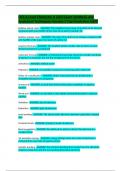
⩥ operational risk. Answer: uncertainties associated with the
organizations procedures, systems, and policies
⩥ financial risk. Answer: uncertainties associated with the organizations
financial activities
⩥ facilitated workshops. Answer: a neutral party, who has no stake int he
outcome or participation responsibilities, administers the risk workshop
and propels the group to achieve its goal
⩥ delphi technique. Answer: uses opinions of a select group of experts
to identify risks
⩥ scenario analysis. Answer: identifies risks and predicts the potential
consequences of those specific risks
⩥ HAZOP. Answer: a team of subject matter experts and stakeholders
identifies the risks associated with a given process and recommends a
solution
,primarily used to design complex, scientific systems such as those used
in engineering, chemical, mechanical, electronic, and computer
operations.
⩥ SWOT analysis. Answer: strengths, weaknesses, opportunities, and
threats
this is a team approach thats useful in analyzing a new project or product
⩥ risk threshold. Answer: the range or amount of risk that is acceptable
⩥ sensor. Answer: a device that detects and measures stimuli in its
environment
⩥ radio frequency identification (RFID). Answer: a technology that uses
radio frequency to identify objects
⩥ artificial intelligence. Answer: computer process or output that
stimulates human reasoning or knowledge
⩥ computer vision. Answer: a technology that simulates human vision
⩥ risk register. Answer: a tool developed at the risk owner level that
links specific activities, processes, projects, or plans to a list of identified
, risks and results of risk analysis and evaluation and that is ultimately
consolidated at the enterprise level
⩥ risk map. Answer: a template depicting the likelihood and potential
impact/consequences of risk
identify, prioritize, and quantify risks in a two dimensional pictorial that
illustrates frequency and severity on vertical and horizontal axes
⩥ process flow analysis. Answer: dissects processes within the
organization from input to output for the purpose of improving them
⩥ audits. Answer: internal and external audits have the potential to
identify both negative risks and opportunity risks
⩥ cause and effect analysis. Answer: identifies the possible reasons,
direct and contributory, that caused a negative event or problem by
looking backwards through a defective process
⩥ fault tree analysis. Answer: a process that originates with an
assumption about what caused an event or failure
working downward from the assumption, a diagram is used to connect
the factors that caused the failure and determine how to devise methods
to prevent similar failures in the future
AND CORRECT ANSWERS GRADED A+
⩥ operational risk. Answer: uncertainties associated with the
organizations procedures, systems, and policies
⩥ financial risk. Answer: uncertainties associated with the organizations
financial activities
⩥ facilitated workshops. Answer: a neutral party, who has no stake int he
outcome or participation responsibilities, administers the risk workshop
and propels the group to achieve its goal
⩥ delphi technique. Answer: uses opinions of a select group of experts
to identify risks
⩥ scenario analysis. Answer: identifies risks and predicts the potential
consequences of those specific risks
⩥ HAZOP. Answer: a team of subject matter experts and stakeholders
identifies the risks associated with a given process and recommends a
solution
,primarily used to design complex, scientific systems such as those used
in engineering, chemical, mechanical, electronic, and computer
operations.
⩥ SWOT analysis. Answer: strengths, weaknesses, opportunities, and
threats
this is a team approach thats useful in analyzing a new project or product
⩥ risk threshold. Answer: the range or amount of risk that is acceptable
⩥ sensor. Answer: a device that detects and measures stimuli in its
environment
⩥ radio frequency identification (RFID). Answer: a technology that uses
radio frequency to identify objects
⩥ artificial intelligence. Answer: computer process or output that
stimulates human reasoning or knowledge
⩥ computer vision. Answer: a technology that simulates human vision
⩥ risk register. Answer: a tool developed at the risk owner level that
links specific activities, processes, projects, or plans to a list of identified
, risks and results of risk analysis and evaluation and that is ultimately
consolidated at the enterprise level
⩥ risk map. Answer: a template depicting the likelihood and potential
impact/consequences of risk
identify, prioritize, and quantify risks in a two dimensional pictorial that
illustrates frequency and severity on vertical and horizontal axes
⩥ process flow analysis. Answer: dissects processes within the
organization from input to output for the purpose of improving them
⩥ audits. Answer: internal and external audits have the potential to
identify both negative risks and opportunity risks
⩥ cause and effect analysis. Answer: identifies the possible reasons,
direct and contributory, that caused a negative event or problem by
looking backwards through a defective process
⩥ fault tree analysis. Answer: a process that originates with an
assumption about what caused an event or failure
working downward from the assumption, a diagram is used to connect
the factors that caused the failure and determine how to devise methods
to prevent similar failures in the future