CAPM PRACTICE EXAM REVIEW; QUESTIONS WITH
DETAILED VERIFIED ANSWERS; ALREADY GRADED A
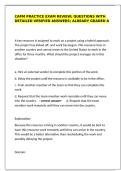
A key resource is assigned to work on a project using a hybrid approach.
The project has kicked off, and work has begun. This resource lives in
another country and cannot move to the United States to work in the
office for three months. What should the project manager do in this
situation?
a. Hire an external vendor to complete this portion of the work.
b. Delay the project until the resource is available to be in the office.
c. Train another member of the team so that they can complete this
work.
d. Request that the team member work remotely until they can move
into the country. - correct answer- d. Request that the team
member work remotely until they can move into the country.
Explanation:
Because the resource is living in another country, it would be best to
have this resource work remotely until they can arrive in the country.
This would be a better alternative than rescheduling the work and
possibly delaying the project.
Domain:
,I. Project Management Fundamentals and Core Concepts
Objective:
04 - Development Approach and Life Cycle Performance Domain
A key stakeholder approaches you and says that there is a missing
requirement that they want incorporated without going through a
formal change control process. What do you do next?
a. Escalate to the project sponsor.
b. Accommodate the request because it is coming from a key
stakeholder.
c. Assess the impact of the requirement and submit it through the
formal change control process.
d. Negotiate with the key stakeholder to remove less valuable
requirements in exchange for this new request. - correct answer- c.
Assess the impact of the requirement and submit it through the formal
change control process.
Explanation:
Changes to a project should always be assessed and evaluated and
brought through change control.
Domain:
IV. Business Analysis Frameworks
,Objective:
10 - Business Analysis Frameworks
A key stakeholder has asked you for an update on the adaptive project
you are working on. They are specifically asking how much work remains
in the current iteration. What do you direct the stakeholder to?
a. Iteration burnup chart
b. Iteration burndown chart
c. Project schedule
d. Work breakdown structure - correct answer- b. Iteration
burndown chart
Explanation:
An iteration burndown chart shows the work remaining in the iteration.
An iteration burnup chart shows the work completed so far in the
iteration. The other two options are used in predictive projects.
Domain:
III. Agile/Adaptive Frameworks and Methodologies
Objective:
07 - Planning, Project Work, and Delivery: Adaptive Approaches
, A key stakeholder on an adaptive project is confused about the product
roadmap and a release plan and asks you to clarify. How do you explain
this?
a. A product roadmap contains the high-level requirements and epics
broken up into releases; a release plan showcases the number of
iterations needed to deliver certain features and user stories
decomposed from epics.
b. A release plan contains the high-level requirements and epics broken
up into products; a product roadmap showcases the number of
iterations needed to deliver certain features and user stories
decomposed from epics.
c. A product roadmap is a highly detailed plan, and a release plan is very
high level.
d. A product roadmap and release plan are used only when scope and
schedule baselines are still not defined. - correct answer- a. A
product roadmap contains the high-level requirements and epics broken
up into releases; a release plan showcases the number of iterations
needed to deliver certain features and user stories decomposed from
epics.
Explanation:
A product roadmap acts as a high-level summary of a product's
alignment to strategic initiatives and objectives. A product roadmap
generally contains themes, epics, and goals broken up into releases. A
release plan decomposes a product roadmap's high-level strategy into
an actionable plan that outlines specific release dates for work on
features, user stories, bug fixes, enhancements, maintenance, and so on.
DETAILED VERIFIED ANSWERS; ALREADY GRADED A
A key resource is assigned to work on a project using a hybrid approach.
The project has kicked off, and work has begun. This resource lives in
another country and cannot move to the United States to work in the
office for three months. What should the project manager do in this
situation?
a. Hire an external vendor to complete this portion of the work.
b. Delay the project until the resource is available to be in the office.
c. Train another member of the team so that they can complete this
work.
d. Request that the team member work remotely until they can move
into the country. - correct answer- d. Request that the team
member work remotely until they can move into the country.
Explanation:
Because the resource is living in another country, it would be best to
have this resource work remotely until they can arrive in the country.
This would be a better alternative than rescheduling the work and
possibly delaying the project.
Domain:
,I. Project Management Fundamentals and Core Concepts
Objective:
04 - Development Approach and Life Cycle Performance Domain
A key stakeholder approaches you and says that there is a missing
requirement that they want incorporated without going through a
formal change control process. What do you do next?
a. Escalate to the project sponsor.
b. Accommodate the request because it is coming from a key
stakeholder.
c. Assess the impact of the requirement and submit it through the
formal change control process.
d. Negotiate with the key stakeholder to remove less valuable
requirements in exchange for this new request. - correct answer- c.
Assess the impact of the requirement and submit it through the formal
change control process.
Explanation:
Changes to a project should always be assessed and evaluated and
brought through change control.
Domain:
IV. Business Analysis Frameworks
,Objective:
10 - Business Analysis Frameworks
A key stakeholder has asked you for an update on the adaptive project
you are working on. They are specifically asking how much work remains
in the current iteration. What do you direct the stakeholder to?
a. Iteration burnup chart
b. Iteration burndown chart
c. Project schedule
d. Work breakdown structure - correct answer- b. Iteration
burndown chart
Explanation:
An iteration burndown chart shows the work remaining in the iteration.
An iteration burnup chart shows the work completed so far in the
iteration. The other two options are used in predictive projects.
Domain:
III. Agile/Adaptive Frameworks and Methodologies
Objective:
07 - Planning, Project Work, and Delivery: Adaptive Approaches
, A key stakeholder on an adaptive project is confused about the product
roadmap and a release plan and asks you to clarify. How do you explain
this?
a. A product roadmap contains the high-level requirements and epics
broken up into releases; a release plan showcases the number of
iterations needed to deliver certain features and user stories
decomposed from epics.
b. A release plan contains the high-level requirements and epics broken
up into products; a product roadmap showcases the number of
iterations needed to deliver certain features and user stories
decomposed from epics.
c. A product roadmap is a highly detailed plan, and a release plan is very
high level.
d. A product roadmap and release plan are used only when scope and
schedule baselines are still not defined. - correct answer- a. A
product roadmap contains the high-level requirements and epics broken
up into releases; a release plan showcases the number of iterations
needed to deliver certain features and user stories decomposed from
epics.
Explanation:
A product roadmap acts as a high-level summary of a product's
alignment to strategic initiatives and objectives. A product roadmap
generally contains themes, epics, and goals broken up into releases. A
release plan decomposes a product roadmap's high-level strategy into
an actionable plan that outlines specific release dates for work on
features, user stories, bug fixes, enhancements, maintenance, and so on.