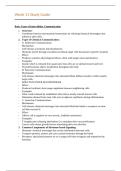
Week 11 Study Guide
Basic Types of Intercellular Communication
1. Overview:
- Coordinate function and maintain homeostasis by releasing chemical messengers that
influence other cells.
2. Types of Chemical Communication:
- A. Endocrine Communication:
- Mechanism:
- Cell releases a hormone into bloodstream
- Hormone travels through circulation to distant target cells that possess specific receptors
- Effect:
- Produces systemic physiological effects, often with longer onset and duration.
- Examples:
- Insulin which is released from pancreatic beta cells act on skeletal muscle and liver
- Thyroid hormone affects metabolism throughout the body.
- B. Paracrine Communication:
- Mechanism:
- Cell releases chemical messenger into interstitial fluid, diffuses locally to affect nearby
target cells.
- DOES NOT ENTER BLOODSTREAM
- Effect:
- Produces localized, short-range regulation between neighboring cells.
- Examples:
- Nitric oxide released by endothelial cells relaxes nearby smooth muscle cells
- Histamine released from mast cells acts on adjacent capillaries during inflammation.
- C. Autocrine Communication:
- Mechanism:
- Cell releases chemical messenger into interstitial fluid that binds to receptors on same
cell that secreted it.
- Effect:
- Allows cell to regulate its own activity, feedback mechanism
- Examples:
- T-lymphocytes releasing interleukon-2 to stimulate their own proliferation.
- Cancer cells release growth factors stimulating their own division.
3. Common Components of Hormone-based Signaling:
- Hormone: chemical messenger that carries information between cells.
- Transport proteins: protect and carry certain hormones through the blood
- Receptors: specialized proteins on or in target cells that recognize and respond to the
hormone.
, Hypothalamo-Hypophyseal Axis
1. Stepwise Process:
- A. Hypothalamic Hormone Release:
- Hypothalamus integrates internal and external inputs
- Releasing or inhibiting hormones into hypophyseal portal circulation, directly connects to
anterior pituitary.
- EX:
- CRH, TRH, GnRH, GHRH and Somatostatin, Dopamine
- B. Pituitary Hormone Release:
- Anterior pituitary responds to hypothalamic signals by secreting tropic hormones into
systemic circulation.
- Tropic hormones stimulate target endocrine glands to produce their own hormones.
- C. Target Gland Hormone Release:
- Target gland releases its effector hormone
- Hormones regulate physiological processes and feedback to pituitary and hypothalamus
- Feedback Mechanism:
- 1. Negative Feedback:
- Target gland hormone inhibits further release:
- Anterior pituitary, hypothalamus
- Ensures stable hormone levels.
- 2. Positive Feedback:
- Target hormone can enhance hypothalamic or pituitary activity
- EX: estrogen during mid-menstrual cycle stimulates LH surge
2. Summary Flow:
- Stimulus -> hypothalamus -> anterior pituitary -> target gland -> effector hormone ->
feedback
Factors Determining Biological Effect of Hormone
1. Hormone Synthesis and Release:
- Endocrine cells synthesize and release hormone into bloodstream
- Biologically active form of hormone is free form.
- Free hormone: not attached to any carrier or transport protein
- Only free fraction can: bind to receptors on target tissues metabolized and produce
physiological effects.
2. Three Possible Fates of Free Hormone:
- A. Bind to Protein Carrier:
- Types:
- 1. Non-specific carriers:
- Ex: albumin
- Binds wide variety of molecules
- 2. Specific carriers:
- Ex: Thyroxine-binding globulin (TBG)
- Selectively binds to thyroid hormone
- Produced primarily by the liver
2
Basic Types of Intercellular Communication
1. Overview:
- Coordinate function and maintain homeostasis by releasing chemical messengers that
influence other cells.
2. Types of Chemical Communication:
- A. Endocrine Communication:
- Mechanism:
- Cell releases a hormone into bloodstream
- Hormone travels through circulation to distant target cells that possess specific receptors
- Effect:
- Produces systemic physiological effects, often with longer onset and duration.
- Examples:
- Insulin which is released from pancreatic beta cells act on skeletal muscle and liver
- Thyroid hormone affects metabolism throughout the body.
- B. Paracrine Communication:
- Mechanism:
- Cell releases chemical messenger into interstitial fluid, diffuses locally to affect nearby
target cells.
- DOES NOT ENTER BLOODSTREAM
- Effect:
- Produces localized, short-range regulation between neighboring cells.
- Examples:
- Nitric oxide released by endothelial cells relaxes nearby smooth muscle cells
- Histamine released from mast cells acts on adjacent capillaries during inflammation.
- C. Autocrine Communication:
- Mechanism:
- Cell releases chemical messenger into interstitial fluid that binds to receptors on same
cell that secreted it.
- Effect:
- Allows cell to regulate its own activity, feedback mechanism
- Examples:
- T-lymphocytes releasing interleukon-2 to stimulate their own proliferation.
- Cancer cells release growth factors stimulating their own division.
3. Common Components of Hormone-based Signaling:
- Hormone: chemical messenger that carries information between cells.
- Transport proteins: protect and carry certain hormones through the blood
- Receptors: specialized proteins on or in target cells that recognize and respond to the
hormone.
, Hypothalamo-Hypophyseal Axis
1. Stepwise Process:
- A. Hypothalamic Hormone Release:
- Hypothalamus integrates internal and external inputs
- Releasing or inhibiting hormones into hypophyseal portal circulation, directly connects to
anterior pituitary.
- EX:
- CRH, TRH, GnRH, GHRH and Somatostatin, Dopamine
- B. Pituitary Hormone Release:
- Anterior pituitary responds to hypothalamic signals by secreting tropic hormones into
systemic circulation.
- Tropic hormones stimulate target endocrine glands to produce their own hormones.
- C. Target Gland Hormone Release:
- Target gland releases its effector hormone
- Hormones regulate physiological processes and feedback to pituitary and hypothalamus
- Feedback Mechanism:
- 1. Negative Feedback:
- Target gland hormone inhibits further release:
- Anterior pituitary, hypothalamus
- Ensures stable hormone levels.
- 2. Positive Feedback:
- Target hormone can enhance hypothalamic or pituitary activity
- EX: estrogen during mid-menstrual cycle stimulates LH surge
2. Summary Flow:
- Stimulus -> hypothalamus -> anterior pituitary -> target gland -> effector hormone ->
feedback
Factors Determining Biological Effect of Hormone
1. Hormone Synthesis and Release:
- Endocrine cells synthesize and release hormone into bloodstream
- Biologically active form of hormone is free form.
- Free hormone: not attached to any carrier or transport protein
- Only free fraction can: bind to receptors on target tissues metabolized and produce
physiological effects.
2. Three Possible Fates of Free Hormone:
- A. Bind to Protein Carrier:
- Types:
- 1. Non-specific carriers:
- Ex: albumin
- Binds wide variety of molecules
- 2. Specific carriers:
- Ex: Thyroxine-binding globulin (TBG)
- Selectively binds to thyroid hormone
- Produced primarily by the liver
2