

NUR 421 Dysrhythmia Exam:
Cardiovascular System:
Rhythm Analysis:
o Rate (verify with HR assessment)
o Rhythm
o P Waves
o PR interval: 0.12-0.2; too long = block; beginning of P wave to QRS
o QRS duration: 0.04-0.10
o ST segment: elevated/depressed?
o T wave: should be round, upright, baseline from QRS
o QT interval: less than half distance of R-R interval/2
o Count complex (PQRS) multiply by 10 quick view of how fast/slow rhythm is
o Use 1500 method (1500 small blocks on graph, 1500 then divide by counted
small b/t P wave to QRS peak)
o Each small box = 0.04
o Dark lines count by 5
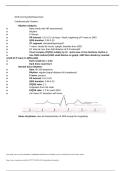
Normal Sinus Rhythm:
o Rate: 60-100 beats/min
o Rhythm: regular (equal distance b/t complexes)
o P wave: present
o PR interval: 0.12-0.20
o QRS duration: 0.04-0.10
o P/QRS ratio: 1:1
o Originates from SA node
o P/QRS ratio: 1 P for each QRS
o Can have ST elevation with sinus
Sinus Arrythmia: Has all characteristics of NSR except for irregularity.
This study source was downloaded by 100000902137948 from CourseHero.com on 11-08-2025 03:19:55 GMT -06:00
https://www.coursehero.com/file/120777215/NUR-421-Dysrhythmia-Examdocx/
, Dysrhythmias:
o Types:
Sinus
Atrial
Junctional
Ventricular
Bundle Branch
Blocks
o Premature Complexes:
Early complexes
Irregular rhythm
May occur repetitively or a rhythmic pattern
Slight pause before next sinus rhythm
o Sinus Tachycardia: Heart rate > 100 bpm
o Sinus Bradycardia: Heart rate < 60 bpm
Sinus causes it beat at rate less than normal; rate equidistance o
Premature Atrial Complex (PAC): plus identify underlying rhythm
Premature complex with an abnormal P wave
Hard to identify; not easy to identify in practice
Impulse fired early b/c of irritable atrial tissue
Premature beat isn’t entire rhythm; can still identify underlying rhythm
(ex: PAC w/ afib)
Premature P wave, long pause next beat, normal for next few
This study source was downloaded by 100000902137948 from CourseHero.com on 11-08-2025 03:19:55 GMT -06:00
https://www.coursehero.com/file/120777215/NUR-421-Dysrhythmia-Examdocx/
Cardiovascular System:
Rhythm Analysis:
o Rate (verify with HR assessment)
o Rhythm
o P Waves
o PR interval: 0.12-0.2; too long = block; beginning of P wave to QRS
o QRS duration: 0.04-0.10
o ST segment: elevated/depressed?
o T wave: should be round, upright, baseline from QRS
o QT interval: less than half distance of R-R interval/2
o Count complex (PQRS) multiply by 10 quick view of how fast/slow rhythm is
o Use 1500 method (1500 small blocks on graph, 1500 then divide by counted
small b/t P wave to QRS peak)
o Each small box = 0.04
o Dark lines count by 5
Normal Sinus Rhythm:
o Rate: 60-100 beats/min
o Rhythm: regular (equal distance b/t complexes)
o P wave: present
o PR interval: 0.12-0.20
o QRS duration: 0.04-0.10
o P/QRS ratio: 1:1
o Originates from SA node
o P/QRS ratio: 1 P for each QRS
o Can have ST elevation with sinus
Sinus Arrythmia: Has all characteristics of NSR except for irregularity.
This study source was downloaded by 100000902137948 from CourseHero.com on 11-08-2025 03:19:55 GMT -06:00
https://www.coursehero.com/file/120777215/NUR-421-Dysrhythmia-Examdocx/
, Dysrhythmias:
o Types:
Sinus
Atrial
Junctional
Ventricular
Bundle Branch
Blocks
o Premature Complexes:
Early complexes
Irregular rhythm
May occur repetitively or a rhythmic pattern
Slight pause before next sinus rhythm
o Sinus Tachycardia: Heart rate > 100 bpm
o Sinus Bradycardia: Heart rate < 60 bpm
Sinus causes it beat at rate less than normal; rate equidistance o
Premature Atrial Complex (PAC): plus identify underlying rhythm
Premature complex with an abnormal P wave
Hard to identify; not easy to identify in practice
Impulse fired early b/c of irritable atrial tissue
Premature beat isn’t entire rhythm; can still identify underlying rhythm
(ex: PAC w/ afib)
Premature P wave, long pause next beat, normal for next few
This study source was downloaded by 100000902137948 from CourseHero.com on 11-08-2025 03:19:55 GMT -06:00
https://www.coursehero.com/file/120777215/NUR-421-Dysrhythmia-Examdocx/


