

D265 CRITICAL THINKING (STUDY THIS ONE!)
EXAM QUESTIONS & DETAILED CORRECT
ANSWERS 100%
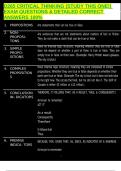
1. PROPOSITIONS Are statements that can be true or false
2. NON- Are sentences that are not statements about matters of fact or fiction.
PROPOSI-
They do not make a claim that can be true or false.
TONS
Have no internal logic structure, meaning whether they are true or false
3. SIMPLE
does not depend on whether a part of them is true or false. They are
PROPO-
simply true or false on their own. (Example: Harry Potter wears glasses.
SITIONS
The sky is blue.)
Have internal logic structure, meaning they are composed of simple
4. COMPLEX
PROPOSITION propositions. Whether they are true or false depends on whether their
S parts are true or false. (Example: The sky is blue, but it does not look blue
to me right now. The cat ate the food, but he did not like it. The GDP of
Canada is either $3 trillion or $12 trillion.)
5. CONCLUSION THEREORE, IT FOLLOWS THAT, AS A RESULT, THUS, & CONSEQUENTLY.
IN- DICATORS
Acronym to remember:
ACT IT
As a result
Consequently
Therefore
It follows that
Thus
6. PREMISE BECAUSE, FOR, GIVEN THAT, AS, SINCE, AS INDICATED BY & WHEREAS.
INDICA- TORS
Acronym to remember:
1/
24
,D265 CRITICAL THINKING (STUDY THIS ONE!)
EXAM QUESTIONS & DETAILED CORRECT
ANSWERS 100%
F
A
B
S
W
A
G
F
o
r
A
s
Because
2/
24
, D265 CRITICAL THINKING (STUDY THIS ONE!)
EXAM QUESTIONS & DETAILED CORRECT
ANSWERS 100%
Since
Whereas
As indicated by
Given that
7. DEDUCTIVE Arguments where the premises guarantee or necessitate the conclusion.
AR- GUMENTS -mathematical arguments, logical arguments, arguments from definition.
8. INDUCTION Arguments where the premises make the conclusion probable.
AR- GUMENTS -analogies, authority, causal inferences, extrapolations, etc.
9. INFERENCE TO Arguments where the best available explanation is chosen as the correct
THE BEST explana- tion.
EXPLA- NATION
OR AB-
DUCTION
10. FORMAL FALLACY Concerns the structure of an argument
11. INFORMAL Concerns the informational content of an argument
FAL- LACY
12. A FORMAL FALLA- Bad Argument Structure
CY IS A TYPE OF
13. PRINCIPLE The principle of charity suggests we should try to understand ideas before
OF CHARITY
criticiz- ing them.
14. CONFIRMATIO
the tendency to interpret new evidence as confirmation of one's existing
N BIAS
beliefs or theories.
15. COGNITIVE BIAS a systematic thought process caused by the tendency of the human
3/
24
EXAM QUESTIONS & DETAILED CORRECT
ANSWERS 100%
1. PROPOSITIONS Are statements that can be true or false
2. NON- Are sentences that are not statements about matters of fact or fiction.
PROPOSI-
They do not make a claim that can be true or false.
TONS
Have no internal logic structure, meaning whether they are true or false
3. SIMPLE
does not depend on whether a part of them is true or false. They are
PROPO-
simply true or false on their own. (Example: Harry Potter wears glasses.
SITIONS
The sky is blue.)
Have internal logic structure, meaning they are composed of simple
4. COMPLEX
PROPOSITION propositions. Whether they are true or false depends on whether their
S parts are true or false. (Example: The sky is blue, but it does not look blue
to me right now. The cat ate the food, but he did not like it. The GDP of
Canada is either $3 trillion or $12 trillion.)
5. CONCLUSION THEREORE, IT FOLLOWS THAT, AS A RESULT, THUS, & CONSEQUENTLY.
IN- DICATORS
Acronym to remember:
ACT IT
As a result
Consequently
Therefore
It follows that
Thus
6. PREMISE BECAUSE, FOR, GIVEN THAT, AS, SINCE, AS INDICATED BY & WHEREAS.
INDICA- TORS
Acronym to remember:
1/
24
,D265 CRITICAL THINKING (STUDY THIS ONE!)
EXAM QUESTIONS & DETAILED CORRECT
ANSWERS 100%
F
A
B
S
W
A
G
F
o
r
A
s
Because
2/
24
, D265 CRITICAL THINKING (STUDY THIS ONE!)
EXAM QUESTIONS & DETAILED CORRECT
ANSWERS 100%
Since
Whereas
As indicated by
Given that
7. DEDUCTIVE Arguments where the premises guarantee or necessitate the conclusion.
AR- GUMENTS -mathematical arguments, logical arguments, arguments from definition.
8. INDUCTION Arguments where the premises make the conclusion probable.
AR- GUMENTS -analogies, authority, causal inferences, extrapolations, etc.
9. INFERENCE TO Arguments where the best available explanation is chosen as the correct
THE BEST explana- tion.
EXPLA- NATION
OR AB-
DUCTION
10. FORMAL FALLACY Concerns the structure of an argument
11. INFORMAL Concerns the informational content of an argument
FAL- LACY
12. A FORMAL FALLA- Bad Argument Structure
CY IS A TYPE OF
13. PRINCIPLE The principle of charity suggests we should try to understand ideas before
OF CHARITY
criticiz- ing them.
14. CONFIRMATIO
the tendency to interpret new evidence as confirmation of one's existing
N BIAS
beliefs or theories.
15. COGNITIVE BIAS a systematic thought process caused by the tendency of the human
3/
24


