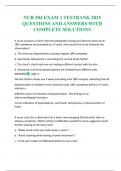
NURS 6501 Advanced Pathophysiology Midterm EXAM Questions with
100% Correct answers | Verified | Updated (Actual Exam) 2025\2026
Rheumatoid Arthritis - correct answer Chronic inflammatory disorder affecting joints.
CBC - correct answer Complete blood count measuring blood components.
Hgb - correct answer Hemoglobin concentration in blood, measured in g/dL.
Hct - correct answer Hematocrit percentage of red blood cells.
MCV - correct answer Mean corpuscular volume of red blood cells.
Platelet Count - correct answer Number of platelets per microliter of blood.
WBC Count - correct answer Total white blood cells per microliter.
Serum Haptoglobin - correct answer Protein that binds free hemoglobin in blood.
Serum Iron Concentration - correct answer Amount of iron in serum, measured in
micrograms/dL.
Total Iron Binding Capacity - correct answer Maximum amount of iron that can bind to
transferrin.
Percent Saturation - correct answer Percentage of transferrin saturated with iron.
Serum Ferritin Concentration - correct answer Indicator of stored iron in the body.
Reticulocyte Concentration - correct answer Percentage of immature red blood cells in
circulation.
Beta-Thalassemia Major - correct answer Severe form of thalassemia causing anemia.
Anemia of Chronic Disease - correct answer Anemia associated with chronic inflammatory
conditions.
Acute Blood Loss Anemia - correct answer Anemia due to sudden loss of blood.
Iron Deficiency Anemia - correct answer Anemia caused by insufficient iron.
Petechial Hemorrhages - correct answer Small red or purple spots from bleeding under skin.
Bone Marrow Examination - correct answer Procedure to assess bone marrow health and
function.
Overwhelming Bacterial Infection - correct answer Severe infection leading to systemic
symptoms.
Aplastic Anemia - correct answer Failure of bone marrow to produce blood cells.
,Sickle Cells - correct answer Abnormally shaped red blood cells in sickle cell disease.
Left Ventricular Hypertrophy - correct answer Thickening of the heart's left ventricle due to
pressure.
Aortic Stenosis - correct answer Narrowing of the aortic valve affecting blood flow.
Aortic Dissection - correct answer Tear in the aorta's inner layer causing severe pain.
Tachycardia - correct answer Heart rate over 100 bpm, often symptomatic.
AV Dissociation - correct answer Atria and ventricles beat independently.
Nonsustained Supraventricular Tachycardia - correct answer Intermittent rapid heart rate from
atria.
Sustained Wide Complex Atrial Tachycardia - correct answer Persistent rapid atrial rhythm with
wide QRS.
Wide Complex Ventricular Tachycardia - correct answer Rapid ventricular rhythm with wide
QRS complexes.
Narrow Complex Ventricular Tachycardia - correct answer Rapid ventricular rhythm with
narrow QRS complexes.
Idiopathic Dilated Cardiomyopathy - correct answer Heart muscle disease with unknown cause,
leads to dilation.
Ejection Fraction - correct answer Percentage of blood pumped from heart per beat.
Mitral Valve Regurgitation - correct answer Backward flow of blood from left ventricle to
atrium.
Tricuspid Valve Regurgitation - correct answer Backward flow of blood from right ventricle to
atrium.
Bradycardia - correct answer Heart rate under 60 bpm, can indicate pathology.
Blocked Pathway at AV Node - correct answer Interruption in electrical conduction below
atrioventricular node.
Blocked Pathway at SA Node - correct answer Interruption in electrical conduction at sinoatrial
node.
Reentry Pathway - correct answer Electrical impulse reenters a previous conduction pathway.
Paravalvular Leak - correct answer Leakage around a prosthetic heart valve.
Aortic Stenosis - correct answer Narrowing of the aortic valve, obstructs blood flow.
, Aortic Regurgitation - correct answer Inadequate closure of aortic valve, causing backflow.
Acute Lymphoblastic Leukemia (ALL) - correct answer Cancer of lymphoid cells, common in
children.
Chronic Lymphocytic Leukemia (CLL) - correct answer Slow-growing leukemia of mature
lymphocytes.
Acute Myelogenous Leukemia (AML) - correct answer Cancer of myeloid cells, rapid
progression.
Chronic Myelogenous Leukemia (CML) - correct answer Slow-growing cancer of myeloid cells,
often with Philadelphia chromosome.
Hypochromic Microcytic Anemia - correct answer Anemia with small, pale red blood cells.
Hemoglobin Electrophoresis - correct answer Test to separate different types of hemoglobin.
Maxillofacial Deformities - correct answer Abnormalities in facial structure, often due to
anemia.
Beta thalassemia - correct answer Genetic disorder causing reduced hemoglobin production.
Gastrointestinal blood loss - correct answer Loss of blood from the digestive tract.
Pernicious anemia - correct answer Vitamin B12 deficiency due to intrinsic factor absence.
Chronic renal failure - correct answer Progressive loss of kidney function over time.
Macronodular cirrhosis - correct answer Severe liver scarring affecting liver function.
Vitamin B12 deficiency - correct answer Insufficient B12 leading to anemia and neurological
issues.
Vitamin C deficiency - correct answer Lack of vitamin C causing scurvy and bleeding.
Von Willebrand disease - correct answer Genetic disorder affecting blood clotting ability.
Allogeneic bone marrow transplant - correct answer Transplant from a genetically different
donor.
Excessive bleeding - correct answer Uncontrolled blood loss from minor injuries.
Low dose aspirin - correct answer Medication reducing platelet aggregation to prevent clots.
Ejection fraction - correct answer Percentage of blood pumped from the heart per beat.
Pulmonary edema - correct answer Fluid accumulation in lungs causing breathing difficulty.
Increased hydrostatic pressure - correct answer Elevated pressure in blood vessels causing
fluid leakage.
100% Correct answers | Verified | Updated (Actual Exam) 2025\2026
Rheumatoid Arthritis - correct answer Chronic inflammatory disorder affecting joints.
CBC - correct answer Complete blood count measuring blood components.
Hgb - correct answer Hemoglobin concentration in blood, measured in g/dL.
Hct - correct answer Hematocrit percentage of red blood cells.
MCV - correct answer Mean corpuscular volume of red blood cells.
Platelet Count - correct answer Number of platelets per microliter of blood.
WBC Count - correct answer Total white blood cells per microliter.
Serum Haptoglobin - correct answer Protein that binds free hemoglobin in blood.
Serum Iron Concentration - correct answer Amount of iron in serum, measured in
micrograms/dL.
Total Iron Binding Capacity - correct answer Maximum amount of iron that can bind to
transferrin.
Percent Saturation - correct answer Percentage of transferrin saturated with iron.
Serum Ferritin Concentration - correct answer Indicator of stored iron in the body.
Reticulocyte Concentration - correct answer Percentage of immature red blood cells in
circulation.
Beta-Thalassemia Major - correct answer Severe form of thalassemia causing anemia.
Anemia of Chronic Disease - correct answer Anemia associated with chronic inflammatory
conditions.
Acute Blood Loss Anemia - correct answer Anemia due to sudden loss of blood.
Iron Deficiency Anemia - correct answer Anemia caused by insufficient iron.
Petechial Hemorrhages - correct answer Small red or purple spots from bleeding under skin.
Bone Marrow Examination - correct answer Procedure to assess bone marrow health and
function.
Overwhelming Bacterial Infection - correct answer Severe infection leading to systemic
symptoms.
Aplastic Anemia - correct answer Failure of bone marrow to produce blood cells.
,Sickle Cells - correct answer Abnormally shaped red blood cells in sickle cell disease.
Left Ventricular Hypertrophy - correct answer Thickening of the heart's left ventricle due to
pressure.
Aortic Stenosis - correct answer Narrowing of the aortic valve affecting blood flow.
Aortic Dissection - correct answer Tear in the aorta's inner layer causing severe pain.
Tachycardia - correct answer Heart rate over 100 bpm, often symptomatic.
AV Dissociation - correct answer Atria and ventricles beat independently.
Nonsustained Supraventricular Tachycardia - correct answer Intermittent rapid heart rate from
atria.
Sustained Wide Complex Atrial Tachycardia - correct answer Persistent rapid atrial rhythm with
wide QRS.
Wide Complex Ventricular Tachycardia - correct answer Rapid ventricular rhythm with wide
QRS complexes.
Narrow Complex Ventricular Tachycardia - correct answer Rapid ventricular rhythm with
narrow QRS complexes.
Idiopathic Dilated Cardiomyopathy - correct answer Heart muscle disease with unknown cause,
leads to dilation.
Ejection Fraction - correct answer Percentage of blood pumped from heart per beat.
Mitral Valve Regurgitation - correct answer Backward flow of blood from left ventricle to
atrium.
Tricuspid Valve Regurgitation - correct answer Backward flow of blood from right ventricle to
atrium.
Bradycardia - correct answer Heart rate under 60 bpm, can indicate pathology.
Blocked Pathway at AV Node - correct answer Interruption in electrical conduction below
atrioventricular node.
Blocked Pathway at SA Node - correct answer Interruption in electrical conduction at sinoatrial
node.
Reentry Pathway - correct answer Electrical impulse reenters a previous conduction pathway.
Paravalvular Leak - correct answer Leakage around a prosthetic heart valve.
Aortic Stenosis - correct answer Narrowing of the aortic valve, obstructs blood flow.
, Aortic Regurgitation - correct answer Inadequate closure of aortic valve, causing backflow.
Acute Lymphoblastic Leukemia (ALL) - correct answer Cancer of lymphoid cells, common in
children.
Chronic Lymphocytic Leukemia (CLL) - correct answer Slow-growing leukemia of mature
lymphocytes.
Acute Myelogenous Leukemia (AML) - correct answer Cancer of myeloid cells, rapid
progression.
Chronic Myelogenous Leukemia (CML) - correct answer Slow-growing cancer of myeloid cells,
often with Philadelphia chromosome.
Hypochromic Microcytic Anemia - correct answer Anemia with small, pale red blood cells.
Hemoglobin Electrophoresis - correct answer Test to separate different types of hemoglobin.
Maxillofacial Deformities - correct answer Abnormalities in facial structure, often due to
anemia.
Beta thalassemia - correct answer Genetic disorder causing reduced hemoglobin production.
Gastrointestinal blood loss - correct answer Loss of blood from the digestive tract.
Pernicious anemia - correct answer Vitamin B12 deficiency due to intrinsic factor absence.
Chronic renal failure - correct answer Progressive loss of kidney function over time.
Macronodular cirrhosis - correct answer Severe liver scarring affecting liver function.
Vitamin B12 deficiency - correct answer Insufficient B12 leading to anemia and neurological
issues.
Vitamin C deficiency - correct answer Lack of vitamin C causing scurvy and bleeding.
Von Willebrand disease - correct answer Genetic disorder affecting blood clotting ability.
Allogeneic bone marrow transplant - correct answer Transplant from a genetically different
donor.
Excessive bleeding - correct answer Uncontrolled blood loss from minor injuries.
Low dose aspirin - correct answer Medication reducing platelet aggregation to prevent clots.
Ejection fraction - correct answer Percentage of blood pumped from the heart per beat.
Pulmonary edema - correct answer Fluid accumulation in lungs causing breathing difficulty.
Increased hydrostatic pressure - correct answer Elevated pressure in blood vessels causing
fluid leakage.