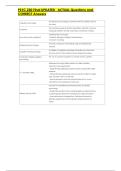
PSYC 230 Final UPDATED ACTUAL Questions and
CORRECT Answers
The branch of psychology concerned with the scientific study of
Cognitive psychology
the mind
The mental processes involved in perception, attention, memory,
Cognition
language, problem solving, reasoning, and decision making
-Experimental Psychology
How do we study cognition? -Cognitive Neuropsychology & Neuroscience
-Computer Modeling
The study of behavior and thinking using the experimental
Experimental psychology
method
A subfield of cognitive psychology that studies how the brain's
Cognitive neuropsychology
structure and function relate to psychological processes
Computer modeling cognitive The use of computer programs to simulate human cognition
psychology
Measured how long it takes a person to make a decision
(reaction time experiment)
- Simple RT task: participant pushes a button quickly after a light
appears
F.C. Donders (1868)
- Choice RT task: participant pushes one button if light is on right
side, another if left is on left side
- Mental responses cannot be measured directly but can be
inferred from the participant's behavior
Scientist who established the first laboratory of scientific
psychology
- Studied structuralism: One's overall experience; determined by
Wilhelm Wundt (1879) combining basic elements of experience called sensations
- And used analytic introspection: Participants trained to
describe experiences and thought-processing response to
stimuli
, Read list of nonsense syllables aloud many times to determine
number of repetitions necessary to repeat list without errors &
Hermann Ebbinghaus (1885) determined the savings/forgetting curve
- Savings = (Original time to learn list) - (Time to relearn list after
delay)
A functionalist who published Principles of Psychology and
taught Harvard's first psychology course
William James (1890)
- Made observations based off of the functions of his own mind,
not experiments
- Had 2 problems with analytic introspection: the results vary per
person and they are difficult to verify as they are due to invisible
mental processes
John Watson (1913)
- Proposed a new approach called behaviorism. Eliminate the
mind as a topic of study - Instead, study directly observable
behavior --> Little Albert Experiment
9-month-old Albert became frightened by a rat after a loud
noise was paired with every presentation of the rat
- Examined how pairing one stimulus with another affected
Watson's Little Albert behavior
Experiment - Demonstrated that behavior can be analyzed without any
reference to the mind.
- Watson's experiment was inspired by Pavlov's research with
dogs
Was interested in determining the relationship between stimuli
and response
B.F. Skinner (1938)
- Used operant conditioning to shape behavior through rewards
or punishment
Trained rats to find food in a four-armed maze
• Two competing interpretations:
- Behaviorism predicts that the rats learned to "turn right to find
Tolman (1938)
food"
- Tolman believed that the rats had created a cognitive map of
the maze and were navigating to a specific area
Argued children learn language through operant conditioning
Skinner (1957) - Children imitate speech they hear
- Correct speech is rewarded
Argued children do not only learn language through imitation
and reinforcement:
- Children say things they have never heard and can not be
Chomsky (1959) imitating
- Children say things that are incorrect and have not been
rewarded for
- Language must be determined by inborn biological program
A shift in psychology, beginning in the 1950s, from the behaviorist
approach to an approach in which the main thrust was to explain
Cognitive revolution behavior in terms of the mind. One of the outcomes of the
cognitive revolution was the introduction of the information-
processing approach to studying the mind.
Introduction of the digital Shift from behaviorist's stimulus-response relationships to an
computer approach that attempts to explain behavior in terms of the mind
CORRECT Answers
The branch of psychology concerned with the scientific study of
Cognitive psychology
the mind
The mental processes involved in perception, attention, memory,
Cognition
language, problem solving, reasoning, and decision making
-Experimental Psychology
How do we study cognition? -Cognitive Neuropsychology & Neuroscience
-Computer Modeling
The study of behavior and thinking using the experimental
Experimental psychology
method
A subfield of cognitive psychology that studies how the brain's
Cognitive neuropsychology
structure and function relate to psychological processes
Computer modeling cognitive The use of computer programs to simulate human cognition
psychology
Measured how long it takes a person to make a decision
(reaction time experiment)
- Simple RT task: participant pushes a button quickly after a light
appears
F.C. Donders (1868)
- Choice RT task: participant pushes one button if light is on right
side, another if left is on left side
- Mental responses cannot be measured directly but can be
inferred from the participant's behavior
Scientist who established the first laboratory of scientific
psychology
- Studied structuralism: One's overall experience; determined by
Wilhelm Wundt (1879) combining basic elements of experience called sensations
- And used analytic introspection: Participants trained to
describe experiences and thought-processing response to
stimuli
, Read list of nonsense syllables aloud many times to determine
number of repetitions necessary to repeat list without errors &
Hermann Ebbinghaus (1885) determined the savings/forgetting curve
- Savings = (Original time to learn list) - (Time to relearn list after
delay)
A functionalist who published Principles of Psychology and
taught Harvard's first psychology course
William James (1890)
- Made observations based off of the functions of his own mind,
not experiments
- Had 2 problems with analytic introspection: the results vary per
person and they are difficult to verify as they are due to invisible
mental processes
John Watson (1913)
- Proposed a new approach called behaviorism. Eliminate the
mind as a topic of study - Instead, study directly observable
behavior --> Little Albert Experiment
9-month-old Albert became frightened by a rat after a loud
noise was paired with every presentation of the rat
- Examined how pairing one stimulus with another affected
Watson's Little Albert behavior
Experiment - Demonstrated that behavior can be analyzed without any
reference to the mind.
- Watson's experiment was inspired by Pavlov's research with
dogs
Was interested in determining the relationship between stimuli
and response
B.F. Skinner (1938)
- Used operant conditioning to shape behavior through rewards
or punishment
Trained rats to find food in a four-armed maze
• Two competing interpretations:
- Behaviorism predicts that the rats learned to "turn right to find
Tolman (1938)
food"
- Tolman believed that the rats had created a cognitive map of
the maze and were navigating to a specific area
Argued children learn language through operant conditioning
Skinner (1957) - Children imitate speech they hear
- Correct speech is rewarded
Argued children do not only learn language through imitation
and reinforcement:
- Children say things they have never heard and can not be
Chomsky (1959) imitating
- Children say things that are incorrect and have not been
rewarded for
- Language must be determined by inborn biological program
A shift in psychology, beginning in the 1950s, from the behaviorist
approach to an approach in which the main thrust was to explain
Cognitive revolution behavior in terms of the mind. One of the outcomes of the
cognitive revolution was the introduction of the information-
processing approach to studying the mind.
Introduction of the digital Shift from behaviorist's stimulus-response relationships to an
computer approach that attempts to explain behavior in terms of the mind