

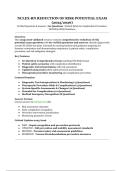
NCLEX-RN REDUCTION OF RISK POTENTIAL EXAM
(2025/2026)
Verified Questions & Answers | 60 Questions | Patient Safety & Complication Prevention |
NCLEX®-RN® Readiness
Overview
This 2025/2026 validated resource contains comprehensive reduction of risk
potential exam questions with 60 verified questions and answers, directly aligned with
current NCLEX® test plans. Essential for nursing students and graduates preparing for
licensure examination and demonstrating competency in patient safety, complication
prevention, and risk mitigation strategies.
Key Features
● 60-Question Comprehensive Exam matching NCLEX® format
● Patient safety scenarios with complication identification
● Diagnostic test interpretation with risk assessment
● Updated 2025/2026 patient safety protocols and standards
● Therapeutic procedure monitoring and complication prevention
Content Domains
● Diagnostic Test Interpretation & Monitoring (15 Questions)
● Therapeutic Procedure Risks & Complications (15 Questions)
● System-Specific Assessments & Changes (12 Questions)
● Potential for Complications (10 Questions)
● Medical Emergency Recognition (8 Questions)
Answer Format
Correct answers in bold green with:
● Risk assessment rationales
● Early complication recognition
● Preventive intervention prioritization
● Monitoring parameter criteria
Critical Updates 2025/2026
● NEW - Sepsis recognition and prevention protocols
● UPDATED - Fall prevention and mobility assessment standards
● REVISED - Pressure injury risk assessment guidelines
● MODIFIED - Venous thromboembolism prevention measures
, DIAGNOSTIC TEST INTERPRETATION & MONITORING (Questions
1–15)
1. A patient post-cholecystectomy has a WBC of 18,000/mm³. What is the
priority action?
a) Encourage ambulation
b) Assess for fever and abdominal pain
c) Administer PRN analgesic
d) Increase IV fluids
b) Assess for fever and abdominal pain
Risk Rationale: Elevated WBC may indicate infection; assess for sepsis signs.
2. A patient with DKA has a potassium of 3.2 mEq/L. What is the risk?
a) Hyperkalemia
b) Hypokalemia with insulin therapy
c) Hyponatremia
d) Hypercalcemia
b) Hypokalemia with insulin therapy
Risk Rationale: Insulin drives K+ intracellularly → risk of cardiac dysrhythmia.
3. Post-op day 1, a patient has Hgb 7.8 g/dL. Priority intervention?
a) Transfuse 2 units PRBCs
b) Monitor for tachycardia and dyspnea
c) Administer iron supplement
d) Increase oral fluids
b) Monitor for tachycardia and dyspnea
Risk Rationale: Assess for symptomatic anemia before transfusion.
4. A patient on warfarin has INR 5.2. First action?
a) Administer vitamin K
b) Hold warfarin
c) Notify provider
d) Recheck INR in 4 hours
b) Hold warfarin
Risk Rationale: Supratherapeutic INR → bleeding risk; hold dose immediately.
5. A patient with heart failure has BNP 1,200 pg/mL. Interpretation?
a) Normal
b) Mild elevation
c) Significant elevation
d) Lab error
c) Significant elevation
Risk Rationale: BNP > 900 pg/mL indicates decompensated HF; monitor for fluid
overload.
(2025/2026)
Verified Questions & Answers | 60 Questions | Patient Safety & Complication Prevention |
NCLEX®-RN® Readiness
Overview
This 2025/2026 validated resource contains comprehensive reduction of risk
potential exam questions with 60 verified questions and answers, directly aligned with
current NCLEX® test plans. Essential for nursing students and graduates preparing for
licensure examination and demonstrating competency in patient safety, complication
prevention, and risk mitigation strategies.
Key Features
● 60-Question Comprehensive Exam matching NCLEX® format
● Patient safety scenarios with complication identification
● Diagnostic test interpretation with risk assessment
● Updated 2025/2026 patient safety protocols and standards
● Therapeutic procedure monitoring and complication prevention
Content Domains
● Diagnostic Test Interpretation & Monitoring (15 Questions)
● Therapeutic Procedure Risks & Complications (15 Questions)
● System-Specific Assessments & Changes (12 Questions)
● Potential for Complications (10 Questions)
● Medical Emergency Recognition (8 Questions)
Answer Format
Correct answers in bold green with:
● Risk assessment rationales
● Early complication recognition
● Preventive intervention prioritization
● Monitoring parameter criteria
Critical Updates 2025/2026
● NEW - Sepsis recognition and prevention protocols
● UPDATED - Fall prevention and mobility assessment standards
● REVISED - Pressure injury risk assessment guidelines
● MODIFIED - Venous thromboembolism prevention measures
, DIAGNOSTIC TEST INTERPRETATION & MONITORING (Questions
1–15)
1. A patient post-cholecystectomy has a WBC of 18,000/mm³. What is the
priority action?
a) Encourage ambulation
b) Assess for fever and abdominal pain
c) Administer PRN analgesic
d) Increase IV fluids
b) Assess for fever and abdominal pain
Risk Rationale: Elevated WBC may indicate infection; assess for sepsis signs.
2. A patient with DKA has a potassium of 3.2 mEq/L. What is the risk?
a) Hyperkalemia
b) Hypokalemia with insulin therapy
c) Hyponatremia
d) Hypercalcemia
b) Hypokalemia with insulin therapy
Risk Rationale: Insulin drives K+ intracellularly → risk of cardiac dysrhythmia.
3. Post-op day 1, a patient has Hgb 7.8 g/dL. Priority intervention?
a) Transfuse 2 units PRBCs
b) Monitor for tachycardia and dyspnea
c) Administer iron supplement
d) Increase oral fluids
b) Monitor for tachycardia and dyspnea
Risk Rationale: Assess for symptomatic anemia before transfusion.
4. A patient on warfarin has INR 5.2. First action?
a) Administer vitamin K
b) Hold warfarin
c) Notify provider
d) Recheck INR in 4 hours
b) Hold warfarin
Risk Rationale: Supratherapeutic INR → bleeding risk; hold dose immediately.
5. A patient with heart failure has BNP 1,200 pg/mL. Interpretation?
a) Normal
b) Mild elevation
c) Significant elevation
d) Lab error
c) Significant elevation
Risk Rationale: BNP > 900 pg/mL indicates decompensated HF; monitor for fluid
overload.


