Checklist – week 1
Rheumatology and Clinical Immunology
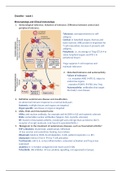
1. Immunological tolerance. Induction of tolerance. Difference between central and
peripheral tolerance.
Tolerance: unresponsiveness to self-
antigens
Central: in lymphoid organs, thymus and
bone marrow. AIRE protein is important for
T-cell maturation, because it presents self-
antigens.
Peripheral: i.e. via anergy or Treg (CTLA-4 in
2dary lymphoid organs and PD-1 in
peripheral tissue)
Tregs suppress T-cell response and
maintain tolerance
2. Disturbed tolerance and autoreactivity.
Failure of tolerance
- i.e. mutation AIRE (=APS-1): injury to
endocrine organs
- mutation FOXP3 IPEX, less Treg
Autoreactivity: antibodies that target
the body’s own tissues.
3. Definition autoimmune disease and classification.
An abnormal immune response to a normal body part.
Systemic: multiple tissues and organs are targeted
Organ specific: one tissue or organ is targeted
4. ANAs, ENAs and rheumatoid factor.
ANAs: anti-nuclear antibody, for example anti-ds DNA in SLE and systemic sclerosis
ENAs: extractable nuclear antibodies (Sjogren, SLE, myositis, sclerosis)
RF: found in rheumatoid arthritis, mostly IgM and a bit IgA that can bind to the Fc
receptor of an IgG molecule. (not found in spondylarthritis.)
5. ‘Biologicals’ in the treatment of autoimmune diseases, such as rheumatoid arthritis?
TNF-a blockers: etanercept, adalimumab, infliximab
less erosion and sometimes healing, less malaise
Rituximab: binds to CD20, B-cell depletion. In RA: patient responds i.c.o. RF+
Abatacept: mimics CTLA-4 less T-cell activation
Tocilizumab: anti IL-6, so less inflammation, osteoclast activation and Treg is less
supressed
anakinra: IL-1 receptor antagonist (not much used in RA)
Tofacitinib: JAK inhibitor less cytokine signalling, not approved in Europe
,6. SLE classification of the American College of Rheumatology.
7. SLE: epidemiology, pathogenesis, clinical symptoms, diagnostics, treatment and
prognosis.
SLE: inflammatory multisystem autoimmune disorder
Epidemiology: more in women(estorgen), gene susceptibility. Environmental: UV,
smoking, meds, viruses, those can trigger SLE, autoimmunity progresses it
Pathogeneses: 1) cells that die via apoptosis are not cleared sufficiently, nuclear pieces
become available and they are transported to lymphoid tissues. Here
they will trigger B-cells to produce IgG. These can form complexes and
deposit, at that side they can cause inflammation. (T3 hypersensitivity)
2) the complement is activated, causing apoptosis, inflammation and
neutrophil influx
Clinical symptoms: painful joints, rash (butterfly on cheeks, can be triggered by UV),
fever, pleural effusion, pericarditis, myocarditis, nephritis, NS
symptoms (epilepsy, depression, migraine) **in flares**
Diagnostics: 4+ of the criteria must be met: malar rash, discoid rash, photosensitivity,
ulcers in mouth/nose, serositis (pleuritis, pericarditis), 2 or more inflamed
joints, renal disorders, NS disorders, anaemia, thrombocytopenia, ANAs,
other antibodies (anti-ds DNA).
Treatment: 1)NSAIDS and topical corticosteroids 2) long active corticoids
3) + immunosuppressants
also avoiding sunlights
Prognosis: complete remission for long times. Mortality is mainly due to cerebral-/renal
involvement. SLE patients also have a bigger chance of lymphoma
8. Autoantibodies involved in SLE.
Anti-ds-DNA (70%), anti-SS-a (40-60%), Anti-SS-b (15%), Anti-UI-RNP (30%)
9. Clinical symptoms of antiphospholipid syndrome, autoantibodies involved.
The antibodies from antiphospholipid syndrome cause hypercoagulation. So DVT,
stroke, clots. Also miscarriage. Life-long anticoagulants needed
10. Clinical symptoms, diagnostics, treatment and prognosis of scleroderma.
Scleroderma: high mortality, fibrosis in skin and organs and vascular damage.
Thickening and hardening of skin due to abnormal dermal collagen.
symptoms: Raynaud’s phenomenon, cutaneous scleroderma (painful digits) oedema in
skin, lung disease, GI and renal involvement and myocardial fibrosis
diagnostics: blood count (normocytic anaemia), high urea and creatinine (AKI)
antibodies (ACA, anti-Scl-70, RF, ANA)
treatment: organ based (not much corticoids and immunosuppressants, only i.c.o. lung
fibrosis)
prognosis: due to lung and gut involvement is the most mortality
11. Raynaud’s phenomenon?
White, blue fingers, blood has gone out due to temperature change.
12. Sjögren syndrome: clinical symptoms and autoantibodies involved.
Sjögren: dry mouth, eyes, nose, vaginal area. Also malaise, joint pain.
autoantibodies: ENAs, anti-SS-a (60-90%), anti-SS-b (35-85%) and RF
, 13. Classification system for systemic vasculitis and several examples of each type.
Small vessel vasculitis: 2 groups: presence and absence of ANCA.
- granulomatosis with polyangiitis (ANCA+): mostly elderly. Ears and upper respiratory
tract are involved. GN can follow
- microscopic polyangiitis (ANCA+): same as above, but no granuloma formation
- eosinophilic granulomatosis with polyangiitis (50% ANCA+): early adulthood, treated
with corticosteroids and sometimes immunosuppressants
Medium vessel vasculitis:
- polyarteritis nodosa: aneurysm, thrombosis, infarct due to fibrinoid necrosis
- Kawasaki’s disease: acute vasculitis affecting children, rash, fever, diarrhoea, dry lips
Large vessel vasculitis: mostly in elderly
- PMR: pain and stiffness around shoulder, neck, hips, lumbar spine (worse in morning)
- giant cell arteritis: in cerebral arteries, headaches, temporal artery visible, vision loss
corticosteroids used, more than in PMR
14. Polymyalgia rheumatica and giant cell arteritis (GCA)/ temporal arteritis: symptoms,
additional examinations and treatment.
PMR: symmetrical aching & severe stiffness in shoulder and hips. Fast onset. Low grade
fever, depression, malaise, anorexia. Arthritis in knees and wrists. Pitting oedema
in hand and feet
- NO anti-CCP, so to differentiate with RA
- ultrasound used to see bursitis. Also CRP and ESR tests elevated.
- treatment: low dose corticosteroids (prednisolone, lots adverse effects)
GCA: headache, visual loss, affects mainly thoracic aorta and branches, ischaemia can
occur (chewing ache), mostly elder women affected. Large vessel aneurysm.
- gold standard diagnosis: temporal artery biopsy
- histology: giant multinucleated cells in intima of the vessels
- fundoscopy for visual loss
- treatment: prednisolone, injection glucocorticoids i.c.o. visual loss and aspirin to
prevent ischaemia.
15. ANCA-associated small vessel vasculitis.
Anti-neutrophil cytosolic antibodies.
16. Clinical characteristics of Wegener’s disease (= Granulomatosis with Polyangiitis [GPA])
and Churg-Strauss syndrome (= Eosinophilic Granulomatosis with Polyangiitis [EGPA]).
GPA: c-ANCA and PR3 +, mostly elderly. Ears and upper respiratory tract are involved.
Organ specific symptoms. GN can follow. Thoracic imaging shows nodule.
EGPA: early adulthood with allergic rhinitis, peripheral blood eosinophilia and asthma.
Treated with corticosteroids and sometimes immunosuppressants.
Dermatology
1. Clinical aspects of cutaneous discoid lupus erythematosus (CDLE), most important
provoking factor.
CDLE: erythematous, scaly atrophic plagues favouring the face, ears, and scalp and at
times on other body areas., hypopigmentation, oral involvement & Raynaud’s.
ONLY skin photosensitive
- ANF + in 30%, also IgM and C3 disposition
- treatment: sunscreen and topical steroids
Rheumatology and Clinical Immunology
1. Immunological tolerance. Induction of tolerance. Difference between central and
peripheral tolerance.
Tolerance: unresponsiveness to self-
antigens
Central: in lymphoid organs, thymus and
bone marrow. AIRE protein is important for
T-cell maturation, because it presents self-
antigens.
Peripheral: i.e. via anergy or Treg (CTLA-4 in
2dary lymphoid organs and PD-1 in
peripheral tissue)
Tregs suppress T-cell response and
maintain tolerance
2. Disturbed tolerance and autoreactivity.
Failure of tolerance
- i.e. mutation AIRE (=APS-1): injury to
endocrine organs
- mutation FOXP3 IPEX, less Treg
Autoreactivity: antibodies that target
the body’s own tissues.
3. Definition autoimmune disease and classification.
An abnormal immune response to a normal body part.
Systemic: multiple tissues and organs are targeted
Organ specific: one tissue or organ is targeted
4. ANAs, ENAs and rheumatoid factor.
ANAs: anti-nuclear antibody, for example anti-ds DNA in SLE and systemic sclerosis
ENAs: extractable nuclear antibodies (Sjogren, SLE, myositis, sclerosis)
RF: found in rheumatoid arthritis, mostly IgM and a bit IgA that can bind to the Fc
receptor of an IgG molecule. (not found in spondylarthritis.)
5. ‘Biologicals’ in the treatment of autoimmune diseases, such as rheumatoid arthritis?
TNF-a blockers: etanercept, adalimumab, infliximab
less erosion and sometimes healing, less malaise
Rituximab: binds to CD20, B-cell depletion. In RA: patient responds i.c.o. RF+
Abatacept: mimics CTLA-4 less T-cell activation
Tocilizumab: anti IL-6, so less inflammation, osteoclast activation and Treg is less
supressed
anakinra: IL-1 receptor antagonist (not much used in RA)
Tofacitinib: JAK inhibitor less cytokine signalling, not approved in Europe
,6. SLE classification of the American College of Rheumatology.
7. SLE: epidemiology, pathogenesis, clinical symptoms, diagnostics, treatment and
prognosis.
SLE: inflammatory multisystem autoimmune disorder
Epidemiology: more in women(estorgen), gene susceptibility. Environmental: UV,
smoking, meds, viruses, those can trigger SLE, autoimmunity progresses it
Pathogeneses: 1) cells that die via apoptosis are not cleared sufficiently, nuclear pieces
become available and they are transported to lymphoid tissues. Here
they will trigger B-cells to produce IgG. These can form complexes and
deposit, at that side they can cause inflammation. (T3 hypersensitivity)
2) the complement is activated, causing apoptosis, inflammation and
neutrophil influx
Clinical symptoms: painful joints, rash (butterfly on cheeks, can be triggered by UV),
fever, pleural effusion, pericarditis, myocarditis, nephritis, NS
symptoms (epilepsy, depression, migraine) **in flares**
Diagnostics: 4+ of the criteria must be met: malar rash, discoid rash, photosensitivity,
ulcers in mouth/nose, serositis (pleuritis, pericarditis), 2 or more inflamed
joints, renal disorders, NS disorders, anaemia, thrombocytopenia, ANAs,
other antibodies (anti-ds DNA).
Treatment: 1)NSAIDS and topical corticosteroids 2) long active corticoids
3) + immunosuppressants
also avoiding sunlights
Prognosis: complete remission for long times. Mortality is mainly due to cerebral-/renal
involvement. SLE patients also have a bigger chance of lymphoma
8. Autoantibodies involved in SLE.
Anti-ds-DNA (70%), anti-SS-a (40-60%), Anti-SS-b (15%), Anti-UI-RNP (30%)
9. Clinical symptoms of antiphospholipid syndrome, autoantibodies involved.
The antibodies from antiphospholipid syndrome cause hypercoagulation. So DVT,
stroke, clots. Also miscarriage. Life-long anticoagulants needed
10. Clinical symptoms, diagnostics, treatment and prognosis of scleroderma.
Scleroderma: high mortality, fibrosis in skin and organs and vascular damage.
Thickening and hardening of skin due to abnormal dermal collagen.
symptoms: Raynaud’s phenomenon, cutaneous scleroderma (painful digits) oedema in
skin, lung disease, GI and renal involvement and myocardial fibrosis
diagnostics: blood count (normocytic anaemia), high urea and creatinine (AKI)
antibodies (ACA, anti-Scl-70, RF, ANA)
treatment: organ based (not much corticoids and immunosuppressants, only i.c.o. lung
fibrosis)
prognosis: due to lung and gut involvement is the most mortality
11. Raynaud’s phenomenon?
White, blue fingers, blood has gone out due to temperature change.
12. Sjögren syndrome: clinical symptoms and autoantibodies involved.
Sjögren: dry mouth, eyes, nose, vaginal area. Also malaise, joint pain.
autoantibodies: ENAs, anti-SS-a (60-90%), anti-SS-b (35-85%) and RF
, 13. Classification system for systemic vasculitis and several examples of each type.
Small vessel vasculitis: 2 groups: presence and absence of ANCA.
- granulomatosis with polyangiitis (ANCA+): mostly elderly. Ears and upper respiratory
tract are involved. GN can follow
- microscopic polyangiitis (ANCA+): same as above, but no granuloma formation
- eosinophilic granulomatosis with polyangiitis (50% ANCA+): early adulthood, treated
with corticosteroids and sometimes immunosuppressants
Medium vessel vasculitis:
- polyarteritis nodosa: aneurysm, thrombosis, infarct due to fibrinoid necrosis
- Kawasaki’s disease: acute vasculitis affecting children, rash, fever, diarrhoea, dry lips
Large vessel vasculitis: mostly in elderly
- PMR: pain and stiffness around shoulder, neck, hips, lumbar spine (worse in morning)
- giant cell arteritis: in cerebral arteries, headaches, temporal artery visible, vision loss
corticosteroids used, more than in PMR
14. Polymyalgia rheumatica and giant cell arteritis (GCA)/ temporal arteritis: symptoms,
additional examinations and treatment.
PMR: symmetrical aching & severe stiffness in shoulder and hips. Fast onset. Low grade
fever, depression, malaise, anorexia. Arthritis in knees and wrists. Pitting oedema
in hand and feet
- NO anti-CCP, so to differentiate with RA
- ultrasound used to see bursitis. Also CRP and ESR tests elevated.
- treatment: low dose corticosteroids (prednisolone, lots adverse effects)
GCA: headache, visual loss, affects mainly thoracic aorta and branches, ischaemia can
occur (chewing ache), mostly elder women affected. Large vessel aneurysm.
- gold standard diagnosis: temporal artery biopsy
- histology: giant multinucleated cells in intima of the vessels
- fundoscopy for visual loss
- treatment: prednisolone, injection glucocorticoids i.c.o. visual loss and aspirin to
prevent ischaemia.
15. ANCA-associated small vessel vasculitis.
Anti-neutrophil cytosolic antibodies.
16. Clinical characteristics of Wegener’s disease (= Granulomatosis with Polyangiitis [GPA])
and Churg-Strauss syndrome (= Eosinophilic Granulomatosis with Polyangiitis [EGPA]).
GPA: c-ANCA and PR3 +, mostly elderly. Ears and upper respiratory tract are involved.
Organ specific symptoms. GN can follow. Thoracic imaging shows nodule.
EGPA: early adulthood with allergic rhinitis, peripheral blood eosinophilia and asthma.
Treated with corticosteroids and sometimes immunosuppressants.
Dermatology
1. Clinical aspects of cutaneous discoid lupus erythematosus (CDLE), most important
provoking factor.
CDLE: erythematous, scaly atrophic plagues favouring the face, ears, and scalp and at
times on other body areas., hypopigmentation, oral involvement & Raynaud’s.
ONLY skin photosensitive
- ANF + in 30%, also IgM and C3 disposition
- treatment: sunscreen and topical steroids