

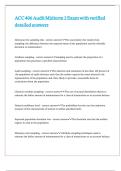
ACC 406 Audit Midterm 2 Exam with verified ||\\//|| ||\\//|| ||\\//|| ||\\//|| ||\\//|| ||\\//|| ||\\//|| ||\\//||
detailed answers ||\\//||
Allowance for sampling risk - correct answer✔✔The uncertainty that results from ||\\//|| ||\\//|| ||\\//|| ||\\//|| ||\\//|| ||\\//|| ||\\//|| ||\\//|| ||\\//|| ||\\//|| ||\\//||
sampling; the difference between the expected mean of the population and the tolerable
||\\//|| ||\\//|| ||\\//|| ||\\//|| ||\\//|| ||\\//|| ||\\//|| ||\\//|| ||\\//|| ||\\//|| ||\\//|| ||\\//|| ||\\//||
deviation or misstatement ||\\//|| ||\\//||
Attribute sampling - correct answer✔✔Sampling used to estimate the proportion of a
||\\//|| ||\\//|| ||\\//|| ||\\//|| ||\\//|| ||\\//|| ||\\//|| ||\\//|| ||\\//|| ||\\//|| ||\\//|| ||\\//||
population that possesses a specified characteristic ||\\//|| ||\\//|| ||\\//|| ||\\//|| ||\\//||
Audit sampling - correct answer✔✔The selection and evaluation of less than 100 percent of
||\\//|| ||\\//|| ||\\//|| ||\\//|| ||\\//|| ||\\//|| ||\\//|| ||\\//|| ||\\//|| ||\\//|| ||\\//|| ||\\//|| ||\\//||
the population of audit relevance such that the auditor expects the items selected to be
||\\//|| ||\\//|| ||\\//|| ||\\//|| ||\\//|| ||\\//|| ||\\//|| ||\\//|| ||\\//|| ||\\//|| ||\\//|| ||\\//|| ||\\//|| ||\\//|| ||\\//|| ||\\//||
representative of the population and, thus, likely to provide a reasonable basis for ||\\//|| ||\\//|| ||\\//|| ||\\//|| ||\\//|| ||\\//|| ||\\//|| ||\\//|| ||\\//|| ||\\//|| ||\\//|| ||\\//|| ||\\//||
conclusions about the population ||\\//|| ||\\//|| ||\\//||
Classical variables sampling - correct answer✔✔The use of normal distribution theory to
||\\//|| ||\\//|| ||\\//|| ||\\//|| ||\\//|| ||\\//|| ||\\//|| ||\\//|| ||\\//|| ||\\//|| ||\\//|| ||\\//||
estimate the dollar amount of misstatement for a class of transactions or an account balance
||\\//|| ||\\//|| ||\\//|| ||\\//|| ||\\//|| ||\\//|| ||\\//|| ||\\//|| ||\\//|| ||\\//|| ||\\//|| ||\\//|| ||\\//|| ||\\//||
Desired confidence level - correct answer✔✔The probability that the true but unknown
||\\//|| ||\\//|| ||\\//|| ||\\//|| ||\\//|| ||\\//|| ||\\//|| ||\\//|| ||\\//|| ||\\//|| ||\\//|| ||\\//||
measure of the characteristic of interest is within specified limits
||\\//|| ||\\//|| ||\\//|| ||\\//|| ||\\//|| ||\\//|| ||\\//|| ||\\//|| ||\\//||
Expected population deviation rate - correct answer✔✔The deviation rate that the auditor
||\\//|| ||\\//|| ||\\//|| ||\\//|| ||\\//|| ||\\//|| ||\\//|| ||\\//|| ||\\//|| ||\\//|| ||\\//|| ||\\//||
expects to exist in the population
||\\//|| ||\\//|| ||\\//|| ||\\//|| ||\\//||
Monetary-unit sampling - correct answer✔✔Attribute-sampling techniques used to ||\\//|| ||\\//|| ||\\//|| ||\\//|| ||\\//|| ||\\//|| ||\\//|| ||\\//||
estimate the dollar amount of misstatement for a class of transactions or an account balance
||\\//|| ||\\//|| ||\\//|| ||\\//|| ||\\//|| ||\\//|| ||\\//|| ||\\//|| ||\\//|| ||\\//|| ||\\//|| ||\\//|| ||\\//|| ||\\//||
, Nonsampling risk - correct answer✔✔The risk that the auditor reaches an erroneous ||\\//|| ||\\//|| ||\\//|| ||\\//|| ||\\//|| ||\\//|| ||\\//|| ||\\//|| ||\\//|| ||\\//|| ||\\//|| ||\\//||
conclusion
Nonstatical sampling - correct answer✔✔Audit sampling that relies on the auditor's ||\\//|| ||\\//|| ||\\//|| ||\\//|| ||\\//|| ||\\//|| ||\\//|| ||\\//|| ||\\//|| ||\\//|| ||\\//||
judgment to determine sample size, select the sample, and/or evaluate the results for the
||\\//|| ||\\//|| ||\\//|| ||\\//|| ||\\//|| ||\\//|| ||\\//|| ||\\//|| ||\\//|| ||\\//|| ||\\//|| ||\\//|| ||\\//|| ||\\//||
purpose of reaching a conclusion about the population ||\\//|| ||\\//|| ||\\//|| ||\\//|| ||\\//|| ||\\//|| ||\\//||
Representative sample - correct answer✔✔The evaluation of the sample will result in ||\\//|| ||\\//|| ||\\//|| ||\\//|| ||\\//|| ||\\//|| ||\\//|| ||\\//|| ||\\//|| ||\\//|| ||\\//|| ||\\//||
conclusions that are similar to those that would be drawn if the same procedures were ||\\//|| ||\\//|| ||\\//|| ||\\//|| ||\\//|| ||\\//|| ||\\//|| ||\\//|| ||\\//|| ||\\//|| ||\\//|| ||\\//|| ||\\//|| ||\\//|| ||\\//||
applied to the entire population ||\\//|| ||\\//|| ||\\//|| ||\\//||
Risk of incorrect acceptance - correct answer✔✔The risk that the sample supports the
||\\//|| ||\\//|| ||\\//|| ||\\//|| ||\\//|| ||\\//|| ||\\//|| ||\\//|| ||\\//|| ||\\//|| ||\\//|| ||\\//|| ||\\//||
conclusion that the control is operating effectively when it is not or that the recorded ||\\//|| ||\\//|| ||\\//|| ||\\//|| ||\\//|| ||\\//|| ||\\//|| ||\\//|| ||\\//|| ||\\//|| ||\\//|| ||\\//|| ||\\//|| ||\\//|| ||\\//||
account balance is not materially misstated when it is materially misstated
||\\//|| ||\\//|| ||\\//|| ||\\//|| ||\\//|| ||\\//|| ||\\//|| ||\\//|| ||\\//|| ||\\//||
Risk of incorrect rejection - correct answer✔✔The risk that the sample supports the
||\\//|| ||\\//|| ||\\//|| ||\\//|| ||\\//|| ||\\//|| ||\\//|| ||\\//|| ||\\//|| ||\\//|| ||\\//|| ||\\//|| ||\\//||
conclusion that the control is not operating effectively when it actually is or that the ||\\//|| ||\\//|| ||\\//|| ||\\//|| ||\\//|| ||\\//|| ||\\//|| ||\\//|| ||\\//|| ||\\//|| ||\\//|| ||\\//|| ||\\//|| ||\\//|| ||\\//||
recorded account balance is materially misstated when it is not materially misstated
||\\//|| ||\\//|| ||\\//|| ||\\//|| ||\\//|| ||\\//|| ||\\//|| ||\\//|| ||\\//|| ||\\//|| ||\\//||
Sampling risk - correct answer✔✔The possibility that the sample drawn is not ||\\//|| ||\\//|| ||\\//|| ||\\//|| ||\\//|| ||\\//|| ||\\//|| ||\\//|| ||\\//|| ||\\//|| ||\\//|| ||\\//||
representative of the population and that, as a result, the auditor reaches an incorrect ||\\//|| ||\\//|| ||\\//|| ||\\//|| ||\\//|| ||\\//|| ||\\//|| ||\\//|| ||\\//|| ||\\//|| ||\\//|| ||\\//|| ||\\//|| ||\\//||
conclusion about the reliability of the control, the account balance, or class of transactions ||\\//|| ||\\//|| ||\\//|| ||\\//|| ||\\//|| ||\\//|| ||\\//|| ||\\//|| ||\\//|| ||\\//|| ||\\//|| ||\\//|| ||\\//|| ||\\//||
based on the sample. ||\\//|| ||\\//|| ||\\//||
Sampling unit - correct answer✔✔The individual items constituting a population being
||\\//|| ||\\//|| ||\\//|| ||\\//|| ||\\//|| ||\\//|| ||\\//|| ||\\//|| ||\\//|| ||\\//|| ||\\//||
sampled
Statistical sampling - correct answer✔✔Sampling that uses the laws of probability to select
||\\//|| ||\\//|| ||\\//|| ||\\//|| ||\\//|| ||\\//|| ||\\//|| ||\\//|| ||\\//|| ||\\//|| ||\\//|| ||\\//|| ||\\//||
and evaluate the results of an audit sample, thereby permitting the auditor to quantify the
||\\//|| ||\\//|| ||\\//|| ||\\//|| ||\\//|| ||\\//|| ||\\//|| ||\\//|| ||\\//|| ||\\//|| ||\\//|| ||\\//|| ||\\//|| ||\\//|| ||\\//||
sampling risk for the purpose of reaching a conclusion about the population
||\\//|| ||\\//|| ||\\//|| ||\\//|| ||\\//|| ||\\//|| ||\\//|| ||\\//|| ||\\//|| ||\\//|| ||\\//||
detailed answers ||\\//||
Allowance for sampling risk - correct answer✔✔The uncertainty that results from ||\\//|| ||\\//|| ||\\//|| ||\\//|| ||\\//|| ||\\//|| ||\\//|| ||\\//|| ||\\//|| ||\\//|| ||\\//||
sampling; the difference between the expected mean of the population and the tolerable
||\\//|| ||\\//|| ||\\//|| ||\\//|| ||\\//|| ||\\//|| ||\\//|| ||\\//|| ||\\//|| ||\\//|| ||\\//|| ||\\//|| ||\\//||
deviation or misstatement ||\\//|| ||\\//||
Attribute sampling - correct answer✔✔Sampling used to estimate the proportion of a
||\\//|| ||\\//|| ||\\//|| ||\\//|| ||\\//|| ||\\//|| ||\\//|| ||\\//|| ||\\//|| ||\\//|| ||\\//|| ||\\//||
population that possesses a specified characteristic ||\\//|| ||\\//|| ||\\//|| ||\\//|| ||\\//||
Audit sampling - correct answer✔✔The selection and evaluation of less than 100 percent of
||\\//|| ||\\//|| ||\\//|| ||\\//|| ||\\//|| ||\\//|| ||\\//|| ||\\//|| ||\\//|| ||\\//|| ||\\//|| ||\\//|| ||\\//||
the population of audit relevance such that the auditor expects the items selected to be
||\\//|| ||\\//|| ||\\//|| ||\\//|| ||\\//|| ||\\//|| ||\\//|| ||\\//|| ||\\//|| ||\\//|| ||\\//|| ||\\//|| ||\\//|| ||\\//|| ||\\//|| ||\\//||
representative of the population and, thus, likely to provide a reasonable basis for ||\\//|| ||\\//|| ||\\//|| ||\\//|| ||\\//|| ||\\//|| ||\\//|| ||\\//|| ||\\//|| ||\\//|| ||\\//|| ||\\//|| ||\\//||
conclusions about the population ||\\//|| ||\\//|| ||\\//||
Classical variables sampling - correct answer✔✔The use of normal distribution theory to
||\\//|| ||\\//|| ||\\//|| ||\\//|| ||\\//|| ||\\//|| ||\\//|| ||\\//|| ||\\//|| ||\\//|| ||\\//|| ||\\//||
estimate the dollar amount of misstatement for a class of transactions or an account balance
||\\//|| ||\\//|| ||\\//|| ||\\//|| ||\\//|| ||\\//|| ||\\//|| ||\\//|| ||\\//|| ||\\//|| ||\\//|| ||\\//|| ||\\//|| ||\\//||
Desired confidence level - correct answer✔✔The probability that the true but unknown
||\\//|| ||\\//|| ||\\//|| ||\\//|| ||\\//|| ||\\//|| ||\\//|| ||\\//|| ||\\//|| ||\\//|| ||\\//|| ||\\//||
measure of the characteristic of interest is within specified limits
||\\//|| ||\\//|| ||\\//|| ||\\//|| ||\\//|| ||\\//|| ||\\//|| ||\\//|| ||\\//||
Expected population deviation rate - correct answer✔✔The deviation rate that the auditor
||\\//|| ||\\//|| ||\\//|| ||\\//|| ||\\//|| ||\\//|| ||\\//|| ||\\//|| ||\\//|| ||\\//|| ||\\//|| ||\\//||
expects to exist in the population
||\\//|| ||\\//|| ||\\//|| ||\\//|| ||\\//||
Monetary-unit sampling - correct answer✔✔Attribute-sampling techniques used to ||\\//|| ||\\//|| ||\\//|| ||\\//|| ||\\//|| ||\\//|| ||\\//|| ||\\//||
estimate the dollar amount of misstatement for a class of transactions or an account balance
||\\//|| ||\\//|| ||\\//|| ||\\//|| ||\\//|| ||\\//|| ||\\//|| ||\\//|| ||\\//|| ||\\//|| ||\\//|| ||\\//|| ||\\//|| ||\\//||
, Nonsampling risk - correct answer✔✔The risk that the auditor reaches an erroneous ||\\//|| ||\\//|| ||\\//|| ||\\//|| ||\\//|| ||\\//|| ||\\//|| ||\\//|| ||\\//|| ||\\//|| ||\\//|| ||\\//||
conclusion
Nonstatical sampling - correct answer✔✔Audit sampling that relies on the auditor's ||\\//|| ||\\//|| ||\\//|| ||\\//|| ||\\//|| ||\\//|| ||\\//|| ||\\//|| ||\\//|| ||\\//|| ||\\//||
judgment to determine sample size, select the sample, and/or evaluate the results for the
||\\//|| ||\\//|| ||\\//|| ||\\//|| ||\\//|| ||\\//|| ||\\//|| ||\\//|| ||\\//|| ||\\//|| ||\\//|| ||\\//|| ||\\//|| ||\\//||
purpose of reaching a conclusion about the population ||\\//|| ||\\//|| ||\\//|| ||\\//|| ||\\//|| ||\\//|| ||\\//||
Representative sample - correct answer✔✔The evaluation of the sample will result in ||\\//|| ||\\//|| ||\\//|| ||\\//|| ||\\//|| ||\\//|| ||\\//|| ||\\//|| ||\\//|| ||\\//|| ||\\//|| ||\\//||
conclusions that are similar to those that would be drawn if the same procedures were ||\\//|| ||\\//|| ||\\//|| ||\\//|| ||\\//|| ||\\//|| ||\\//|| ||\\//|| ||\\//|| ||\\//|| ||\\//|| ||\\//|| ||\\//|| ||\\//|| ||\\//||
applied to the entire population ||\\//|| ||\\//|| ||\\//|| ||\\//||
Risk of incorrect acceptance - correct answer✔✔The risk that the sample supports the
||\\//|| ||\\//|| ||\\//|| ||\\//|| ||\\//|| ||\\//|| ||\\//|| ||\\//|| ||\\//|| ||\\//|| ||\\//|| ||\\//|| ||\\//||
conclusion that the control is operating effectively when it is not or that the recorded ||\\//|| ||\\//|| ||\\//|| ||\\//|| ||\\//|| ||\\//|| ||\\//|| ||\\//|| ||\\//|| ||\\//|| ||\\//|| ||\\//|| ||\\//|| ||\\//|| ||\\//||
account balance is not materially misstated when it is materially misstated
||\\//|| ||\\//|| ||\\//|| ||\\//|| ||\\//|| ||\\//|| ||\\//|| ||\\//|| ||\\//|| ||\\//||
Risk of incorrect rejection - correct answer✔✔The risk that the sample supports the
||\\//|| ||\\//|| ||\\//|| ||\\//|| ||\\//|| ||\\//|| ||\\//|| ||\\//|| ||\\//|| ||\\//|| ||\\//|| ||\\//|| ||\\//||
conclusion that the control is not operating effectively when it actually is or that the ||\\//|| ||\\//|| ||\\//|| ||\\//|| ||\\//|| ||\\//|| ||\\//|| ||\\//|| ||\\//|| ||\\//|| ||\\//|| ||\\//|| ||\\//|| ||\\//|| ||\\//||
recorded account balance is materially misstated when it is not materially misstated
||\\//|| ||\\//|| ||\\//|| ||\\//|| ||\\//|| ||\\//|| ||\\//|| ||\\//|| ||\\//|| ||\\//|| ||\\//||
Sampling risk - correct answer✔✔The possibility that the sample drawn is not ||\\//|| ||\\//|| ||\\//|| ||\\//|| ||\\//|| ||\\//|| ||\\//|| ||\\//|| ||\\//|| ||\\//|| ||\\//|| ||\\//||
representative of the population and that, as a result, the auditor reaches an incorrect ||\\//|| ||\\//|| ||\\//|| ||\\//|| ||\\//|| ||\\//|| ||\\//|| ||\\//|| ||\\//|| ||\\//|| ||\\//|| ||\\//|| ||\\//|| ||\\//||
conclusion about the reliability of the control, the account balance, or class of transactions ||\\//|| ||\\//|| ||\\//|| ||\\//|| ||\\//|| ||\\//|| ||\\//|| ||\\//|| ||\\//|| ||\\//|| ||\\//|| ||\\//|| ||\\//|| ||\\//||
based on the sample. ||\\//|| ||\\//|| ||\\//||
Sampling unit - correct answer✔✔The individual items constituting a population being
||\\//|| ||\\//|| ||\\//|| ||\\//|| ||\\//|| ||\\//|| ||\\//|| ||\\//|| ||\\//|| ||\\//|| ||\\//||
sampled
Statistical sampling - correct answer✔✔Sampling that uses the laws of probability to select
||\\//|| ||\\//|| ||\\//|| ||\\//|| ||\\//|| ||\\//|| ||\\//|| ||\\//|| ||\\//|| ||\\//|| ||\\//|| ||\\//|| ||\\//||
and evaluate the results of an audit sample, thereby permitting the auditor to quantify the
||\\//|| ||\\//|| ||\\//|| ||\\//|| ||\\//|| ||\\//|| ||\\//|| ||\\//|| ||\\//|| ||\\//|| ||\\//|| ||\\//|| ||\\//|| ||\\//|| ||\\//||
sampling risk for the purpose of reaching a conclusion about the population
||\\//|| ||\\//|| ||\\//|| ||\\//|| ||\\//|| ||\\//|| ||\\//|| ||\\//|| ||\\//|| ||\\//|| ||\\//||


