NURS 111 Restrictive Pulmonary Disorders Quiz – Holy Names University | NURS111 Restrictive Pulmonary Disorders Quiz – 2020
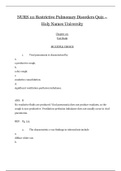
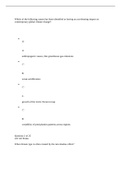
NURS 111 Restrictive Pulmonary Disorders Quiz – Holy Names University Chapter 23: Test Bank MULTIPLE CHOICE 1. Viral pneumonia is characterized by a. a productive cough. b. a dry cough. c. exudative consolidation. d. significant ventilation-perfusion imbalance. 2. The characteristic x-ray findings in tuberculosis include a. diffuse white-out. b. Ghon tubercles. c. bibasilar infiltrates. d. tracheal deviation. 3. Widespread atelectasis, non-cardiogenic pulmonary edema, and diffuse, fluffy alveolar infiltrates on chest radiograph are characteristic of a. acute respiratory distress syndrome. b. chronic obstructive pulmonary disease. c. asthma. d. cor pulmonale. 4. Which is indicative of a left tension pneumothorax? a. Course crackles throughout the left chest b. Tracheal deviation to the left c. Absent breath sounds on the left d. Respiratory acidosis 5. A patient exhibiting respiratory distress as well as a tracheal shift should be evaluated for a. pneumonia. b. pneumothorax. c. pulmonary edema. d. pulmonary embolus. 6. A patient with a productive cough and parenchymal infiltrates on x-ray is demonstrating symptomology of a. bacterial pneumonia. b. viral pneumonia. c. tuberculosis. d. acute respiratory distress syndrome. 7. The organism that causes pulmonary tuberculosis is a. Mycobacterium tuberculosis. b. Haemophilus tuberculosis. c. Tuberculosis tuberculoci. d. Mycococcidio tuberculosis. 8. Which clinical manifestation is not likely the result of a tuberculosis infection? a. Productive cough b. Low-grade fever c. Night sweats d. Cyanosis 9. Which disorder is caused by inhalation of organic substances? a. Diffuse interstitial lung disease b. Hypersensitivity pneumonitis c. Sarcoidosis d. Acute respiratory distress syndrome 10. The hallmark manifestation of acute respiratory distress syndrome is a. tachycardia. b. hypotension. c. frothy secretions. d. hypoxemia. 11. The primary cause of infant respiratory distress syndrome is a. prematurity. b. lack of surfactant. c. maternal illegal drug use during pregnancy. d. umbilical cord compression. 12. Empyema is defined as an a. exudative bronchitis. b. infection in the pleural space. c. infection localized in the lung. d. infection in the blood. 13. A patient with flail chest will demonstrate a. absence of chest movement with breaths. b. no inspiratory breath sounds. c. fluttering chest movements on expirations. d. outward chest movement on expiration. 14. Obstructive sleep apnea would most likely be found in a patient diagnosed with a. myasthenia gravis. b. poliomyelitis. c. Pickwickian syndrome. d. pneumonia. 15. Pneumocystitis is a term that refers to a a. fungal pneumonia secondary to HIV. b. viral pneumonia found in transplant recipients. c. non-infectious inflammation in the lung. d. pneumonia secondary to bladder infection. 16. The most definitive diagnostic method for active tuberculosis is acquired via a. sputum culture. b. Mantoux skin test. c. chest x-ray. d. blood culture. 17. A major cause of treatment failure in tuberculosis is a. resistant organism. b. allergy to drugs used. c. noncompliance. d. immunosuppression. 18. Neuromuscular disorders impair lung function primarily due to a. inflammatory events in the lung. b. secondary pneumonia. c. weak muscles of respiration. d. inactivity secondary to the disorder. 19. Legionnaires disease is characterized by a. presence of systemic illness. b. airborne mechanism of communicability. c. mild symptomatology. d. resolution with or without antimicrobial therapy. 20. Bacterial pneumonia leads to hypoxemia due to a. cardiogenic pulmonary edema. b. upper airway obstruction. c. accumulation of alveolar exudates. d. interstitial edema. 21. A common characteristic of viral pneumonia is a. high fever. b. alveolar infiltrates on a chest x-ray. c. increased white blood cell count. d. dry cough. 22. A major risk factor for the development of active pulmonary tuberculosis (TB) disease is a. contaminated water. b. immunosuppression. c. being a male. d. overuse of antibiotics. 23. Accumulation of fluid in the pleural space is called a. an abscess. b. pleurisy. c. flail chest. d. pleural effusion. 24. A restrictive respiratory disorder is characterized by a. increased total lung capacity. b. decreased residual volume. c. inspiratory wheezing. d. expiratory wheezing. 25. Air that enters the pleural space during inspiration but is unable to exit during expiration creates a condition called a. tension pneumothorax. b. open pneumothorax. c. pleural effusion. d. empyema. 26. When a parent of a toddler recently diagnosed with pneumococcal pneumonia asks why their child is so much sicker than a classmate was when they were diagnosed with pneumonia, the nurse replies a. “It sounds as if the classmate was just lucky and less exposed at daycare.” b. “It sounds like your child has a case of bacterial pneumonia, while the classmate had viral pneumonia.” c. “It sounds as if your child is having a severe reaction to bacterial pneumonia. It hits some children harder than others.” d. “It sounds as if your child has a case of viral pneumonia, while the classmate had bacterial pneumonia.” MULTIPLE RESPONSE 27. It is true that diffuse interstitial lung disease (Select all that apply.) a. leads to loss of alveolar walls. b. may be immunologic in nature. c. produces a productive cough. d. is always reversible. e. shows on x-ray as a “honeycomb lung.” 28. Common characteristics of sarcoidosis include (Select all that apply.) a. presence of CD4+ T cells. b. a non-productive cough. c. leukocytosis. d. granulomas in multiple body systems. e. fatigue, weight loss, and fever. 29. Clinical manifestations of pleural effusion include (Select all that apply.) a. dyspnea. b. sharp pain in expiration. c. productive cough. d. diminished breath sounds. e. a tracheal shift, if large. 30. Chronic occupational lung disease is characterized by (Select all that apply.) a. causation from long-term inhalation of inorganic material. b. a latent period before symptoms occur. c. hyperactive respiratory macrophages. d. a progressive cough and dyspnea with exercise. e. possible negative chest x-ray when symptom-free. 31. Restrictive respiratory disorders include (Select all that apply.) a. pneumothorax. b. emphysema. c. chronic asthma. d. type B COPD. e. ARDS.
Written for
Document information
- Uploaded on
- January 23, 2021
- Number of pages
- 20
- Written in
- 2020/2021
- Type
- Exam (elaborations)
- Contains
- Questions & answers
Subjects
- restrictive pulmonary d
-
nurs 111 restrictive pulmonary disorders quiz – holy names university
-
nurs 111 restrictive pulmonary disorders quiz
-
restrictive pulmonary disorders quiz – holy names university

Also available in package deal