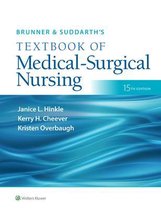
Brunner & Suddarth's Textbook of Medical-
Surgical Nursing
15th Edition
Author(s)Janice Hinkle, Kerry H. Cheever,
Kristen Overbaugh
TEST BANK
1️⃣ Question 1️
Reference: Ch. 1 — The Patient’s Basic Needs: Maslow
Hierarchy of Needs
Question Stem: A postoperative patient who is alert reports
mild shortness of breath, pain at the incision site rated 6/10,
and anxiety about returning home alone. Which need should
the nurse address first?
Options:
A. Assist the patient to arrange community resources for
,support at home.
B. Administer prescribed opioid analgesic for the incision pain.
C. Provide inhalation therapy and assess oxygen saturation.
D. Sit with the patient and use therapeutic communication to
reduce anxiety.
Correct Answer: C
Rationales:
• Correct (C): Physiologic needs (airway/respiration) are
highest priority in Maslow-based clinical triage; assessing
oxygenation and providing inhalation therapy addresses
immediate risk of hypoxemia and potential respiratory
compromise. This aligns with prioritizing basic physiologic
safety in Brunner & Suddarth.
• Incorrect (A): Arranging home resources is important but
addresses safety/psychosocial needs later in planning, not
immediate physiologic threat.
• Incorrect (B): Pain control is important, but untreated
respiratory compromise takes precedence over analgesia.
Opioids may worsen respiration.
• Incorrect (D): Anxiety reduction is useful, but does not
address potential life-threatening respiratory needs.
Teaching Point: Always treat airway/oxygenation before
comfort or psychosocial interventions.
,Citation: Hinkle, J., Cheever, K., & Overbaugh, K. (2022).
Brunner & Suddarth’s Textbook of Medical-Surgical Nursing
(15th Ed.). Ch. 1.
2️⃣ Question 2️
Reference: Ch. 1 — Health Promotion
Question Stem: A nurse designing a community teaching event
wants to reduce Type 2 diabetes risk in a population with rising
obesity rates. Which intervention aligns best with primary
prevention?
Options:
A. Teach foot-care and glucose monitoring to people with
diabetes.
B. Offer lifestyle counseling and free fitness classes to
community members.
C. Screen adults over 40 for fasting glucose and refer positives.
D. Organize a support group for patients recently diagnosed
with diabetes.
Correct Answer: B
Rationales:
• Correct (B): Primary prevention aims to prevent disease
onset; promoting healthy behaviors and access to fitness
reduces risk factors for Type 2 diabetes per health-
promotion strategies in Brunner & Suddarth.
, • Incorrect (A): Foot care and glucose monitoring are
secondary/tertiary strategies for those who already have
diabetes.
• Incorrect (C): Screening is a secondary prevention
activity—early detection—not primary prevention.
• Incorrect (D): Support groups are tertiary prevention
focusing on disease management and coping.
Teaching Point: Primary prevention reduces disease incidence
by changing risk behaviors and environments.
Citation: Hinkle, J., Cheever, K., & Overbaugh, K. (2022).
Brunner & Suddarth’s Textbook of Medical-Surgical Nursing
(15th Ed.). Ch. 1.
3️⃣ Question 3️
Reference: Ch. 1 — Quality, Safety, and Evidence-Based Practice
Question Stem: During shift report a nurse learns that a new
central-line dressing protocol reduced CRBSI rates in recent
trials. The nurse’s unit currently uses the old protocol. Which is
the best first action to move toward evidence-based change?
Options:
A. Immediately replace the unit’s protocol with the new
protocol.
B. Collect baseline CRBSI data for the unit and propose a plan to
test the new protocol.
Surgical Nursing
15th Edition
Author(s)Janice Hinkle, Kerry H. Cheever,
Kristen Overbaugh
TEST BANK
1️⃣ Question 1️
Reference: Ch. 1 — The Patient’s Basic Needs: Maslow
Hierarchy of Needs
Question Stem: A postoperative patient who is alert reports
mild shortness of breath, pain at the incision site rated 6/10,
and anxiety about returning home alone. Which need should
the nurse address first?
Options:
A. Assist the patient to arrange community resources for
,support at home.
B. Administer prescribed opioid analgesic for the incision pain.
C. Provide inhalation therapy and assess oxygen saturation.
D. Sit with the patient and use therapeutic communication to
reduce anxiety.
Correct Answer: C
Rationales:
• Correct (C): Physiologic needs (airway/respiration) are
highest priority in Maslow-based clinical triage; assessing
oxygenation and providing inhalation therapy addresses
immediate risk of hypoxemia and potential respiratory
compromise. This aligns with prioritizing basic physiologic
safety in Brunner & Suddarth.
• Incorrect (A): Arranging home resources is important but
addresses safety/psychosocial needs later in planning, not
immediate physiologic threat.
• Incorrect (B): Pain control is important, but untreated
respiratory compromise takes precedence over analgesia.
Opioids may worsen respiration.
• Incorrect (D): Anxiety reduction is useful, but does not
address potential life-threatening respiratory needs.
Teaching Point: Always treat airway/oxygenation before
comfort or psychosocial interventions.
,Citation: Hinkle, J., Cheever, K., & Overbaugh, K. (2022).
Brunner & Suddarth’s Textbook of Medical-Surgical Nursing
(15th Ed.). Ch. 1.
2️⃣ Question 2️
Reference: Ch. 1 — Health Promotion
Question Stem: A nurse designing a community teaching event
wants to reduce Type 2 diabetes risk in a population with rising
obesity rates. Which intervention aligns best with primary
prevention?
Options:
A. Teach foot-care and glucose monitoring to people with
diabetes.
B. Offer lifestyle counseling and free fitness classes to
community members.
C. Screen adults over 40 for fasting glucose and refer positives.
D. Organize a support group for patients recently diagnosed
with diabetes.
Correct Answer: B
Rationales:
• Correct (B): Primary prevention aims to prevent disease
onset; promoting healthy behaviors and access to fitness
reduces risk factors for Type 2 diabetes per health-
promotion strategies in Brunner & Suddarth.
, • Incorrect (A): Foot care and glucose monitoring are
secondary/tertiary strategies for those who already have
diabetes.
• Incorrect (C): Screening is a secondary prevention
activity—early detection—not primary prevention.
• Incorrect (D): Support groups are tertiary prevention
focusing on disease management and coping.
Teaching Point: Primary prevention reduces disease incidence
by changing risk behaviors and environments.
Citation: Hinkle, J., Cheever, K., & Overbaugh, K. (2022).
Brunner & Suddarth’s Textbook of Medical-Surgical Nursing
(15th Ed.). Ch. 1.
3️⃣ Question 3️
Reference: Ch. 1 — Quality, Safety, and Evidence-Based Practice
Question Stem: During shift report a nurse learns that a new
central-line dressing protocol reduced CRBSI rates in recent
trials. The nurse’s unit currently uses the old protocol. Which is
the best first action to move toward evidence-based change?
Options:
A. Immediately replace the unit’s protocol with the new
protocol.
B. Collect baseline CRBSI data for the unit and propose a plan to
test the new protocol.