
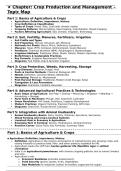
★ Chapter: Crop Production and Management –
Topic Map
Part 1: Basics of Agriculture & Crops
Agriculture: Definition, Importance, History
Crop Definition & Classification
Types of Crops: Kharif, Rabi, Zaid (with climatic needs)
Cropping Patterns: Monocropping, Intercropping, Crop Rotation, Mixed Cropping
Factors Affecting Agriculture: Soil, Climate, Irrigation, Technology
Part 2: Soil, Fertility, Manures, Fertilizers, Irrigation
Soil Profile and Types
Soil Properties: Texture, Structure, pH, Moisture
Nutrients for Plants: Macro, Micro, Deficiency Symptoms
Manures: Types (FYM, Compost, Vermicompost, Green Manure)
Fertilizers: Chemical Nutrients (NPK), Advantages & Disadvantages
Irrigation Methods: Traditional (Moat, Dhekli, Rahat), Modern (Sprinkler, Drip)
Biofertilizers & Sustainable Practices
Key Formula: Irrigation Requirement Formula
Diagrams: Soil Profile, Drip & Sprinkler Irrigation
Part 3: Crop Protection, Weeds, Harvesting, Storage
Crop Diseases: Bacterial, Fungal, Viral
Pests & Control Methods: Chemical, Biological, IPM
Weeds: Definition, Common Weeds, Weedicides
Harvesting: Manual vs. Mechanized
Post-Harvest Storage: Traditional, Modern (Cold Storage, Silos)
Fumigation & Loss Prevention
Diagrams: Granaries, Combine Harvester
Part 4: Advanced Agricultural Practices & Technologies
Basic Steps of Agriculture: Soil Prep → Sowing → Manuring → Irrigation → Weeding →
Harvesting → Storage
Farm Tools & Machinery: Plough, Hoe, Seed Drill, Cultivator
Green Revolution: HYV seeds, Fertilizers, Irrigation Development
Modern Practices: Organic Farming, Precision Farming, GM Crops
Diagrams: Seed Drill, Tractor-Driven Cultivator
Part 5: Integration with Animal Husbandry
Animal Husbandry Basics: Dairy, Poultry, Fisheries, Apiculture, Sericulture
Mixed Farming and Crop-Livestock Systems
Livestock Role in Economy & Agriculture
Emerging Tech in Farming: Drones, Hydroponics, Vertical Farming
Revision Corner: Quick Facts, Key Formulas, Summary Table
Part 1: Basics of Agriculture & Crops
▪ Agriculture: Definition, Importance, History
Definition: Agriculture is the science and practice of cultivating the soil, growing crops, and
raising livestock to produce food, fiber, and other products essential for life.
Agriculture marks the shift from hunter-gatherer life (Neolithic Age) to settled
civilization.
India is an agricultural powerhouse, with diverse cropping patterns due to varied climates
and soils.
Agriculture’s role:
o Economic Backbone (provides employment).
o Food Security (grains, pulses, fruits, vegetables).
o Raw Materials for industries (cotton for textiles, sugarcane for sugar).
, ▲ What is a Crop?
A crop is a group of plants of the same species cultivated in a field at a large scale for
commercial purposes.
Examples:
o Food crops: Wheat, Rice.
o Fiber crops: Cotton, Jute.
o Oilseeds: Mustard, Groundnut.
o Fodder crops: Sorghum, Berseem.
Crops are classified based on use, growing season, water requirement, and climate
adaptability.
● Types of Crops (Seasonal Classification)
1. Kharif Crops:
o Sown: June–July (start of monsoon).
o Harvested: September–October.
o Climate: Warm and wet.
o Examples: Paddy, Maize, Cotton, Soybean.
2. Rabi Crops:
o Sown: October–November.
o Harvested: March–April.
o Climate: Cool, dry growth period; mild summer at harvest.
o Examples: Wheat, Barley, Mustard, Pea.
3. Zaid Crops:
o Sown: Between Rabi and Kharif (March–June).
o Examples: Watermelon, Cucumber, Muskmelon.
📌 Olympiad Tip: Match crop name with season + climate; this is a common question format.
★ Cropping Patterns
1. Monocropping:
o Growing a single crop repeatedly in the same field.
o Risk: Soil nutrient depletion, pest attack vulnerability.
2. Mixed Cropping:
o Growing two or more crops together without a fixed row pattern.
o Advantage: Minimizes total crop failure risk.
3. Intercropping:
o Crops grown in a specific row arrangement to maximize space & nutrients.
o Example: Maize + Soybean.
4. Crop Rotation:
o Growing crops in planned succession to restore soil nutrients.
o Example: Cereals → Legumes (adds nitrogen).
💡 Hinglish Deep Insight:
“Socho agar hum bar-bar ek hi crop lagayenge (monocropping), toh soil ke nutrients khatam ho
jayenge. Crop rotation ek natural fertilizer ka kaam karta hai kyunki legumes nitrogen fix karte hain.
Ye Olympiad ke liye bahut hi common tricky question hai.”
■ Factors Affecting Agriculture
Soil Type: Determines crops (Black soil → Cotton; Alluvial → Rice, Wheat).
Climate: Temperature, rainfall decide crop choice.
Irrigation: Water availability is crucial in arid zones.
Technology: Use of machinery, HYV seeds, fertilizers boosts production.
Topic Map
Part 1: Basics of Agriculture & Crops
Agriculture: Definition, Importance, History
Crop Definition & Classification
Types of Crops: Kharif, Rabi, Zaid (with climatic needs)
Cropping Patterns: Monocropping, Intercropping, Crop Rotation, Mixed Cropping
Factors Affecting Agriculture: Soil, Climate, Irrigation, Technology
Part 2: Soil, Fertility, Manures, Fertilizers, Irrigation
Soil Profile and Types
Soil Properties: Texture, Structure, pH, Moisture
Nutrients for Plants: Macro, Micro, Deficiency Symptoms
Manures: Types (FYM, Compost, Vermicompost, Green Manure)
Fertilizers: Chemical Nutrients (NPK), Advantages & Disadvantages
Irrigation Methods: Traditional (Moat, Dhekli, Rahat), Modern (Sprinkler, Drip)
Biofertilizers & Sustainable Practices
Key Formula: Irrigation Requirement Formula
Diagrams: Soil Profile, Drip & Sprinkler Irrigation
Part 3: Crop Protection, Weeds, Harvesting, Storage
Crop Diseases: Bacterial, Fungal, Viral
Pests & Control Methods: Chemical, Biological, IPM
Weeds: Definition, Common Weeds, Weedicides
Harvesting: Manual vs. Mechanized
Post-Harvest Storage: Traditional, Modern (Cold Storage, Silos)
Fumigation & Loss Prevention
Diagrams: Granaries, Combine Harvester
Part 4: Advanced Agricultural Practices & Technologies
Basic Steps of Agriculture: Soil Prep → Sowing → Manuring → Irrigation → Weeding →
Harvesting → Storage
Farm Tools & Machinery: Plough, Hoe, Seed Drill, Cultivator
Green Revolution: HYV seeds, Fertilizers, Irrigation Development
Modern Practices: Organic Farming, Precision Farming, GM Crops
Diagrams: Seed Drill, Tractor-Driven Cultivator
Part 5: Integration with Animal Husbandry
Animal Husbandry Basics: Dairy, Poultry, Fisheries, Apiculture, Sericulture
Mixed Farming and Crop-Livestock Systems
Livestock Role in Economy & Agriculture
Emerging Tech in Farming: Drones, Hydroponics, Vertical Farming
Revision Corner: Quick Facts, Key Formulas, Summary Table
Part 1: Basics of Agriculture & Crops
▪ Agriculture: Definition, Importance, History
Definition: Agriculture is the science and practice of cultivating the soil, growing crops, and
raising livestock to produce food, fiber, and other products essential for life.
Agriculture marks the shift from hunter-gatherer life (Neolithic Age) to settled
civilization.
India is an agricultural powerhouse, with diverse cropping patterns due to varied climates
and soils.
Agriculture’s role:
o Economic Backbone (provides employment).
o Food Security (grains, pulses, fruits, vegetables).
o Raw Materials for industries (cotton for textiles, sugarcane for sugar).
, ▲ What is a Crop?
A crop is a group of plants of the same species cultivated in a field at a large scale for
commercial purposes.
Examples:
o Food crops: Wheat, Rice.
o Fiber crops: Cotton, Jute.
o Oilseeds: Mustard, Groundnut.
o Fodder crops: Sorghum, Berseem.
Crops are classified based on use, growing season, water requirement, and climate
adaptability.
● Types of Crops (Seasonal Classification)
1. Kharif Crops:
o Sown: June–July (start of monsoon).
o Harvested: September–October.
o Climate: Warm and wet.
o Examples: Paddy, Maize, Cotton, Soybean.
2. Rabi Crops:
o Sown: October–November.
o Harvested: March–April.
o Climate: Cool, dry growth period; mild summer at harvest.
o Examples: Wheat, Barley, Mustard, Pea.
3. Zaid Crops:
o Sown: Between Rabi and Kharif (March–June).
o Examples: Watermelon, Cucumber, Muskmelon.
📌 Olympiad Tip: Match crop name with season + climate; this is a common question format.
★ Cropping Patterns
1. Monocropping:
o Growing a single crop repeatedly in the same field.
o Risk: Soil nutrient depletion, pest attack vulnerability.
2. Mixed Cropping:
o Growing two or more crops together without a fixed row pattern.
o Advantage: Minimizes total crop failure risk.
3. Intercropping:
o Crops grown in a specific row arrangement to maximize space & nutrients.
o Example: Maize + Soybean.
4. Crop Rotation:
o Growing crops in planned succession to restore soil nutrients.
o Example: Cereals → Legumes (adds nitrogen).
💡 Hinglish Deep Insight:
“Socho agar hum bar-bar ek hi crop lagayenge (monocropping), toh soil ke nutrients khatam ho
jayenge. Crop rotation ek natural fertilizer ka kaam karta hai kyunki legumes nitrogen fix karte hain.
Ye Olympiad ke liye bahut hi common tricky question hai.”
■ Factors Affecting Agriculture
Soil Type: Determines crops (Black soil → Cotton; Alluvial → Rice, Wheat).
Climate: Temperature, rainfall decide crop choice.
Irrigation: Water availability is crucial in arid zones.
Technology: Use of machinery, HYV seeds, fertilizers boosts production.



