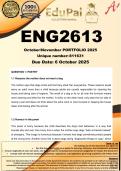
ENG2613
October November PORTFOLIO 2025
2 2025
Unique Number:
Due date: 6 October 2025
QUESTION 1: POETRY
1.1 Reasons the mother does not want a dog
The mother says that dogs smell and that they shed hair everywhere. These reasons would
worry an adult more than a child because adults are usually responsible for cleaning the
house and taking care of hygiene. The smell of a dog or its fur all over the furniture means
more cleaning and effort for the mother. A child, on the other hand, only sees the fun side of
having a pet and does not think about the extra work or cost involved in keeping the house
clean and looking after the animal.
1.2 Humour in the poem
This poem is funny because the child describes the dog’s bad behaviour in a way that
sounds silly and real. One funny line is when the mother says dogs “bark at friends instead”
of strangers. This image is humorous because it shows how dogs sometimes protect people
at the wrong time. Another funny line is about dogs doing “disgraceful things on rugs”, which
DISCLAIMER & TERMS OF USE
Educational Aid: These study notes are intended to be used as educational resources and should not be seen as a
replacement for individual research, critical analysis, or professional consultation. Students are encouraged to perform
their own research and seek advice from their instructors or academic advisors for specific assignment guidelines.
Personal Responsibility: While every effort has been made to ensure the accuracy and reliability of the information in
these study notes, the seller does not guarantee the completeness or correctness of all content. The buyer is
responsible for verifying the accuracy of the information and exercising their own judgment when applying it to their
assignments.
Academic Integrity: It is essential for students to maintain academic integrity and follow their institution's policies
regarding plagiarism, citation, and referencing. These study notes should be used as learning tools and sources of
inspiration. Any direct reproduction of the content without proper citation and acknowledgment may be considered
academic misconduct.
Limited Liability: The seller shall not be liable for any direct or indirect damages, losses, or consequences arising from
the use of these notes. This includes, but is not limited to, poor academic performance, penalties, or any other negative
consequences resulting from the application or misuse of the information provided.
, For additional support +27 81 278 3372
QUESTION 1: POETRY
1.1 Reasons the mother does not want a dog
The mother says that dogs smell and that they shed hair everywhere. These reasons
would worry an adult more than a child because adults are usually responsible for
cleaning the house and taking care of hygiene. The smell of a dog or its fur all over
the furniture means more cleaning and effort for the mother. A child, on the other
hand, only sees the fun side of having a pet and does not think about the extra work
or cost involved in keeping the house clean and looking after the animal.
1.2 Humour in the poem
This poem is funny because the child describes the dog’s bad behaviour in a way
that sounds silly and real. One funny line is when the mother says dogs “bark at
friends instead” of strangers. This image is humorous because it shows how dogs
sometimes protect people at the wrong time. Another funny line is about dogs doing
“disgraceful things on rugs”, which makes readers laugh because children often find
such behaviour embarrassing yet amusing. The last funny image is of a dog that
“flops upon your bed at night and snores their doggy snore”, which paints a picture of
a noisy, lazy pet. These examples create humour because they exaggerate the
naughty habits of dogs that many people can relate to.
1.3 Teaching the poem “off the page”
To take this poem “off the page,” I would use creative and active teaching methods.
First, I would ask learners to act out the poem in small groups. One learner could
play the mother, another the child, and others could pretend to be the dog. This
helps them understand the tone and emotions in the poem. Second, I would let
learners draw pictures of the messy or funny moments described, such as the dog
tracking mud on the floor or snoring on the bed. This builds imagination and
connection with the text. Third, I would encourage learners to write their own short
poems about pets they would like to have, using simple rhymes and humour like
October November PORTFOLIO 2025
2 2025
Unique Number:
Due date: 6 October 2025
QUESTION 1: POETRY
1.1 Reasons the mother does not want a dog
The mother says that dogs smell and that they shed hair everywhere. These reasons would
worry an adult more than a child because adults are usually responsible for cleaning the
house and taking care of hygiene. The smell of a dog or its fur all over the furniture means
more cleaning and effort for the mother. A child, on the other hand, only sees the fun side of
having a pet and does not think about the extra work or cost involved in keeping the house
clean and looking after the animal.
1.2 Humour in the poem
This poem is funny because the child describes the dog’s bad behaviour in a way that
sounds silly and real. One funny line is when the mother says dogs “bark at friends instead”
of strangers. This image is humorous because it shows how dogs sometimes protect people
at the wrong time. Another funny line is about dogs doing “disgraceful things on rugs”, which
DISCLAIMER & TERMS OF USE
Educational Aid: These study notes are intended to be used as educational resources and should not be seen as a
replacement for individual research, critical analysis, or professional consultation. Students are encouraged to perform
their own research and seek advice from their instructors or academic advisors for specific assignment guidelines.
Personal Responsibility: While every effort has been made to ensure the accuracy and reliability of the information in
these study notes, the seller does not guarantee the completeness or correctness of all content. The buyer is
responsible for verifying the accuracy of the information and exercising their own judgment when applying it to their
assignments.
Academic Integrity: It is essential for students to maintain academic integrity and follow their institution's policies
regarding plagiarism, citation, and referencing. These study notes should be used as learning tools and sources of
inspiration. Any direct reproduction of the content without proper citation and acknowledgment may be considered
academic misconduct.
Limited Liability: The seller shall not be liable for any direct or indirect damages, losses, or consequences arising from
the use of these notes. This includes, but is not limited to, poor academic performance, penalties, or any other negative
consequences resulting from the application or misuse of the information provided.
, For additional support +27 81 278 3372
QUESTION 1: POETRY
1.1 Reasons the mother does not want a dog
The mother says that dogs smell and that they shed hair everywhere. These reasons
would worry an adult more than a child because adults are usually responsible for
cleaning the house and taking care of hygiene. The smell of a dog or its fur all over
the furniture means more cleaning and effort for the mother. A child, on the other
hand, only sees the fun side of having a pet and does not think about the extra work
or cost involved in keeping the house clean and looking after the animal.
1.2 Humour in the poem
This poem is funny because the child describes the dog’s bad behaviour in a way
that sounds silly and real. One funny line is when the mother says dogs “bark at
friends instead” of strangers. This image is humorous because it shows how dogs
sometimes protect people at the wrong time. Another funny line is about dogs doing
“disgraceful things on rugs”, which makes readers laugh because children often find
such behaviour embarrassing yet amusing. The last funny image is of a dog that
“flops upon your bed at night and snores their doggy snore”, which paints a picture of
a noisy, lazy pet. These examples create humour because they exaggerate the
naughty habits of dogs that many people can relate to.
1.3 Teaching the poem “off the page”
To take this poem “off the page,” I would use creative and active teaching methods.
First, I would ask learners to act out the poem in small groups. One learner could
play the mother, another the child, and others could pretend to be the dog. This
helps them understand the tone and emotions in the poem. Second, I would let
learners draw pictures of the messy or funny moments described, such as the dog
tracking mud on the floor or snoring on the bed. This builds imagination and
connection with the text. Third, I would encourage learners to write their own short
poems about pets they would like to have, using simple rhymes and humour like