

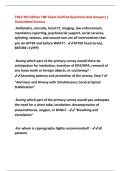
TNCC 9th Edition TNP Exam Verified Questions And Answers |
Guaranteed Success
-Antibiotics, consults, head CT, imaging, law enforcement,
mandatory reporting, psychosocial support, social services,
splinting, tetanus, and wound care are all interventions that
you do AFTER and before WHAT? - ✔✔AFTER head-to-toe,
BEFORE J (VIPP)
-During which part of the primary survey would there be
anticipation for intubation, insertion of OPA/NPA, removal of
any loose teeth or foreign objects, or suctioning? -
✔✔Assessing patency and protection of the airway, Step 7 of
"Alertness and Airway with Simultaneous Cervical Spinal
Stabilization"
-During which part of the primary survey would you anticipate
the need for a chest tube, intubation, decompression of
pneumothorax, oxygen, or BVMs? - ✔✔"Breathing and
Ventilation"
-For whom is capnography highly recommended? - ✔✔all
patients
,-Four of these must be identified to assess breathing
effectiveness: - ✔✔Breath sounds, depth/pattern/rate,
spontaneous breathing, subcutaneous emphysema, increased
work of breathing, symmetrical chest rise and fall, tracheal
deviation/JVD, open wounds/deformities, skin color
-Four of these must be identified to assess patency and
protection of the airway: - ✔✔bony deformity, loose teeth,
edema, inhalation injury, sounds, tongue obstruction, burns,
fluids, foreign objects, vocalization
-If the patient is intubated and you've already assessed ETT
placement, what else needs to be done with the ETT? (step
10) - ✔✔assess ETT position by noting the number at
teeth/gums AND secure ETT
-In Step 16 of "Exposure and Environment", you must name at
least one of these interventions: - ✔✔blankets, room temp
increase, warmed fluids, warming lights
-In step M of "Get Adjuncts", what else might be indicated
besides cardiac monitor? - ✔✔EKG
,-To assess circulation, you must do these two main tasks: -
✔✔1. inspect AND palpate skin color, temp, moisture and 2.
palpate a pulse
-What are examples of nonpharmacologic measures? (must
identify at least one during testing) - ✔✔Distraction, family
presence, padding bony prominences, repositioning, splinting,
verbal reassurance
-What can be applied in step 12 of "Circulation and Control of
Hemorrhage" for which credit is given in the LMNOP section? -
✔✔cardiac monitor
-What do you do when alterations are identified in any of the
steps in the primary survery? - ✔✔intervene as appropriate
and reassess
-What is sometimes deferred at the end of the head-to-toe? -
✔✔inspecting posterior
-What should you verbalize after completing all ETT
assessments? - ✔✔moving patient from assisted ventilation to
mechanical
, -What three assessments must be done if the patient is
intubated? - ✔✔1. attach CO2 detector and assess for
evidence of exhaled CO2; 2. observe for rise and fall of the
chest w/ assisted ventilations; 3. auscultate over epigastrium
for gurgling AND lungs for bilateral breath sounds
-What three items are obtained during the pertinent history
assessment? - ✔✔Medical records, prehospital report,
SAMPLE
-When should 2 IV sites be established? - ✔✔During
"Circulation" assessment
—During the head-to-toe, where would you find Cullen's sign?
- ✔✔umbilicus
—During the head-to-toe, where would you find Grey-Turner's
sign? - ✔✔flank
—What does the J stand for at the end of the secondary
survery? - ✔✔just keep evaluating - vipp
Guaranteed Success
-Antibiotics, consults, head CT, imaging, law enforcement,
mandatory reporting, psychosocial support, social services,
splinting, tetanus, and wound care are all interventions that
you do AFTER and before WHAT? - ✔✔AFTER head-to-toe,
BEFORE J (VIPP)
-During which part of the primary survey would there be
anticipation for intubation, insertion of OPA/NPA, removal of
any loose teeth or foreign objects, or suctioning? -
✔✔Assessing patency and protection of the airway, Step 7 of
"Alertness and Airway with Simultaneous Cervical Spinal
Stabilization"
-During which part of the primary survey would you anticipate
the need for a chest tube, intubation, decompression of
pneumothorax, oxygen, or BVMs? - ✔✔"Breathing and
Ventilation"
-For whom is capnography highly recommended? - ✔✔all
patients
,-Four of these must be identified to assess breathing
effectiveness: - ✔✔Breath sounds, depth/pattern/rate,
spontaneous breathing, subcutaneous emphysema, increased
work of breathing, symmetrical chest rise and fall, tracheal
deviation/JVD, open wounds/deformities, skin color
-Four of these must be identified to assess patency and
protection of the airway: - ✔✔bony deformity, loose teeth,
edema, inhalation injury, sounds, tongue obstruction, burns,
fluids, foreign objects, vocalization
-If the patient is intubated and you've already assessed ETT
placement, what else needs to be done with the ETT? (step
10) - ✔✔assess ETT position by noting the number at
teeth/gums AND secure ETT
-In Step 16 of "Exposure and Environment", you must name at
least one of these interventions: - ✔✔blankets, room temp
increase, warmed fluids, warming lights
-In step M of "Get Adjuncts", what else might be indicated
besides cardiac monitor? - ✔✔EKG
,-To assess circulation, you must do these two main tasks: -
✔✔1. inspect AND palpate skin color, temp, moisture and 2.
palpate a pulse
-What are examples of nonpharmacologic measures? (must
identify at least one during testing) - ✔✔Distraction, family
presence, padding bony prominences, repositioning, splinting,
verbal reassurance
-What can be applied in step 12 of "Circulation and Control of
Hemorrhage" for which credit is given in the LMNOP section? -
✔✔cardiac monitor
-What do you do when alterations are identified in any of the
steps in the primary survery? - ✔✔intervene as appropriate
and reassess
-What is sometimes deferred at the end of the head-to-toe? -
✔✔inspecting posterior
-What should you verbalize after completing all ETT
assessments? - ✔✔moving patient from assisted ventilation to
mechanical
, -What three assessments must be done if the patient is
intubated? - ✔✔1. attach CO2 detector and assess for
evidence of exhaled CO2; 2. observe for rise and fall of the
chest w/ assisted ventilations; 3. auscultate over epigastrium
for gurgling AND lungs for bilateral breath sounds
-What three items are obtained during the pertinent history
assessment? - ✔✔Medical records, prehospital report,
SAMPLE
-When should 2 IV sites be established? - ✔✔During
"Circulation" assessment
—During the head-to-toe, where would you find Cullen's sign?
- ✔✔umbilicus
—During the head-to-toe, where would you find Grey-Turner's
sign? - ✔✔flank
—What does the J stand for at the end of the secondary
survery? - ✔✔just keep evaluating - vipp


