

RUSSIAN
REVOLUTION
Context: Russia was facing significant economic, social, and political challenges, including widespread
poverty, inequality, and food shortages. The country's involvement in World War I also strained resources
and led to military failures. Strikes and protests erupted and the Russian Revolution began.
Russia before the Revolution
19- Russia was an autocratic country led by a
‘Tsarist’ system.
19- The Tsar ruled Russia as a dictatorship.
19- The Tsar was the sole source of law, taxation
19 and justice.
The Tsar was supported by the privileged nobles,
Chiefs and Land Owners. Those powerful enough
possessed Serfs, the slaves of Russia.
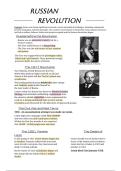
Tsar Nicholas II of Russia
The 1917 Revolution
Tsar Nicholas II lead Russia into the First
World War, political rights reached an all time
climax at this point and the ‘Tsarist’ system was
overthrown.
The leading political party, Bolsheviks takes charge
and Vladimir Lenin instils himself as
the new leader of Russia.
Lenin's vision for Russia was based on Marxist-Leninist
ideology and included establishing a communist state.
He aimed to abolish capitalism, Lenin emphasised the Vladimir Lenin
need for a strong centralised state to carry out the
revolution and advocated for the liberation of oppressed groups.
The Civil War and Red Terror
1918 - An assassination attempt was made on Lenin.
Lenin began his campaign called ‘RED TERROR’
and went after any anti-communist civilians.
Within the first few months it was reported
that 10 000 - 15 000 people were executed.
The 1921 Famine The Death of
Lenin
In the spring of 1921 severe famine began due - Lenin’s health was in decline due to
to weather. Peasants suffered the most and - stress of the famine and revolution.
were forced to eat grass, clay, harnesses and Lenin had two strokes in 1922 and
dead or rotting animals. - another in 1923.
By the winter of 1921 cannibalism began and - Lenin died 21st January 1924.
this along with the famine led to 5 million
deaths.
REVOLUTION
Context: Russia was facing significant economic, social, and political challenges, including widespread
poverty, inequality, and food shortages. The country's involvement in World War I also strained resources
and led to military failures. Strikes and protests erupted and the Russian Revolution began.
Russia before the Revolution
19- Russia was an autocratic country led by a
‘Tsarist’ system.
19- The Tsar ruled Russia as a dictatorship.
19- The Tsar was the sole source of law, taxation
19 and justice.
The Tsar was supported by the privileged nobles,
Chiefs and Land Owners. Those powerful enough
possessed Serfs, the slaves of Russia.
Tsar Nicholas II of Russia
The 1917 Revolution
Tsar Nicholas II lead Russia into the First
World War, political rights reached an all time
climax at this point and the ‘Tsarist’ system was
overthrown.
The leading political party, Bolsheviks takes charge
and Vladimir Lenin instils himself as
the new leader of Russia.
Lenin's vision for Russia was based on Marxist-Leninist
ideology and included establishing a communist state.
He aimed to abolish capitalism, Lenin emphasised the Vladimir Lenin
need for a strong centralised state to carry out the
revolution and advocated for the liberation of oppressed groups.
The Civil War and Red Terror
1918 - An assassination attempt was made on Lenin.
Lenin began his campaign called ‘RED TERROR’
and went after any anti-communist civilians.
Within the first few months it was reported
that 10 000 - 15 000 people were executed.
The 1921 Famine The Death of
Lenin
In the spring of 1921 severe famine began due - Lenin’s health was in decline due to
to weather. Peasants suffered the most and - stress of the famine and revolution.
were forced to eat grass, clay, harnesses and Lenin had two strokes in 1922 and
dead or rotting animals. - another in 1923.
By the winter of 1921 cannibalism began and - Lenin died 21st January 1924.
this along with the famine led to 5 million
deaths.


