LRA 211 Final Review Questions With 100% Solved Answers!!
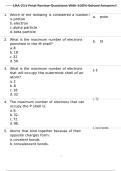
1. Which of the following is considered a nucleon?
a. proton
a. proton
b. electron
c. alpha particle
d. beta particle
2. What is the maximum number of electrons
b. 18
permitted in the M shell?
a. 8
b. 18
c. 32
d. 50
3. What is the maximum number of electrons b. 8
that will occupy the outermost shell of an
atom?
a. 2
b. 8
c. 18
d. 32
c. 72
4. The maximum number of electrons that can
occupy the P shell is:
a. 8.
b. 32.
c. 72.
d. 98.
c. ionic bonds
5. Atoms that bind together because of their
opposite charges form:
a. covalent bonds.
b. convalescent bonds.
1/
15
, LRA 211 Final Review Questions With 100% Solved Answers!!
c. ionic bonds.
d. nonionic bonds
6. The horizontal periods of the periodic table b. the same
contain elements with: number of
a. the same number of electron shells. electrons
b. the same number of electrons.
c. the same chemical properties.
d. the same number of protons.
7. As the frequency of electromagnetic radiation decreas- a. increase
es, wavelength will:
a. increase.
b. decrease.
c. remain the same.
d. frequency and wavelength are unrelated.
8. Which of the following members of the electromagnet- b. x-rays
ic spectrum has the ability to ionize matter?
a. Radiowaves
b. X-rays
c. Microwaves
d. Ultraviolet light
9. Which of the following is not within the a. 10-24
wavelength range of electromagnetic
radiation?
a. 10−24
b. 10−12
c. 107
d. 10−16
c. radiowaves
10. Which member of the electromagnetic
spectrum has the longest wavelength?
2/
15
1. Which of the following is considered a nucleon?
a. proton
a. proton
b. electron
c. alpha particle
d. beta particle
2. What is the maximum number of electrons
b. 18
permitted in the M shell?
a. 8
b. 18
c. 32
d. 50
3. What is the maximum number of electrons b. 8
that will occupy the outermost shell of an
atom?
a. 2
b. 8
c. 18
d. 32
c. 72
4. The maximum number of electrons that can
occupy the P shell is:
a. 8.
b. 32.
c. 72.
d. 98.
c. ionic bonds
5. Atoms that bind together because of their
opposite charges form:
a. covalent bonds.
b. convalescent bonds.
1/
15
, LRA 211 Final Review Questions With 100% Solved Answers!!
c. ionic bonds.
d. nonionic bonds
6. The horizontal periods of the periodic table b. the same
contain elements with: number of
a. the same number of electron shells. electrons
b. the same number of electrons.
c. the same chemical properties.
d. the same number of protons.
7. As the frequency of electromagnetic radiation decreas- a. increase
es, wavelength will:
a. increase.
b. decrease.
c. remain the same.
d. frequency and wavelength are unrelated.
8. Which of the following members of the electromagnet- b. x-rays
ic spectrum has the ability to ionize matter?
a. Radiowaves
b. X-rays
c. Microwaves
d. Ultraviolet light
9. Which of the following is not within the a. 10-24
wavelength range of electromagnetic
radiation?
a. 10−24
b. 10−12
c. 107
d. 10−16
c. radiowaves
10. Which member of the electromagnetic
spectrum has the longest wavelength?
2/
15